


Healthcare Interoperability Solutions
Get Started with a Free Demo
New Keyword Page
New Keyword Page
"*" indicates required fields
Today, healthcare interoperability solutions are driving the change in how doctors and hospitals share patient records across different networks. These solutions facilitate providers, payers, and patients in accessing critical data without barriers. As healthcare organizations grapple with fragmented records, adopting robust interoperability frameworks becomes important for improving care coordination and operational efficiency.
Here, we dive into the core aspects of healthcare interoperability solutions, exploring their definitions, standards, benefits, and future directions.
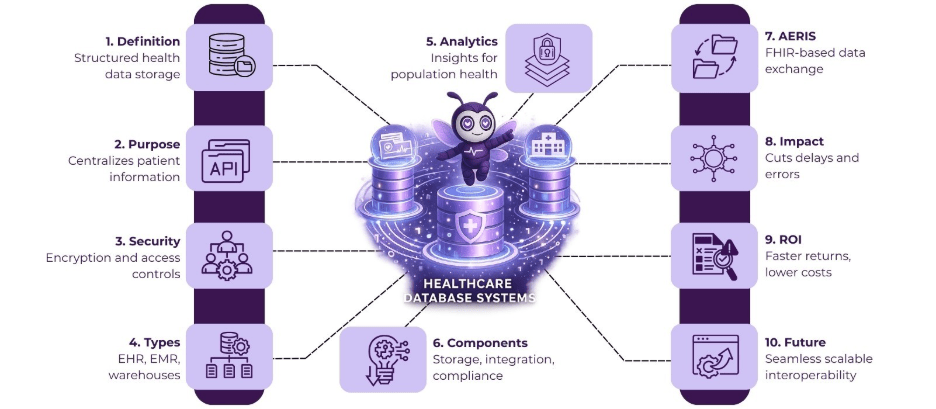
Understanding Healthcare Interoperability
Simply put, healthcare interoperability involves the integration of electronic health records (EHRs), medical devices, and other IT systems to enable seamless data flow. The Institute of Electrical and Electronics Engineers defines interoperability as the ability of systems to work together without special effort from users. In healthcare, this translates to providers accessing lab results, imaging reports, and medication histories from various sources effortlessly.
Levels of interoperability include foundational (basic data exchange), structural (standardized formats), semantic (shared meaning of data), and organizational (policy-aligned sharing). Achieving higher levels requires adherence to common protocols, which healthcare interoperability solutions provide through tools like health information exchanges (HIEs) and vendor-specific networks.
For example, HIEs operate at local, state, and regional levels to share patient information among providers, hospitals, and public health agencies. These exchanges support continuity of care by aggregating data from multiple points, such as EHRs and diagnostic labs. Vendor-driven solutions offer ecosystem-specific integration but may limit broader connectivity unless combined with national frameworks.
Key Standards in Healthcare Interoperability Solutions
Effective healthcare interoperability solutions rely on standardized protocols to facilitate data exchange. Prominent among these is HL7 (Health Level Seven), a set of international standards for transferring clinical and administrative data between software applications. FHIR (Fast Healthcare Interoperability Resources), an evolution of HL7, organizes data into resources like patients, conditions, and medications, making it easier for systems to interpret and share information.
FHIR has gained traction due to its API-based approach, which supports real-time data access. Other standards include DICOM for medical imaging, X12 for administrative transactions, and USCDI (United States Core Data for Interoperability) for essential data elements.
The Trusted Exchange Framework and Common Agreement (TEFCA) establishes a national structure for data sharing through Qualified Health Information Networks (QHINs). This framework reduces complexity by providing common technical and governance standards.
Benefits of Implementing Healthcare Interoperability Solutions
Adopting healthcare interoperability solutions has numerous advantages. They enhance patient outcomes by providing clinicians with complete, real-time data, which leads to better-informed treatments and reduced medical errors. Operational efficiency improves as workflows streamline, with automated data sharing reducing administrative burdens.
Additionally, cost savings arise from minimized duplicative tests and improved resource allocation. For payers, seamless information exchange supports better care coordination and compliance with regulations like the 21st Century Cures Act. As a result, patients benefit from empowered access to their records.
How AERIS Makes FHIR Interoperability Possible in 2026
Imagine a world where your healthcare organization thrives with seamless, secure, and real-time data exchange. That’s the power of AERIS by Helixbeat, a game-changing platform designed to transform how you connect, collaborate, and care. Built for healthcare providers, clinics, hospitals, and cross-industry partners like pharmacies and insurers, AERIS harnesses FHIR standards to break down data silos, streamline operations, and put patient care first.
Ready to cut delays by 50%, double your ROI, and empower your team with instant access to critical data? Let’s dive into why AERIS is the solution you’ve been waiting for.
Why AERIS is Your Key to Healthcare Innovation
At Helixbeat, we know your challenges: fragmented systems, delayed data, and rising costs. AERIS is here to change that, offering a personalized, scalable, and secure platform that fits your unique needs. Whether you’re a small clinic or a sprawling hospital network, AERIS delivers measurable results that elevate patient outcomes and boost your bottom line.
- 20+ Years of Expertise: Our team brings decades of healthcare IT experience to ensure AERIS works for you.
- 50+ IT Professionals: A dedicated crew powers AERIS, delivering unmatched support and innovation.
- 1,000+ Customers: Join a thriving community of healthcare leaders already transforming with AERIS.
- 10,000+ Projects Completed: Proven success across countless integrations and workflows.
- 95% Returning Customers: Our clients trust AERIS to deliver, time and time again.
Providers adopting AERIS report faster diagnoses, lower costs, and improved outcomes, positioning it as the go-to tool for future-proof HIE.
Your Benefits, Amplified
- 50% Fewer Delays: Real-time data means critical information is always at your fingertips, turning hours into seconds.
- 100% Faster ROI: Plug-and-play integration maximizes your investment without expensive system replacements.
- 30% Cost Savings, 90% Fewer Errors: Automation eliminates waste, saving resources and ensuring accuracy.
Future Trends in Healthcare Interoperability Solutions
Looking ahead, healthcare interoperability solutions will evolve with advancements in AI for enhanced data security and analytics. Wider FHIR adoption, mandated by regulations, will standardize exchanges globally. Cloud platforms will dominate, offering scalable, HIPAA-compliant storage and access. Patient-centric models, with apps integrating wearables and EHRs, will further personalize care.
Final Thoughts
Healthcare interoperability solutions have become the backbone of modern digital health ecosystems. As data volumes grow and care delivery becomes more complex, the ability to exchange accurate, real-time information across systems directly influences clinical outcomes, operational performance, and patient experience. Standards like FHIR, frameworks such as TEFCA, and cloud-based platforms are shaping a future where information moves freely, securely, and meaningfully across the healthcare continuum.
Take the next step toward smarter, faster, and connected healthcare. Discover how AERIS by Helixbeat can help your organization unlock real-time FHIR interoperability, streamline workflows, and achieve measurable results.
Frequently Ask Questions
1. Why is health information exchange important in healthcare?
It improves care coordination, reduces duplicate tests, minimizes errors, and helps providers make timely, data-driven decisions across different healthcare settings.
2. What are the main models of health information exchange?
3. Which standards guide health information exchange?
Standards like FHIR and HL7 define consistent data formats, making it easier for EHRs, HIEs, and other healthcare platforms to exchange information.
4. What are the benefits of using health information exchange?
HIE improves care coordination, reduces healthcare costs, supports population health management, enhances research, and increases operational efficiency.
5. How does AERIS enhance healthcare information exchange?
AERIS leverages FHIR standards, connects legacy systems, automates workflows, reduces manual errors, and provides real-time access to patient records and lab results.
1. What is TEFCA, and why does it matter?
TEFCA provides a national framework for standardized and trusted health data exchange across Qualified Health Information Networks.
2. How do interoperability solutions reduce healthcare costs?
They minimize duplicate tests, streamline workflows, and improve resource utilization.
3. Can small clinics use interoperability platforms?
Yes, modern platforms are scalable and designed to support both small practices and large health systems.
4. How does interoperability improve patient engagement?
Patients gain easier access to their health records and can share information across providers.
5. What role does cloud technology play in interoperability?
Cloud platforms offer scalable, secure infrastructure for storing and exchanging healthcare data.
6. How does AERIS support healthcare interoperability?
AERIS uses FHIR standards to enable real-time data exchange, reduce delays, and simplify integration across healthcare ecosystems.