
Custom software development services
Get Started with a Free Demo
New Keyword Page
New Keyword Page
"*" indicates required fields
Have you ever struggled with software that just doesn’t match your business needs? Maybe it’s slow, hard to manage, or can’t keep up with new demands. In 2025, this is a common problem—many off-the-shelf solutions simply aren’t flexible enough for growing businesses.
The solution is custom software development services. These services create software tailored specifically to your business, solving real problems instead of creating new ones. By adopting the latest technologies like AI, cloud-native systems, low-code platforms, and IoT, businesses can make their software faster, smarter, and more reliable. Even companies looking for custom software development services in USA can benefit from solutions that scale and adapt as their needs evolve.
With the right custom software, you don’t have to adjust your business to fit the software—you let the software work for you.
New Technologies Shaping Custom Software in 2025
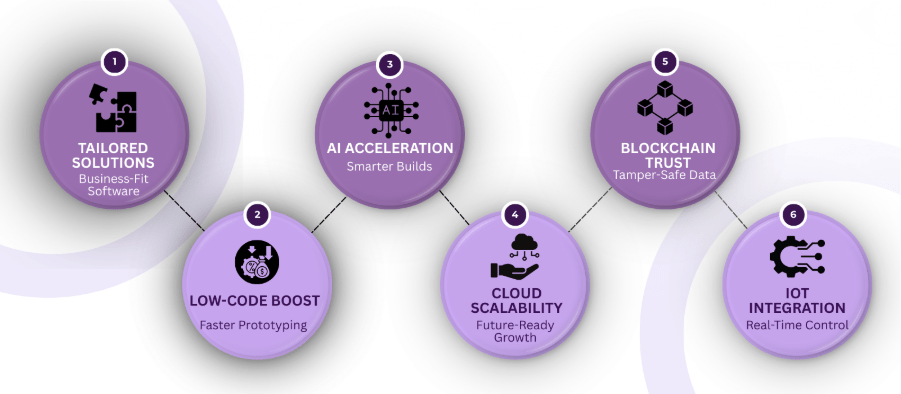
In 2025, businesses need software that can keep up with fast-changing demands. Traditional solutions often fall short, making it essential to adopt innovations in custom software development services. These technologies solve current challenges while helping companies stay competitive and agile. Here are the key technologies shaping this change:
1. AI-Powered Development Tools
- Smarter Software Creation: Artificial Intelligence can now analyze patterns in business operations and suggest tailored code solutions. It can also detect potential bugs before they become serious issues, ensuring software is more reliable and efficient.
- Faster Development: AI automates repetitive and time-consuming tasks, significantly speeding up the development process. This allows businesses to launch applications faster and respond to market changes with agility.
2. Low-Code and No-Code Platforms
- Simplified Development: Low-code and no-code platforms allow even non-technical users to participate in building software. Visual drag-and-drop interfaces reduce dependency on extensive coding knowledge.
- Rapid Innovation: Companies can quickly prototype ideas, test new features, and deploy solutions without long development cycles. This flexibility encourages experimentation and continuous improvement.
3. Cloud-Native Architecture and Microservices
- Flexible and Scalable: Cloud-native design and microservices architecture break applications into smaller, independent modules. This makes updates simpler and improves system performance.
- Future-Proof Solutions: Businesses can scale applications to handle growing users or increased workloads without system crashes. This approach ensures software remains robust as operations expand.
4. Blockchain for Security and Transparency
- Enhanced Security: Blockchain protects sensitive data by making it tamper-proof. It significantly reduces risks related to fraud, cyberattacks, and unauthorized access.
- Transparent Operations: Blockchain enables businesses to maintain clear records of transactions and processes. Industries like finance, healthcare, and supply chain management benefit from improved trust and accountability.
5. IoT and Edge Computing for Real-Time Applications
- Instant Data Processing: Edge computing allows IoT devices to process data locally rather than sending it to a central server. This enables real-time insights and faster decision-making.
- Connected Operations: Businesses can monitor operations, track assets, and respond to changes immediately. Industries like logistics, manufacturing, and smart buildings can optimize efficiency and reduce downtime.
By adopting these technologies, businesses using custom software development services, including custom software development services in USA, can build faster, smarter, and more flexible applications, staying ahead of future challenges.
5 Simple Steps to Choose the Best Custom Software Development Services in 2025
Choosing the right software development partner can make or break your project, so it’s important to follow a clear process.
Step 1: Understand Your Requirements
Start by clearly defining what your business needs from the software. Identify the key problems you want to solve, the processes that need improvement, and the features that are non-negotiable. This clarity will help you communicate effectively with potential service providers.
Step 2: Research Technology Expertise
Look for providers who are well-versed in modern technologies like AI, cloud-native systems, low-code/no-code platforms, and IoT. A team familiar with emerging tools can build software that not only meets today’s needs but is also future-ready.
Step 3: Evaluate Their Experience
Check the provider’s portfolio and case studies. Focus on projects similar to yours and assess their ability to deliver scalable, efficient, and reliable software. Testimonials and client feedback can also give insight into their reliability and professionalism.
Step 4: Consider Scalability and Support
Your software should grow with your business. Ensure the provider can scale the solution as your requirements increase and offers post-launch support, maintenance, and updates to keep your system running smoothly.
Step 5: Assess Communication and Collaboration
Choose a team that communicates clearly and collaborates effectively. A provider who actively involves your team, listens to your input, and provides transparent updates will reduce delays and misunderstandings.
Following this step-by-step approach will help you select custom software development services that align with your business goals and set you up for success in 2025.
What Makes Helixbeat Custom Software Development Service Stand Out
Helixbeat stands out because we focus on building software that truly fits your business. We combine modern technologies like AI, cloud systems, and microservices with agile development to create solutions that are fast, secure, and scalable. Our clients benefit from a 35% faster time-to-market, and we maintain a high satisfaction rate of 98%.
What makes us different is our commitment to security and compliance. For example, we are SOC 2 Type 2 certified and HIPAA-compliant, which is essential for businesses in healthcare, finance, and other regulated industries. This means our clients can trust us to deliver software that’s not only innovative but also reliable and secure.
Difference Between Helixbeat and other Solutions
|
Feature |
Helixbeat Custom Software Development |
Typical Custom Software Providers |
|
Technology |
Uses AI, cloud-native systems, microservices, and modern tools. |
Often uses older technology stacks. |
|
Development Process |
Agile approach for faster delivery and iterative improvements. |
Slower waterfall-style process. |
|
Scalability |
Software is built to grow as your business grows. |
Scaling may be difficult or costly. |
|
Security & Compliance |
SOC 2 Type 2 certified, HIPAA-compliant, follows industry standards. |
Security and compliance may be limited. |
|
Support & Maintenance |
Provides ongoing updates, fixes, and optimization after launch. |
Support is usually limited or short-term. |
|
Team Flexibility |
Offers staff augmentation with pre-vetted talent when needed. |
Scaling teams is slower and less flexible. |
|
Innovation & Growth |
Focus on innovation and global reach, including offshore capabilities. |
Growth is slower and less focused on innovation. |
Final Words
When it comes to building software that truly fits your business, Helixbeat custom software development services make the difference. We don’t just deliver a product—we create solutions that solve real problems, scale with your growth, and use the latest technologies to keep you ahead of the competition.
Choosing Helixbeat means choosing a partner who is committed to your success. From faster time-to-market to secure applications, our services make sure your software works for you, not the other way around.
Frequently Ask Questions
1. Why is health information exchange important in healthcare?
It improves care coordination, reduces duplicate tests, minimizes errors, and helps providers make timely, data-driven decisions across different healthcare settings.
2. What are the main models of health information exchange?
3. Which standards guide health information exchange?
Standards like FHIR and HL7 define consistent data formats, making it easier for EHRs, HIEs, and other healthcare platforms to exchange information.
4. What are the benefits of using health information exchange?
HIE improves care coordination, reduces healthcare costs, supports population health management, enhances research, and increases operational efficiency.
5. How does AERIS enhance healthcare information exchange?
AERIS leverages FHIR standards, connects legacy systems, automates workflows, reduces manual errors, and provides real-time access to patient records and lab results.
1. How can Helixbeat ensure my software stays future-ready?
We use modern technologies like AI, cloud-native systems, microservices, and low-code platforms, which allow your software to adapt and scale as your business grows. This future-proof approach prevents your solution from becoming obsolete quickly.
2. Can I make changes to the software after it’s deployed?
Yes. Helixbeat follows an agile development process, allowing for iterative improvements and updates even after launch. Your feedback can be implemented quickly, ensuring the software evolves alongside your business needs.
3. What industries can benefit from Helixbeat custom software services?
Our solutions are versatile, serving industries like healthcare, finance, logistics, e-commerce, and manufacturing. Any business that needs scalable, secure, and tailored software can leverage our services for improved efficiency.
4. How does Helixbeat handle data security and compliance?
We follow strict security protocols and are SOC 2 Type 2 and HIPAA-compliant. This ensures your data is protected, and your software meets industry regulations, giving you peace of mind in sensitive industries.
5. How quickly can I expect to see ROI from custom software?
By automating workflows, reducing manual effort, and streamlining operations, Helixbeat’s custom solutions can deliver measurable results in months. Many clients report faster processes, reduced errors, and higher productivity within the first quarter after implementation.