


Electronic Medical Record Systems
Electronic medical record systems have completely changed how US healthcare providers handle patient information. These digital platforms replace paper charts with structured data that clinicians access in real time.
Here, we’ll discuss the core components, benefits, and standards that define electronic medical record systems in the US healthcare.
What Are Electronic Medical Record Systems?
Electronic medical record systems, often abbreviated as EMRs, store patient data in digital format within a single healthcare organization. Unlike electronic health records (EHRs), which span multiple providers, EMRs focus on internal workflows. A typical system includes patient demographics, medical history, medications, allergies, lab results, and imaging reports.
The Centers for Medicare & Medicaid Services (CMS) defines certified electronic medical record systems under the Promoting Interoperability Programs. Certification requires compliance with criteria set by the ONC Health IT Certification Program.
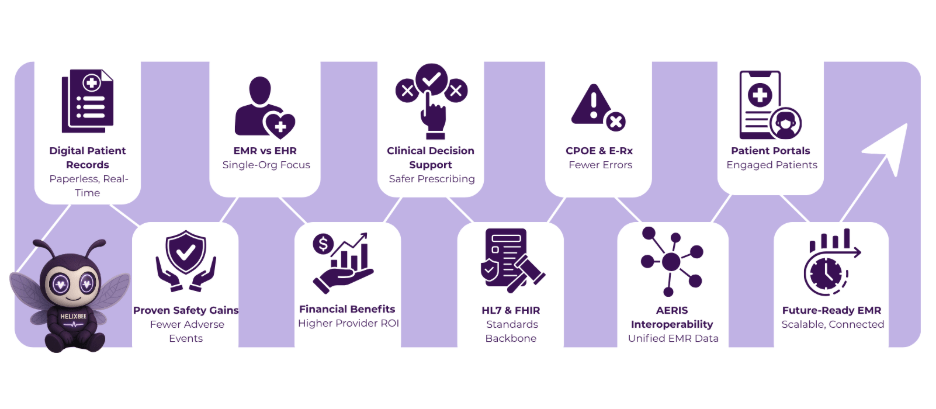
Key Features of Modern Electronic Medical Record Systems
US-based electronic medical record systems incorporate several standardized functions:
- Clinical Decision Support (CDS): Algorithms flag drug interactions and suggest evidence-based orders.
- Computerized Provider Order Entry (CPOE): When physicians enter orders electronically, they naturally reduce errors from handwriting. CMS requires CPOE for at least 60% of medication orders in eligible hospitals.
- E-Prescribing: Direct electronic transmission of prescriptions to pharmacies streamlines the process. In 2021, 94% of all prescriptions in the US were electronically filled, and 92% of prescribers have adopted e‑prescribing methods.
- Patient Portals: Secure messaging and result viewing comply with HIPAA regulations. In 2024, approximately 65% of US patients reported accessing their online medical records or patient portals at least once, according to ONC data.
Benefits of Electronic Medical Record Systems
Implementation of electronic medical record systems yields measurable gains:
1. Improved Patient Safety
A study (published 2016) funded by the Agency for Healthcare Research and Quality (AHRQ) found that hospitals with “fully‑electronic” EHR systems (where physician notes, nursing assessments, problem lists, medication lists, discharge summaries, and provider orders were all electronically generated) had 17%‑30% lower odds of any adverse in‑hospital event compared with hospitals that were less digitized.
2. Cost Savings
According to the Commonwealth Fund summary, the average financial benefit for the practices in the study was $32,737 per full‑time provider per year (labelled “per physician or nurse practitioner”).
3. Population Health Management
Aggregated data from electronic medical record systems enables tracking of chronic conditions.
HL7, FHIR, and Interoperability in Electronic Medical Record Systems
Interoperability remains a critical focus for electronic medical record systems in the US. The 21st Century Cures Act of 2016 mandated information blocking prohibitions and standardized APIs.
HL7 Standards: Health Level Seven International develops messaging protocols. Version 2.x, widely used in US hospitals, transmits admission, discharge, and lab orders. HL7 v2 supports structured data exchange but lacks native web compatibility.
FHIR Specification: Fast Healthcare Interoperability Resources, pronounced “fire,” represents the next generation. Released in 2014, FHIR uses RESTful APIs and JSON/XML formats familiar to web developers.
AERIS: Streamlining Electronic Medical Record Systems Through FHIR Interoperability
AERIS, developed by Helixbeat, serves as an integration engine that connects disparate electronic medical record systems across US healthcare organizations. By leveraging HL7 and FHIR standards, AERIS normalizes data from multiple sources into a single, actionable view.
Ready to cut delays by 50%, double your ROI, and empower your team with instant access to critical data? Let’s dive into why AERIS is the solution you’ve been waiting for.
How AERIS Solves Core Challenges in Electronic Medical Record Systems
US providers rely on electronic medical record systems from different vendors. AERIS bridges these gaps without replacing existing EMR investments.
- Fragmented Data Flows – Legacy HL7 v2 interfaces require custom mapping for every endpoint.
- Delayed Transitions of Care – According to ONC 2023 data, fewer than half (42 %) of hospitals send summary‑of‑care records to most or all external hospitals and ambulatory providers, and only around 16‑17 % send them to most or all long‑term/post‑acute or behavioral health providers.
- High Integration Costs – Industry estimates suggest building an interoperable health app with HL7/FHIR integration can require $65,000–$130,000 in development costs; individual vendor interface packages (e.g., for major EHR systems) may start at $75,000 and go much higher.
AERIS automates these processes using FHIR APIs and USCDI v4 profiles.
Helixbeat by the Numbers
- 20+ Years of Expertise: Our team brings decades of healthcare IT experience to ensure AERIS works for you.
- 50+ IT Professionals: A dedicated crew powers AERIS, delivering unmatched support and innovation.
- 1,000+ Customers: Join a thriving community of healthcare leaders already transforming with AERIS.
- 10,000+ Projects Completed: Proven success across countless integrations and workflows.
- 95% Returning Customers: Our clients trust AERIS to deliver, time and time again.
The AERIS Advantage: Numbers That Speak for Themselves
Metric | Without AERIS | With AERIS | Your Benefit |
Data Exchange Delays | Frequent bottlenecks | Reduced by 50%
| Faster care in emergencies |
Return on Investment | Slow, costly overhauls | 100% faster ROI | Grow without breaking the bank |
Operational Costs | High redundancies | Cut by 30% | Save thousands annually |
Error Rates | Up to 20% manual errors | Slashed by 90% | Precision for better patient outcomes |
Ready to cut delays by 50%, double your ROI, and empower your team with instant access to critical data? Let’s dive into why AERIS is the solution you’ve been waiting for.
Your Benefits, Amplified
- 50% Fewer Delays: Real-time data means critical information is always at your fingertips, turning hours into seconds.
- 100% Faster ROI: Plug-and-play integration maximizes your investment without expensive system replacements.
- 30% Cost Savings, 90% Fewer Errors: Automation eliminates waste, saving resources and ensuring accuracy.
How AERIS Works: Your 3-Step Path to Success
- Connect Seamlessly: Integrate AERIS effortlessly into your existing systems, from legacy EMRs to modern platforms.
- Share Securely: Activate real-time data exchange with HIPAA-compliant encryption. Watch your teams and partners collaborate effortlessly.
- Optimize and Grow: Because AERIS evolves with your organization, it’s set up to help you succeed for the long haul.
What Users Say About AERIS
Dr. Sarah L.
Hospital Administrator
John T.
Telemedicine Provider
Emily P.
Healthcare Executive
FAQs
1.What role does interoperability play in EMRs?
Interoperability allows EMRs to exchange data across systems using standards like HL7 v2 and FHIR, supporting better care coordination.
2. How does AERIS improve EMR integration?
AERIS connects disparate EMR systems using HL7 and FHIR, creating a unified view and automating data exchange.
3. What are common challenges in EMR systems?
Fragmented data flows, delayed transitions of care, and high integration costs are key issues EMRs face in the US.
4. What benefits does AERIS deliver to healthcare providers?
AERIS reduces data exchange delays by 50%, cuts operational costs by 30%, slashes manual errors by 90%, and accelerates ROI by 100%.
Final Thoughts
Electronic medical record systems have entirely changed how US healthcare providers manage patient data, improving safety, efficiency, and care coordination. Yet, fragmented data flows, delayed transitions of care, and high integration costs continue to challenge providers across organizations. AERIS addresses these obstacles by connecting disparate EMRs through FHIR APIs and USCDI v4 profiles, turning complex integrations into a streamlined process.
With AERIS, healthcare teams gain real-time access to critical data, reduce delays, cut operational costs, and improve overall patient outcomes—all without replacing existing EMR investments.
Ready to transform your EMR workflows and accelerate interoperability?