


Semantic Interoperability in Healthcare: The Key to Connected Care in 2026
Semantic interoperability in healthcare represents the highest level of health information exchange. It means that the receiving system comprehends the clinical meaning of exchanged information exactly as the sending system intended, without human interpretation or manual mapping.
What Is Semantic Interoperability in Healthcare?
The Healthcare Information and Management Systems Society (HIMSS) defines semantic interoperability as the ability of health IT systems to exchange information with unambiguous, shared meaning. Two clinicians—or two different EHR systems—can interpret “myocardial infarction,” “heart attack,” and the SNOMED CT code 22298006 as identical concepts because they carry the same clinical semantics.
This level requires three core components:
- Standardized terminologies and vocabularies (SNOMED CT, LOINC, ICD-10-CM/PCS)
- Common information models (HL7 FHIR)
- Value sets and code bindings that constrain possible entries to specific clinical contexts
In practice, semantic interoperability in healthcare enables a blood pressure reading recorded as LOINC 55284-4 in one system to appear correctly in another system’s flowsheet, trigger the same clinical decision support rules, and contribute accurately to population health analytics.
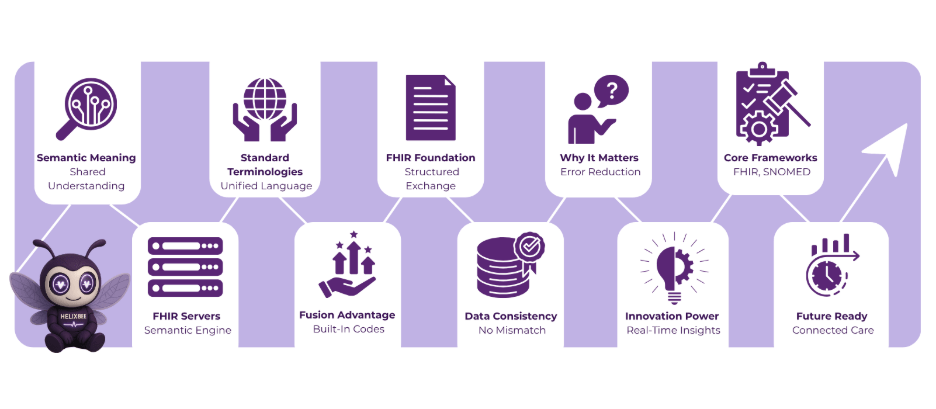
Why Semantic Interoperability Matters Now
Healthcare continues to generate massive amounts of data across multiple systems, from electronic health records (EHRs) to lab reports and imaging systems. Much of this information is stored in proprietary formats, making it difficult to share and interpret across providers, specialties, and institutions.
The consequences of poor semantic interoperability are evident in everyday clinical practice:
- Duplicate testing increases costs and wastes resources.
- Medication errors occur more frequently when information is incomplete or misinterpreted.
- Clinical trial matching and research efforts are slowed by inconsistent terminology.
Achieving true semantic interoperability in healthcare allows systems to communicate effectively, reduces errors, improves patient safety, and supports better clinical and research outcomes.
Major Standards and Frameworks Driving Progress
HL7 FHIR (Fast Healthcare Interoperability Resources)
Released in 2014 and reaching maturity with R5 in 2023, FHIR has become the de-facto standard for semantic interoperability in healthcare. FHIR Resources use SNOMED CT, LOINC, and RxNorm as primary terminologies and support terminology binding through ValueSet and CodeSystem resources.
The U.S. Core Implementation Guides (USCDI v4 as of 2025) mandate specific codes for 80+ data elements. For example, every Observation resource representing hemoglobin A1c must use LOINC 4548-4 and appear in mmol/mol or % according to binding strength.
SNOMED CT
SNOMED CT offers over 350,000 active concepts, with powerful post‑coordination capabilities for detailed clinical expression. SNOMED International has 50 member countries as of 2025. Its use is mandated in some settings—for example, in the United States (Meaningful Use), the United Kingdom (NHS GP systems), and Australia (preferred national clinical terminology).
LOINC and UCUM
LOINC covers laboratory and clinical observations (over 100,000 terms), while UCUM standardizes units of measure. Together, they make a lab result like “SARS-CoV-2 RNA” universally comparable across continents.
Terminologies for Specific Domains
- RxNorm and ATC for medications
- ICD-10 (widely used globally for mortality, morbidity, and billing purposes)
- NCI Thesaurus and ICD-O-3 for oncology
Role of FHIR Servers in Achieving Semantic Interoperability in Healthcare
A modern FHIR server is the operational backbone that turns the promise of semantic interoperability in healthcare into a daily reality. Unlike traditional interface engines that merely move XML or CSV files, a capable FHIR server actively enforces and exploits semantics at every transaction.
A FHIR server like FUSION provides built-in terminology services that go far beyond simple storage. This active semantic enforcement eliminates the “garbage in, garbage out” problem that plagued earlier HL7 v2 and CDA exchanges.
Unlock Seamless Healthcare Interoperability with FUSION
Imagine a platform that not only meets modern healthcare standards like FHIR but actually pushes your operations forward. That’s FUSION: the FHIR server designed to make interoperability effortless and impactful. Whether you’re a hospital administrator streamlining workflows or a payer optimizing reimbursements, FUSION bridges the gap.
Built on FHIR, it leverages RESTful APIs for plug-and-play integration, enabling seamless connectivity with legacy systems, modern EHRs, and emerging tools like wearable devices and telehealth platforms. This isn’t just compliance, it’s acceleration.
FUSION goes deeper by embedding critical medical coding systems like SNOMED CT, LOINC, and ICD-10 directly into its architecture. This built-in intelligence maintains data consistency and accuracy, transforming raw information into actionable insights ready for clinical decisions, regulatory reporting, and advanced analytics. No more wrestling with mismatched formats or manual mappings: FUSION handles the heavy lifting!
Organizations using FUSION report up to 70% faster data sharing, slashing referral delays by 60% and reducing redundant tests by 25%. That’s not hype; it’s a measurable impact, with providers saving $1,000–$2,000 per patient annually through streamlined claims and operations.
How FUSION Ignites Data-Driven Innovation
The true magic of healthcare FHIR lies in its potential to fuel innovation, and FUSION amplifies this like no other. As a reliable engine for standardized data flows, it powers downstream applications that were once out of reach.
Take chronic disease management, for example. By integrating real-time data from wearables and EHRs, FUSION enables continuous monitoring and proactive interventions, potentially cutting hospital readmissions and optimizing therapies. Or, imagine a telehealth consultation that’s instantly better because the doctor has the patient’s full history right there. FUSION makes that happen, giving virtual care a huge boost in quality and making patients much happier.
Certified Excellence
FUSION is officially certified by the Drummond Group for FHIR-based interoperability, validating its conformance with healthcare data exchange standards HL7, FHIR, and SMART on FHIR. This certification demonstrates that FUSION meets industry-recognized benchmarks for secure, standardized data exchange — giving you the confidence to integrate seamlessly across systems.
What This Means for You
In a complex healthcare ecosystem, FUSION simplifies connectivity and safeguards data integrity. With enterprise-grade uptime (99.99%) and secure authentication powered by OAuth2 and encrypted endpoints, it supports trusted, real-time collaboration between hospitals, labs, and payers.
Whether you’re mapping USCDI elements for regulatory reporting or automating data flows for public-health initiatives, FUSION keeps you compliant with current interoperability frameworks and ready for future mandates.
What Users Say About AERIS
Dr. Sarah L.
Hospital Administrator
John T.
Telemedicine Provider
Emily P.
Healthcare Executive
FAQs
1.What is semantic interoperability in healthcare?
Semantic interoperability allows different health IT systems to exchange data so that the receiving system interprets the clinical meaning exactly as the sending system intended, without manual translation.
2. Why is semantic interoperability important for patient safety?
It reduces errors caused by misinterpreted data, prevents duplicate testing, improves medication accuracy, and supports timely clinical decisions.
3. Can semantic interoperability in healthcare improve clinical research?
Yes. Standardized and accurately interpreted data allow researchers to aggregate and analyze information more effectively, accelerating clinical trial matching and population health studies.
4. What benefits do healthcare organizations see in using a server like FUSION?
Organizations report faster data sharing, reduced redundant tests, improved referrals, and cost savings per patient, along with smoother integration of wearables and telehealth data.
Final Thoughts
The data exists. The standards exist. The remaining step requires implementation at scale—and the right FHIR server makes the difference between partial connectivity and true semantic exchange.
Ready to make your health system fully semantically interoperable in months instead of years? Book a free FUSION discovery call today and see how the only enterprise FHIR platform with native Ontoserver syndication, 100 % USCDI v4 compliance out-of-the-box, and zero-code terminology mapping can eliminate your local codes forever.