


Health Information Exchange and Interoperability
Health information exchange and interoperability represent two of the most critical yet challenging goals today. They enable patient data to flow securely and meaningfully between providers, hospitals, labs, pharmacies, and patients themselves. When implemented effectively, health information exchange and interoperability reduce duplicate testing, prevent medical errors, lower costs, and improve patient outcomes.
What Is Health Information Exchange (HIE)?
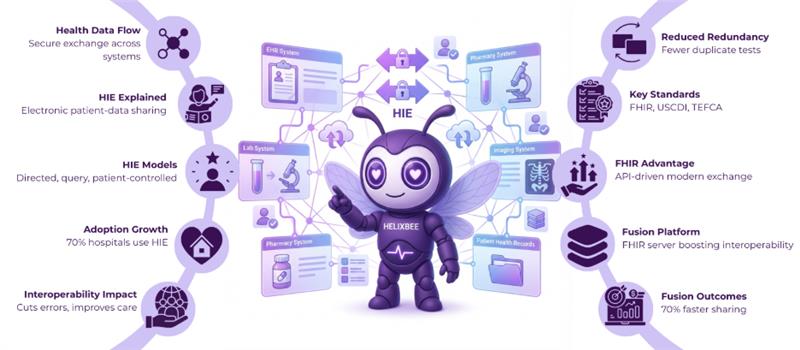
Health information exchange refers to the electronic sharing of health-related data among authorized organizations and individuals. HIE allows clinicians and hospitals that do not share the same electronic health record (EHR) system to access and transmit patient information like medications, allergies, lab results, imaging reports, and discharge summaries.
Three primary models of HIE exist in the United States:
- Directed Exchange – Secure point-to-point push of information (e.g., a primary care physician sending a referral summary to a specialist).
- Query-Based Exchange – Providers search for and pull patient records from other participants when unplanned care occurs (common in emergency departments).
- Consumer-Mediated Exchange – Patients collect, control, and share their own health data through personal health records or patient portals.
As of 2023, about 70% of U.S. non‑federal acute care hospitals reported routine engagement in interoperable electronic exchange of health information across all four key domains (find, send, receive, integrate). For office‑based physicians, data from 2019 shows approximately 65% had participated in some form of HIE (sending, receiving, or querying health information with outside providers).
Benefits of Robust Health Information Exchange and Interoperability
Research and recent data highlight several advantages of effective health information exchange (HIE) and interoperability — though outcomes vary by context, implementation, and use patterns.
Many hospitals now exchange patient data electronically across systems. According to ONC’s 2023 survey, roughly 70 % of non-federal acute‑care hospitals routinely engaged in all four interoperability domains (send, receive, find, integrate).
Access to external records can reduce duplicate imaging. A 2022 study of a longitudinal health‑record viewer showed a lower likelihood of ordering repeat imaging when providers reviewed images from external systems.
Similarly, interoperability is associated with improvements in medication safety, lower patient‑safety event rates, and reduced healthcare costs in some studies.
In some settings, better electronic documentation and information flow (even within a hospital) has been linked to modest reductions in readmissions. For example, when hospitals treated heart failure patients using EHR dashboards and followed guideline-based care, they saw fewer readmissions within 30 days.
Key Standards Driving Health Information Exchange and Interoperability
Several technical standards have emerged as cornerstones:
- HL7 FHIR (Fast Healthcare Interoperability Resources) – Released in 2014 and now the dominant standard. FHIR uses modern web-based APIs, making it developer-friendly and mobile-ready. The 21st Century Cures Act mandates support for FHIR-based APIs without special effort.
- USCDI (United States Core Data for Interoperability) – Defines a baseline set of data classes and elements that certified health IT must be able to exchange (e.g., allergies, medications, problems, immunizations, procedures, and clinical notes). USCDI Version 4 became effective in 2025.
- TEFCA (Trusted Exchange Framework and Common Agreement) – Launched in 2023 by ONC and now operational nationwide. TEFCA establishes a universal floor for interoperability by connecting Qualified Health Information Networks (QHINs).
Unlock Seamless Healthcare Interoperability with FUSION
Imagine a platform that not only meets modern healthcare standards like FHIR but actually pushes your operations forward. That’s FUSION: the FHIR server designed to make interoperability effortless and impactful. Whether you’re a hospital administrator streamlining workflows or a payer optimizing reimbursements, FUSION bridges the gap.
Built on FHIR, it leverages RESTful APIs for plug-and-play integration, enabling seamless connectivity with legacy systems, modern EHRs, and emerging tools like wearable devices and telehealth platforms. This isn’t just compliance, it’s acceleration.
FUSION goes deeper by embedding critical medical coding systems like SNOMED CT, LOINC, and ICD-10 directly into its architecture. This built-in intelligence maintains data consistency and accuracy, transforming raw information into actionable insights ready for clinical decisions, regulatory reporting, and advanced analytics. No more wrestling with mismatched formats or manual mappings: FUSION handles the heavy lifting!
Organizations using FUSION report up to 70% faster data sharing, slashing referral delays by 60% and reducing redundant tests by 25%. That’s not hype; it’s a measurable impact, with providers saving $1,000–$2,000 per patient annually through streamlined claims and operations.
How FUSION Ignites Data-Driven Innovation?
The true magic of healthcare FHIR lies in its potential to fuel innovation, and FUSION amplifies this like no other. As a reliable engine for standardized data flows, it powers downstream applications that were once out of reach.
Take chronic disease management, for example. By integrating real-time data from wearables and EHRs, FUSION enables continuous monitoring and proactive interventions, potentially cutting hospital readmissions and optimizing therapies. Or, imagine a telehealth consultation that’s instantly better because the doctor has the patient’s full history right there. FUSION makes that happen, giving virtual care a huge boost in quality and making patients much happier.
Certified Excellence
FUSION is officially certified by the Drummond Group for FHIR-based interoperability, validating its conformance with healthcare data exchange standards HL7, FHIR, and SMART on FHIR. This certification demonstrates that FUSION meets industry-recognized benchmarks for secure, standardized data exchange — giving you the confidence to integrate seamlessly across systems.
What This Means for You?
In a complex healthcare ecosystem, FUSION simplifies connectivity and safeguards data integrity. With enterprise-grade uptime (99.99%) and secure authentication powered by OAuth2 and encrypted endpoints, it supports trusted, real-time collaboration between hospitals, labs, and payers.
Whether you’re mapping USCDI elements for regulatory reporting or automating data flows for public-health initiatives, FUSION keeps you compliant with current interoperability frameworks and ready for future mandates.
What Users Say About AERIS
Dr. Sarah L.
Hospital Administrator
John T.
Telemedicine Provider
Emily P.
Healthcare Executive
FAQs
1. What is health information exchange (HIE)?
HIE refers to the electronic sharing of health-related data among authorized providers, hospitals, labs, and patients, enabling coordinated care across systems.
2. How does interoperability improve patient care?
It allows clinicians to access accurate, up-to-date information from other providers, reducing duplicate tests, preventing errors, and supporting timely treatment decisions.
3. Can interoperability reduce healthcare costs?
Yes. By reducing redundant tests, improving workflow efficiency, and supporting better care coordination, interoperable systems can lower operational costs in specific settings.
4. What role does FUSION play in interoperability?
FUSION is a FHIR server that connects legacy systems, modern EHRs, wearables, and telehealth tools, enabling faster data sharing, reduced redundant tests, and improved clinical workflows.
Final Thoughts
Health information exchange and interoperability form the backbone of modern, connected healthcare. By allowing secure and meaningful data sharing between hospitals, clinics, labs, pharmacies, and patients, these systems help reduce redundant testing, lower medical errors, and support better care coordination.
FHIR servers like FUSION accelerate these benefits by streamlining workflows, improving data accuracy, and enabling advanced analytics. As healthcare becomes increasingly digital, leveraging robust interoperability solutions allows organizations to improve efficiency, reduce costs, and enhance patient outcomes while preparing for future regulatory and technological developments.