


HL7 Integration Services
Get Started with a Free Demo
New Keyword Page
New Keyword Page
"*" indicates required fields
Professional HL7 Integration Services & Healthcare Data Exchange
Fast, accurate, and secure data sharing is important for modern healthcare companies. As hospitals, clinics, labs, imaging centers, telemedicine platforms, and digital health apps expand, the need for unified, interoperable data becomes critical.
FUSION, a powerful healthcare interoperability engine, delivers advanced capabilities to streamline how providers connect, manage, and exchange clinical data across systems. At the core of its architecture are robust HL7 Integration Services, enabling seamless communication across diverse healthcare environments.
This comprehensive guide explains what HL7 integration services are, why they are essential, and how FUSION uses advanced HL7, FHIR, and healthcare data exchange technologies to help organizations achieve end-to-end interoperability.
What Are HL7 Integration Services?
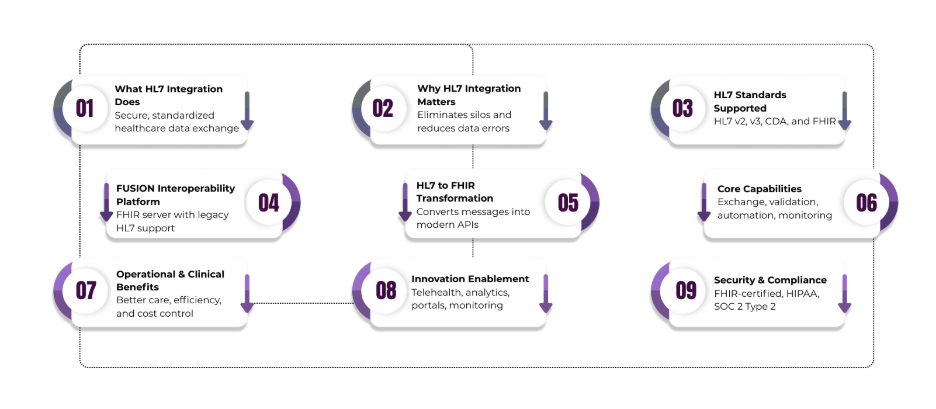
HL7 Integration Services refer to the processes, technologies, protocols, and tools that enable healthcare systems to exchange clinical and administrative data smoothly. HL7, or Health Level Seven, is a global messaging standard used by hospitals and clinics to share information between Electronic Health Records (EHR), Laboratory Information Systems (LIS), Radiology (RIS), PACS, pharmacy systems, billing systems, and many other applications.
HL7 Integration Services ensure that every application can communicate using standard HL7 v2, HL7 v3, CDA, and FHIR formats.
By enabling smooth communication between disparate systems, HL7 Integration Services significantly improve interoperability, reduce clinical and administrative errors, eliminate repetitive manual tasks, and support highly coordinated patient care.
Modern integrations rely on advanced interface engines such as FUSION ensuring reliable message routing and transformation. These solutions also support a full spectrum of HL7 standards—HL7 v2, HL7 v3, CDA, and FHIR—to accommodate both legacy and next-generation healthcare applications.
The Role of HL7 Integration Solutions
HL7 Integration Solutions encompass the software platforms, interface engines, and middleware used to implement HL7 Integration Services. These solutions ensure that different healthcare applications, even from different vendors, can communicate using standardized HL7 formats like HL7 v2, HL7 v3, CDA, and FHIR.
In modern healthcare, HL7 Integration Solutions are not just about sending messages; they also handle data transformation, validation, and workflow automation. Hospitals and labs rely on these solutions to translate complex HL7 messages into actionable data, while maintaining data integrity and compliance with clinical standards.
FUSION serves as a modern HL7 Integration Solution by acting as a FHIR server. It enables hospitals and healthcare providers to adopt next-generation interoperability without disrupting their legacy HL7 systems. By integrating seamlessly with HL7 engines, FUSION allows HL7 messages from EHRs, LIS, and other systems to be transformed into FHIR resources, providing a unified data layer for modern applications.
HL7 Integration Software Services: Simplifying Healthcare Interoperability
HL7 Integration Software Services provide organizations with the tools and expertise required to deploy and manage HL7 integrations efficiently. These services include:
- HL7 interface development
- HL7 message mapping and transformation
- Workflow automation
- Data validation and integrity checks
- Monitoring, troubleshooting, and optimization
- Integration with FHIR servers like FUSION
By getting HL7 Integration Software Services, healthcare organizations can ensure that clinical and administrative data is accurate, secure, and readily available to all systems that need it. FUSION enhances these services by providing a FHIR-based platform for modern healthcare interoperability.
FUSION: A FHIR Server Supporting HL7 Integration Services
Although FUSION is a FHIR server, it is an integral part of HL7 Integration Services for several reasons:
- FHIR is an HL7 Standard: FHIR (Fast Healthcare Interoperability Resources) is developed by HL7 International. By supporting FHIR, FUSION is inherently aligned with HL7 standards.
- Legacy HL7 Transformation: Many hospitals continue to use HL7 v2 or v3 messaging. FUSION works alongside HL7 integration engines, which convert legacy HL7 messages into FHIR resources. This allows hospitals to modernize without replacing existing systems.
- Central Data Repository: Once HL7 messages are converted to FHIR, FUSION stores and serves this data via APIs. This ensures all connected applications—patient portals, mobile apps, analytics platforms, and telehealth systems—access standardized, real-time data.
- Enhanced Interoperability: FUSION bridges the gap between traditional HL7 messaging and modern healthcare applications. It enables seamless healthcare data exchange, supporting both legacy and new-generation workflows.
Key Functions of HL7 Integration Services
HL7 Integration Services encompass several essential functions that ensure smooth healthcare data exchange:
- Data Exchange: Transfers patient demographics, lab results, orders, billing information, and clinical notes between disparate systems.
- Interoperability: Bridges communication gaps between different applications (EHR, EMR, LIS, HIS) from multiple vendors.
- Workflow Automation: Automates tasks such as data entry, scheduling, reminders, and lab orders, reducing manual errors and administrative overhead.
- Data Integrity: Ensures accuracy and consistency of patient information across all connected systems.
- Support for Standards: Works with HL7 v2, HL7 v3, CDA, and FHIR, as well as modern data formats like JSON and XML.
Benefits of HL7 Integration Services with FUSION
By leveraging HL7 Integration Services and FUSION, healthcare organizations can achieve:
- Improved Patient Care: Clinicians receive real-time access to accurate patient data, enabling faster diagnoses and better treatment decisions.
- Operational Efficiency: Streamlined clinical workflows reduce administrative burden, allowing staff to focus on patient care.
- Reduced Costs: Less duplication of tests and procedures lowers operational costs.
- Better Collaboration: Interdisciplinary teams can collaborate more effectively with consistent, accurate data.
- Scalable Interoperability: FUSION supports growth, handling high-volume data exchange while ensuring reliability.
How FUSION Ignites Data-Driven Innovation
The true power of healthcare FHIR lies in its ability to unlock innovation, and FUSION takes this potential to the next level. As a reliable engine for standardized data flows, FUSION empowers downstream applications that were previously difficult or impossible to implement.
Consider chronic disease management: by integrating real-time data from wearables, EHRs, and lab systems, FUSION enables continuous monitoring and proactive interventions. This can reduce hospital readmissions, optimize therapy plans, and improve overall patient outcomes.
Or imagine a telehealth consultation: the physician has instant access to the patient’s complete history, lab results, and imaging reports in one place. FUSION makes this possible, elevating virtual care, enhancing clinical decision-making, and improving patient satisfaction.
Technologies and Providers Behind HL7 Integration Services
Integration Engines
HL7 integrations often rely on specialized engines like:
- Mirth Connect
- Corepoint Integration Engine
- Cloverleaf
- Rhapsody
- Ensemble
These engines handle HL7 message routing, transformation, and mapping, feeding data into platforms like FUSION for modern FHIR-based interoperability.
Service Providers
Healthcare technology providers offer:
- Custom HL7 interface development
- HL7 consulting and architecture planning
- Managed HL7 software services
- Troubleshooting and optimization
- Migration from legacy HL7 to FHIR
FUSION complements these services by providing a FHIR-based central platform, enabling seamless healthcare data exchange for modern applications.
FUSION and the Transition from HL7 to FHIR
A 2025 global survey reports that over 70% of countries have active FHIR use for at least some national healthcare use cases, with adoption expected to grow rapidly.
This worldwide momentum reflects how healthcare systems are embracing modern standards moving from legacy HL7 v2 messaging to FHIR servers for several reasons:
- Web-Friendly and API-Driven: FHIR supports RESTful APIs, making integration with mobile apps, cloud systems, and analytics platforms easier.
- Real-Time Data Access: FHIR enables instant access to patient information, improving clinical decisions.
- Interoperability Across Legacy Systems: HL7 integration engines convert existing HL7 messages to FHIR, allowing hospitals to modernize without losing existing functionality.
- Scalable and Future-Ready: FHIR servers like FUSION support emerging standards, ensuring organizations are prepared for future interoperability requirements.
Discover how FUSION can modernize your HL7 and FHIR integrations. Click here to explore features, certifications, and real-world use cases.
FUSION in Action: Real-World Use Cases
- Hospital EHR Integration: Connects EHR, LIS, RIS, PACS, and billing systems for a unified data view.
- Diagnostics and Labs: Instantly shares lab and imaging results with clinical teams.
- Telehealth Platforms: Enables virtual care with complete patient history available in FHIR format.
- Pharmacy Systems: Synchronizes prescriptions and medication history across clinics and hospitals.
- Patient Engagement: Supports mobile apps and portals for real-time access to clinical data.
- Health Information Exchanges (HIEs): Facilitates regional or national healthcare data exchange with FHIR as the central standard.
Why FUSION is a Leading HL7 Integration Solution
FUSION is trusted for its reliability, scalability, and future-ready architecture, making it a preferred platform for healthcare interoperability. Its key strengths include:
- Rapid integration and interface development – deploy connections and workflows quickly across multiple systems.
- Support for legacy HL7 and modern FHIR standards – ensuring smooth coexistence of old and new healthcare systems.
- Seamless interoperability with multiple systems – from EHRs and LIS to PACS, telehealth platforms, and billing systems.
- Built-in medical coding – SNOMED CT, LOINC, and ICD-10 are natively supported for accurate clinical data exchange.
- High-volume data handling – 99.99% uptime ensures reliability for mission-critical operations.
- Secure access via OAuth2 and encrypted endpoints – keeping sensitive healthcare data protected at all times.
By combining HL7 Integration Services, HL7 Integration Solutions, and FUSION, healthcare organizations can achieve end-to-end interoperability, streamlining clinical workflows, reducing errors, and delivering measurable operational improvements.
Certified Excellence
FUSION is officially certified by the Drummond Group for FHIR-based interoperability, validating its compliance with industry standards including HL7, FHIR, and SMART on FHIR. This certification ensures that FUSION adheres to recognized benchmarks for secure, accurate, and standardized healthcare data exchange, giving organizations the confidence to integrate seamlessly across multiple systems.
Other critical certifications include:
- HIPAA Compliance – Ensures legal compliance for handling Protected Health Information (PHI) in the U.S.
- SOC 2 Type 2 – Confirms robust controls for security, availability, processing integrity, confidentiality, and privacy, which are vital for enterprise adoption.
Wrapping up
HL7 Integration Services remain the backbone of healthcare interoperability. FUSION complements these services as a modern FHIR server, enabling hospitals, clinics, labs, and telehealth platforms to transition smoothly from legacy HL7 messaging to next-generation, API-driven healthcare data exchange.
With FUSION, healthcare organizations gain faster, more reliable, and standardized access to clinical data, enabling better patient care, operational efficiency, and collaboration across the healthcare ecosystem.
Modernizing your interoperability infrastructure with FUSION ensures that your organization is prepared for the future of healthcare while maintaining continuity with legacy HL7 systems.
Schedule a free demo today and experience seamless HL7 Integration Services and FHIR-based healthcare data exchange
Frequently Ask Questions
1. What are HL7 integrations?
HL7 integrations connect healthcare systems such as EHRs, LIS, RIS, and billing platforms, enabling seamless data exchange using HL7 standards.
2. What is HL7 service?
An HL7 service provides tools and protocols to transfer, map, and validate healthcare data, ensuring interoperability across multiple systems.
3. Is HL7 a type of API?
HL7 itself is a messaging standard, not an API, but modern HL7 Integration Services often use APIs like FHIR to enable real-time data access.
4. How do HL7 Integration Services improve patient care?
By enablingaccurate and real-time data exchange, HL7 Integration Services reduce errors, speed up diagnosis, and support coordinated care across providers.
5. What is the difference between HL7 Integration Solutions and HL7 Integration Software Services?
HL7 Integration Solutions refer to the platforms and engines used for integration, while HL7 Integration Software Services include development, mapping, monitoring, and optimization of those integrations.
6. Can FUSION convert legacy HL7 messages to FHIR?
Yes, FUSION acts as a FHIR server and works with HL7 integration engines to transform legacy HL7 v2/v3 messages into FHIR resources for modern healthcare applications.