


Solving Electronic Health Record Interoperability Challenges With FUSION
Get Started with a Free Demo
New Keyword Page
New Keyword Page
"*" indicates required fields
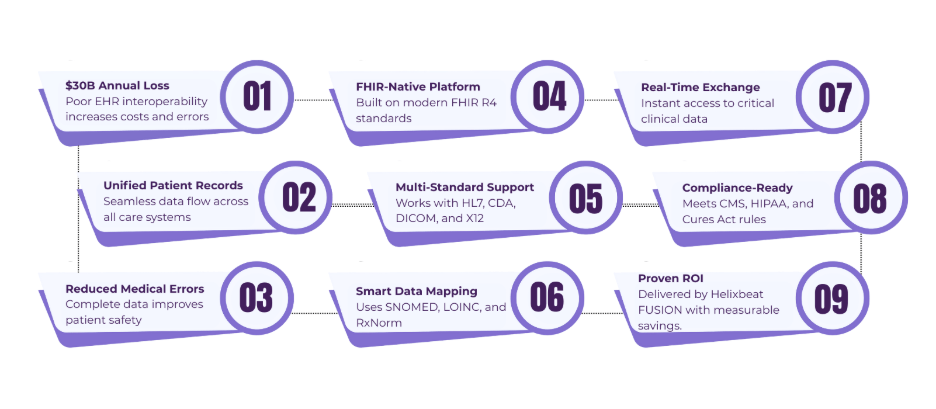
Healthcare organizations waste $30 billion annually due to poor electronic health record interoperability. When your EHR systems can’t communicate effectively, patient safety suffers, costs skyrocket, and regulatory compliance becomes nearly impossible. Studies show that 86% of healthcare providers face significant data exchange barriers, contributing to over 80% of serious medical errors.
FUSION by Helixbeat solves these critical EHR and interoperability challenges through advanced FHIR-based technology that connects disparate healthcare systems seamlessly.
What Is Electronic Health Record Interoperability?
Electronic health record interoperability enables different healthcare information systems to exchange, access, and use patient data regardless of the originating platform. When a patient visits multiple providers—primary care, specialists, hospitals, labs—their complete medical history should flow seamlessly across all systems.
Without proper interoperability and EHR infrastructure, critical patient information gets trapped in data silos. This fragmentation creates dangerous gaps in care, with research indicating that incomplete medical records contribute to approximately 400,000 preventable deaths annually in the United States.
Three Levels of Interoperability
The Office of the National Coordinator identifies three levels of electronic health records interoperability:
Foundational: Basic data exchange where receiving systems don’t automatically interpret information.
Structural: Data exchanges preserve format and meaning, allowing automated processing through standards like HL7 or FHIR.
Semantic: The highest level, where exchanged data carries identical meaning across all systems. FUSION operates at this semantic level, ensuring true data usability.
The Cost of Poor Electronic Health Record Interoperability
Healthcare organizations without effective EHR and interoperability solutions face severe consequences:
- $8.3 billion wasted annually on duplicate medical imaging alone
- 18% of emergency department visits result in repeated diagnostic tests
- 25-30% of laboratory tests are unnecessary duplicates
- Medical errors rank third among leading causes of death, with data fragmentation as a major contributor
- CMS penalties up to $1.5 million annually for non-compliance with interoperability mandates
Beyond financial impact, inadequate electronic health record interoperability creates patient safety risks. When emergency physicians can’t access medication lists or allergy information, treatment delays and adverse events increase dramatically.
How FUSION Delivers True Electronic Health Records Interoperability
FUSION by Helixbeat provides comprehensive interoperability and EHR solutions through FHIR-native architecture designed specifically for modern healthcare’s data exchange demands.
FHIR-First Architecture
Unlike legacy systems retrofitted with FHIR capabilities, FUSION was purpose-built on Fast Healthcare Interoperability Resources (FHIR) standards. This architectural advantage enables:
- Native FHIR R4 support covering clinical, administrative, and financial data
- RESTful API endpoints for seamless third-party integration
- Real-time data synchronization using FHIR subscriptions
- Standardized data models ensuring semantic consistency
Comprehensive Standards Support
FUSION bridges legacy and modern systems by supporting multiple healthcare data standards:
HL7 v2.x Messages: Seamlessly processes laboratory interfaces, ADT notifications, and order communications from systems using HL7 v2.3 through v2.7.
HL7 v3 and CDA: Parses Clinical Document Architecture files including discharge summaries and continuity of care documents.
DICOM: Integrates medical imaging workflows, connecting PACS systems with EHRs.
X12 EDI: Handles administrative transactions including eligibility checks and claims submissions.
This multi-standard approach means healthcare organizations achieve electronic health record interoperability without replacing existing infrastructure.
Intelligent Data Transformation
FUSION’s transformation engine performs sophisticated data normalization using industry-standard terminologies:
- SNOMED CT for clinical concepts (350,000+ standardized medical terms)
- LOINC for laboratory tests and clinical observations
- RxNorm for medication standardization
When different systems use varying nomenclature for identical information, FUSION automatically maps these variations to consistent standards, reducing medication reconciliation errors by 60-70%.
Real-Time Data Exchange
Clinical decisions require immediate information access. FUSION processes thousands of transactions per minute with sub-second latency, ensuring critical data—lab results, medication orders, allergy alerts—reaches clinicians instantly.
Real-time monitoring dashboards provide complete visibility into data flows, enabling rapid issue resolution and reducing mean time to resolution by 60-80%.
See how FUSION works as a healthcare integration engine to unify data across your systems in real time
FUSION Use Cases: Real-World Results
Multi-Facility Health System Integration
A regional health network operating six hospitals with three different EHR platforms (Epic, Cerner, Meditech) implemented FUSION to solve EHR and interoperability challenges:
Results within 90 days:
- Unified patient views across all facilities
- 50% reduction in duplicate laboratory tests
- 78% decrease in patient safety incidents related to incomplete records
- $8 million in annual savings
Laboratory Integration
An academic medical center partnering with seven different Laboratory Information Systems used FUSION to eliminate testing redundancy:
Outcomes:
- Standardized interfaces with automatic LOINC mapping
- Test results delivered within 2 minutes regardless of laboratory
- 32% reduction in duplicate orders, saving $2.3 million annually
- 40% decrease in test result turnaround time
Specialist Referral Coordination
A multi-specialty group implemented FUSION to improve interoperability and EHR workflows between primary care and specialists:
Improvements:
- Referral completion rates increased from 68% to 91%
- 35% reduction in time to specialist appointments
- 90% specialist satisfaction with clinical information quality
- Automated clinical summary generation eliminating manual record requests
Have interoperability challenges? Our experts will help you design the right integration strategy.
Regulatory Compliance Through Electronic Health Record Interoperability
The 21st Century Cures Act and CMS interoperability mandates require specific electronic health records interoperability capabilities. Non-compliance carries penalties up to $1 million annually plus potential program exclusion.
FUSION ensures compliance through:
Patient Access API: FHIR-based APIs enabling patients to access health information through apps of their choice.
Provider Directory API: Publicly accessible, FHIR-formatted provider directories.
Payer-to-Payer Data Exchange: Seamless patient data exchange when members change health plans.
Comprehensive Audit Logs: Documentation proving your organization facilitates rather than blocks data exchange.
FUSION maintains the highest security and compliance standards essential for electronic health records interoperability. Our platform holds SOC 2 Type 2 (Service Organization Control Type 2) certification, demonstrating rigorous operational security controls. FUSION is fully HIPAA-certified (Health Insurance Portability & Accountability Act), ensuring patient data protection across all EHR and interoperability workflows.
We’re registered with SAM (System for Award Management), enabling federal healthcare partnerships. Additionally, FUSION 2.0 earned Drummond Certificate of Health IT Compliance, validating our adherence to ONC certification criteria. These certifications guarantee that your interoperability and EHR implementation meets the strictest regulatory and security requirements.
Implementation: Achieving Electronic Health Record Interoperability
FUSION implementation follows a structured approach minimizing disruption while accelerating value delivery:
Phase 1 (Weeks 1-4): Current state assessment, pain point identification, and stakeholder engagement.
Phase 2 (Weeks 5-12): Platform deployment and migration of critical interfaces including ADT, laboratory results, and medication orders.
Phase 3 (Weeks 13-24): Expansion to remaining systems, external partner integration, and workflow optimization.
Phase 4 (Ongoing): Performance monitoring, continuous improvement, and new integration additions.
Most organizations achieve substantial value within 90 days, with critical integrations live and measurable improvements in data accessibility and clinical efficiency.
Why Choose FUSION for Electronic Health Records Interoperability
FUSION differentiates itself in the EHR and interoperability market through:
FHIR-Native Architecture: Purpose-built for modern standards, not legacy technology with retrofitted capabilities.
Proven ROI: Organizations report 12-18 month payback through 25% reduction in duplicate testing, 30% faster claims processing, and 50% decrease in manual data entry.
Scalability: Supports small practices to enterprise health systems processing millions of daily transactions.
Cloud Flexibility: Available as SaaS, on-premises, or hybrid deployment based on your requirements.
Expert Support: Implementation teams combining healthcare domain expertise with technical proficiency.
The Future of Electronic Health Record Interoperability
Electronic health records interoperability continues evolving beyond traditional EHR systems:
Consumer Health Technologies: Wearables and health apps generate patient-generated health data requiring seamless integration into clinical records.
Artificial Intelligence: AI-powered clinical decision support and predictive analytics require high-quality, standardized data that FUSION provides.
Social Determinants of Health: Integration of social services data with clinical records enables holistic care coordination.
Genomic Medicine: FUSION supports FHIR Genomics standards, enabling precision medicine integration.
Organizations building robust interoperability and EHR infrastructure today position themselves for innovation leadership tomorrow.
Take the Next Step
Electronic health record interoperability challenges compromise patient safety, increase costs, and create regulatory risks. FUSION by Helixbeat provides the technology platform and implementation methodology necessary to achieve true interoperability across your healthcare ecosystem.
Frequently Ask Questions
What is electronic health record interoperability and why does it matter?
Electronic health record interoperability enables different healthcare systems to exchange and use patient data seamlessly. It matters because lack of interoperability contributes to 400,000 preventable deaths annually, wastes $30 billion through duplicate testing, and creates compliance risks with penalties up to $1 million yearly. FUSION solves these challenges through FHIR-based integration ensuring complete patient information availability in real-time.
How does FUSION differ from other EHR and interoperability solutions?
FUSION features FHIR-native architecture rather than retrofitted capabilities, providing superior performance and future-proof scalability. Unlike point-to-point integrations creating maintenance challenges, FUSION offers centralized hub-and-spoke architecture supporting HL7 v2, v3, FHIR, DICOM, and X12 EDI simultaneously. Organizations achieve ROI within 12-18 months through measurable operational improvements and compliance assurance.
Can FUSION integrate with our existing systems?
Yes, FUSION supports diverse technology stacks including Epic, Cerner, Meditech, Allscripts, and hundreds of other platforms. The solution bridges legacy HL7 v2 interfaces with modern FHIR APIs, enabling gradual modernization without system replacement. Implementation typically begins with high-priority interfaces live within 4-8 weeks.
What ROI can we expect from implementing FUSION?
Organizations typically achieve positive ROI within 12-18 months through reduced duplicate testing (25% reduction saving $200-$400 per patient), faster claims processing (30% improvement), eliminated manual data entry (50% reduction), and avoided compliance penalties. Additional benefits include 78% reduction in patient safety incidents and 60% decrease in external communication costs.
How does FUSION ensure regulatory compliance?
FUSION ensures electronic health records interoperability compliance through built-in Patient Access APIs, Provider Directory APIs, and Payer-to-Payer exchange capabilities meeting 21st Century Cures Act and CMS requirements. The platform maintains comprehensive audit logs, end-to-end encryption, and role-based access controls ensuring HIPAA compliance. Learn more about FUSION’s compliance features.