


bi data warehousing
Data does not fail businesses—disconnected data does. When reports contradict dashboards, leaders question the numbers, and analytics teams lose time fixing pipelines instead of delivering insights. This is precisely why BI data warehousing becomes the foundation of reliable, confident decision-making.
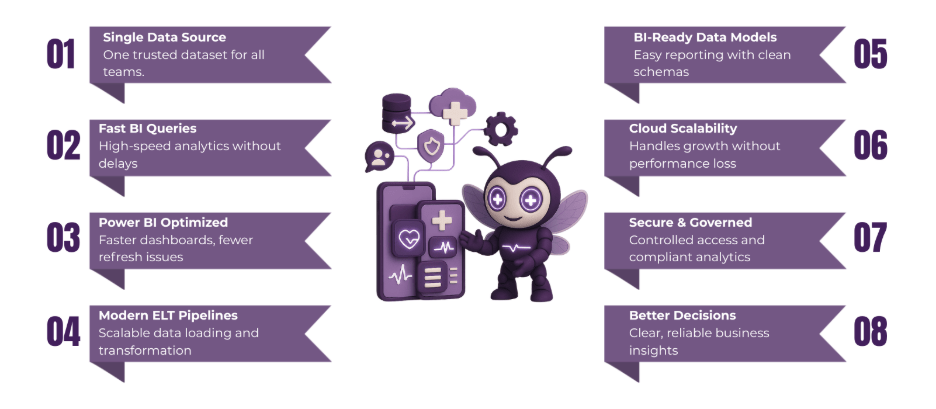
BI data warehousing brings structure, consistency, and speed to business intelligence by centralizing data that is purpose-built for analytics, reporting, and performance tracking. Instead of pulling information from scattered systems for every report, teams rely on a single, trusted source that supports BI workloads at scale.
For US organizations scaling rapidly, managing complex SaaS ecosystems, or depending heavily on tools like Power BI, a well-architected BI data warehouse changes how insights are delivered across the business. It removes reporting delays, reduces data ambiguity, and gives decision-makers confidence in every number they see.
Why BI Data Warehousing Drives Better Decisions
BI data warehousing directly impacts how quickly and confidently US businesses make decisions across departments.
Single Source of Truth for Leadership
Executives rely on consistent metrics across finance, operations, sales, and marketing. A BI data warehouse ensures every dashboard reflects the same definitions, calculations, and data sources.
Faster Analytics Without Performance Bottlenecks
By separating analytics workloads from operational systems, bi data warehousing enables high-speed querying without affecting day-to-day business applications.
Stats That Highlight the Impact
Industry studies consistently show that organizations with centralized bi data warehousing environments experience faster reporting cycles, higher analytics adoption, and fewer data discrepancies compared to siloed setups. In fact, over 72% of US enterprises report improved decision-making speed and accuracy after implementing a BI-ready data warehouse.
How BI Data Warehousing Actually Works
Understanding the architecture clarifies why bi data warehousing outperforms traditional reporting setups.
Data Sources Feeding the Warehouse
Data flows in from CRMs, ERPs, finance systems, marketing platforms, customer support tools, and operational databases. APIs and event streams further enrich analytics.
ETL vs ELT in BI Data Warehousing
Modern bi data warehousing favors ELT, where raw data is loaded first and transformed within the warehouse. This improves scalability and supports evolving BI requirements.
BI-Optimized Data Modeling
Star and snowflake schemas structure data around business metrics, making BI tools faster and easier to use for non-technical users.
Power BI Data Warehouse Integration
Power BI data warehouse integration plays a central role in many US analytics stacks, making optimized implementation essential.
Power BI Data Warehouse Design Considerations
A data warehouse in Power BI must prioritize query efficiency, aggregated tables, and semantic consistency. Poor modeling leads to slow dashboards and unreliable insights.
Data Warehouse in Power BI Workflows
Power BI connects directly to the warehouse using live or import modes. A BI-ready warehouse minimizes DAX complexity and reduces refresh failures, ensuring faster, reliable insights.
Improving Power BI Performance with BI Data Warehousing
By pre-calculating metrics and structuring data for BI consumption, dashboards load faster and scale across departments without performance degradation. This demonstrates the power of bi and data warehouse synergy in enterprise analytics.
BI Data Warehousing vs Traditional Warehousing
Not all data warehouses are designed for BI success.
Purpose-Built for Analytics
Traditional warehouses focus on storage and batch processing, while bi data warehousing prioritizes analytics speed, concurrency, and usability, ensuring that insights are delivered reliably to decision-makers.
Cost Efficiency for BI Queries
BI and data warehouse solutions reduce unnecessary compute usage by optimizing query patterns, which helps US companies control cloud analytics costs and maximize ROI.
Scalability for Growing BI Teams
As BI adoption increases, a power bi data warehouse scales seamlessly to support more users, dashboards, and real-time insights without performance degradation.
Cloud-Based BI Data Warehousing for US Businesses
Cloud platforms have reshaped how bi data warehousing is implemented.
Elastic Scalability and Performance
Cloud bi data warehousing scales compute independently from storage, allowing organizations to handle peak BI demand without overprovisioning and ensuring consistent performance.
Security and Compliance Readiness
Modern BI warehouses support role-based access, encryption, audit logging, and compliance requirements critical for US industries, making data warehouse in Power BI implementations secure and reliable.
Faster Time to Value
Cloud deployments eliminate infrastructure delays, enabling BI teams to deliver insights in weeks instead of months, which accelerates business decision-making.
Challenges That BI Data Warehousing Solves
Many analytics problems stem from missing or poorly designed bi data warehousing.
Conflicting Metrics Across Teams
Without centralized definitions, teams interpret KPIs differently. BI and data warehouse systems enforce consistency across all reporting and dashboards.
Slow and Unreliable Dashboards
Poorly structured data causes latency. A power bi data warehouse ensures analytics-ready data is always available, and dashboards refresh reliably.
Low Trust in Analytics
When numbers change unexpectedly, trust erodes. A governed bi data warehousing setup restores confidence in decision-making because all metrics are sourced from a single trusted system.
BI Data Warehousing Strategy That Scales
A successful implementation goes beyond technology.
Aligning BI Metrics with Business Goals
Metrics should reflect real business outcomes, not just available data. Business intelligence and data warehousing concepts enable this alignment by ensuring that KPIs are meaningful and consistent.
Designing for Self-Service BI
A well-modeled warehouse empowers business users to explore data without constant IT support, leveraging data warehouse in Power BI for direct access to analytics-ready datasets.
Planning for Future Data Growth
Scalable architecture ensures that new data sources and analytics use cases can be added without rework, preserving the long-term value of bi data warehousing.
BI Data Warehousing Implementation
Below is a simplified view of how bi data warehousing delivers value:
Layer | Purpose |
Business Impact
|
Data Sources
| Collect operational and SaaS data | Comprehensive visibility |
ETL/ELT Pipelines
| Clean and transform data | Reliable analytics |
BI Data Warehouse
| Store analytics-ready data | Fast, consistent reporting |
BI Tools (Power BI) | Visualize insights | Informed decisions |
Why Choose Helixbeat DaaS for BI Data Warehousing
Helixbeat DaaS delivers bi data warehousing designed specifically for analytics-driven organizations.
Analytics-First Architecture
We design warehouses optimized for BI and data warehouse synergy, not just data storage, ensuring faster and more reliable analytics.
Power BI–Ready Data Models
Our solutions simplify data warehouse in Power BI reporting by reducing complexity at the dashboard layer, enabling faster insights for business users.
Scalable, Secure, and Cost-Aware
Helixbeat DaaS ensures performance, compliance, and cost efficiency as your analytics footprint grows, making it the ideal power bi data warehouse solution for US enterprises.
Get Started with BI Data Warehousing
Reliable analytics begins with a foundation built for business intelligence.
What Users Say About AERIS
Dr. Sarah L.
Hospital Administrator
John T.
Telemedicine Provider
Emily P.
Healthcare Executive
Frequently Asked Questions
- What is BI data warehousing?
BI data warehousing is the practice of designing data warehouses specifically for business intelligence reporting and analytics performance.
- How does BI datawarehousingsupport Power BI?
It structures and optimizes data, so Power BI dashboards load faster, refresh reliably, and scale across users.
- Is BI data warehousing suitable for mid-sized US companies?
Yes, cloud-based BI data warehousing makes enterprise-grade analytics accessible to mid-sized organizations.
- How is BI data warehousing different from a data lake?
A data lake stores raw data, while BI data warehousing delivers cleaned, modeled, and analytics-ready data.
- How long does BI data warehousing implementation take?
Timelines vary, but focused BI data warehousing projects often deliver value within a few weeks.