


Digital Medical Records
Digital medical records represent a pivotal shift in how healthcare providers manage patient information. These electronic systems, often referred to as electronic health records (EHRs), store comprehensive patient data in a digital format. By replacing traditional paper charts, digital medical records facilitate real-time updates and collaboration among medical professionals.
The History of Digital Medical Records
The journey of digital medical records began in the 1960s when early computer technology laid the groundwork for electronic systems. Pioneering efforts emerged as healthcare sought alternatives to cumbersome paper records. For example, the Mayo Clinic in Rochester, Minnesota, adopted one of the first EHR systems during this period. In 1972, the Regenstrief Institute developed the initial electronic medical record system, marking a significant advancement in medical practice. This innovation was welcomed for its potential to streamline data management.
By the 2000s, government initiatives accelerated adoption. In the United States, the Health Information Technology for Economic and Clinical Health (HITECH) Act of 2009 provided incentives for EHR implementation, boosting usage rates significantly. This historical progression highlights a transition from isolated experiments to widespread, interconnected networks.
How Digital Medical Records Work?
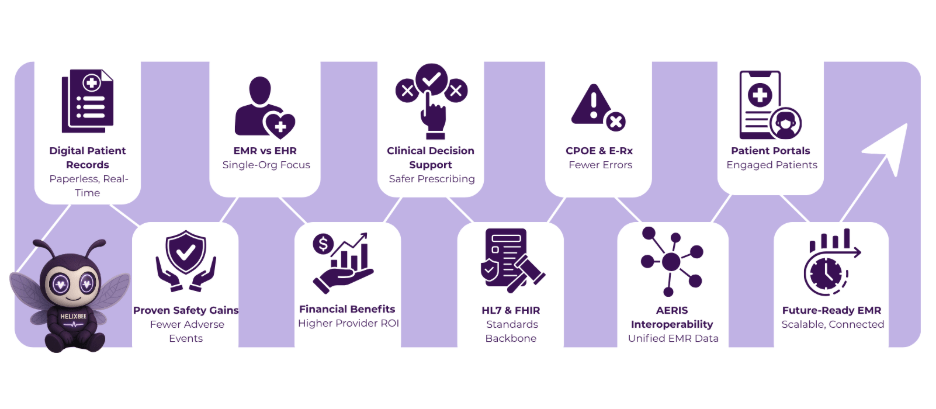
Digital medical records function as centralized repositories for patient information, capturing a wide range of data in electronic format. They include demographics, medical history, medications, allergies, immunization status, laboratory results, radiology images, vital signs, and billing details. Unlike paper records, these systems allow authorized providers to create, manage, and consult data across multiple organizations, integrating inputs from doctors, pharmacies, labs, and imaging facilities.
Workflows in digital medical records automate tasks, such as alerting providers to potential drug interactions or reminding them about preventive care. Tools based on solid evidence help with decisions, and features like voice recognition cut down on manual data entry. Overall, digital medical records enhance accuracy by minimizing handwriting errors and providing real-time updates.
Benefits of Digital Medical Records
Adopting digital medical records yields multiple advantages for healthcare delivery. They enable more effective diagnosis by providing comprehensive, up-to-date patient information. As a result, providers access histories instantly, which improves interactions and care coordination.
Cost savings from streamlined operations is another key advantage. Digital medical records support patient mobility, increase information reliability, and enable multiple users simultaneous access. This efficiency lowers administrative burdens and reduces redundant tests. Besides, quick access facilitates informed decisions, as seen in systems that integrate lab results and imaging directly. Similarly, patient outcomes improve through features like automated reminders for screenings.
The Role of HL7 and FHIR in Digital Medical Records
Interoperability stands as a cornerstone of modern digital medical records, and two standards, HL7 and FHIR, drive much of this capability. Health Level Seven (HL7) emerged in 1987 as a framework to standardize the exchange of clinical and administrative data between software applications used by healthcare providers. Its Version 2 messaging protocol became widely adopted in the 1990s and 2000s, enabling Electronic Health Record systems to transmit laboratory results, admission details, and billing information across disparate platforms. HL7 Version 3 introduced a more rigorous reference information model, though its complexity slowed uptake compared to Version 2.
Fast Healthcare Interoperability Resources (FHIR), pronounced “fire,” represents the next generation of HL7 standards. FHIR adopts a modular, web-based approach using RESTful APIs, JSON, and XML formats familiar to modern developers. This design enables digital medical records to exchange discrete data elements called resources.
HL7 and FHIR together reduce the fragmentation of isolated digital medical records. A 2023 study in the Journal of the American Medical Informatics Association found that facilities using FHIR-based exchanges cut data retrieval times by 68% compared to legacy HL7 Version 2 methods.
These standards enable nationwide networks like the Trusted Exchange Framework and Common Agreement (TEFCA), launched in 2023, which connects over 70% of U.S. hospitals through qualified health information networks.
AERIS: Streamlining Digital Medical Records Through FHIR
AERIS, by Helixbeat, acts as a translator for your EHR, using standards like HL7 and FHIR to tie all your data into one neat, unified system. This approach simplifies electronic health record integration by automating data mapping and validation.
Ready to cut delays by 50%, double your ROI, and empower your team with instant access to critical data? Let’s dive into why AERIS is the solution you’ve been waiting for.
Why AERIS is Your Key to Healthcare Innovation?
At Helixbeat, we know your challenges: fragmented systems, delayed data, and rising costs. AERIS is here to change that, offering a personalized, scalable, and secure platform that fits your unique needs. Whether you’re a small clinic or a sprawling hospital network, AERIS delivers measurable results that elevate patient outcomes and boost your bottom line.
- 20+ Years of Expertise: Our team brings decades of healthcare IT experience to ensure AERIS works for you.
- 50+ IT Professionals: A dedicated crew powers AERIS, delivering unmatched support and innovation.
- 1,000+ Customers: Join a thriving community of healthcare leaders already transforming with AERIS.
- 10,000+ Projects Completed: Proven success across countless integrations and workflows.
- 95% Returning Customers: Our clients trust AERIS to deliver, time and time again.
Providers adopting AERIS report faster diagnoses, lower costs, and improved outcomes, positioning it as the go-to tool for future-proof HIE.
The AERIS Advantage: Numbers That Speak for Themselves
Metric | Without AERIS | With AERIS | Your Benefit |
Data Exchange Delays | Frequent bottlenecks | Reduced by 50%
| Faster care in emergencies |
Return on Investment | Slow, costly overhauls | 100% faster ROI | Grow without breaking the bank |
Operational Costs | High redundancies | Cut by 30% | Save thousands annually |
Error Rates | Up to 20% manual errors | Slashed by 90% | Precision for better patient outcomes |
Your Benefits, Amplified
- 50% Fewer Delays: Real-time data means critical information is always at your fingertips, turning hours into seconds.
- 100% Faster ROI: Plug-and-play integration maximizes your investment without expensive system replacements.
- 30% Cost Savings, 90% Fewer Errors: Automation eliminates waste, saving resources and ensuring accuracy.
How AERIS Works: Your 3-Step Path to Success?
- Connect Seamlessly: Integrate AERIS effortlessly into your existing systems, from legacy EHRs to modern platforms.
- Share Securely: Activate real-time data exchange with HIPAA-compliant encryption. Watch your teams and partners collaborate effortlessly.
- Optimize and Grow: Because AERIS evolves with your organization, it’s set up to help you succeed for the long haul.
What Users Say About AERIS
Dr. Sarah L.
Hospital Administrator
John T.
Telemedicine Provider
Emily P.
Healthcare Executive
FAQs
1. How do digital medical records improve patient care?
Digital records give healthcare providers real-time access to a patient’s medical history, medications, allergies, and lab results. This helps in faster, more accurate diagnoses, safer treatment plans, and coordinated care across multiple providers.
2. What types of data are stored in a digital medical record?
Digital medical records store diagnoses, treatment plans, medications, lab results, immunizations, vital signs, imaging reports, lifestyle information, and referral history, providing a comprehensive view of a patient’s health.
3. How do HL7 and FHIR standards enhance interoperability?
HL7 and FHIR are healthcare data standards that make sharing information between different systems seamless. FHIR, in particular, uses modern web technologies to allow real-time, structured data exchange, making integration faster and more reliable.
4. How does AERIS integrate with existing EHR systems?
AERIS acts as a translator, using HL7 and FHIR standards to unify data from various EHR platforms. It automates data mapping, validation, and transfer, allowing seamless integration with both legacy and modern systems.
Final Thoughts
Digital medical records have transformed healthcare by making patient information more accessible, accurate, and actionable. With AERIS, managing your electronic health records becomes seamless, reducing delays, cutting costs, and improving patient outcomes. Upgrade your healthcare system today and experience a smarter, faster, and more efficient way to handle patient data.