


FHIR Data Exchange
Get Started with a Free Demo
New Keyword Page
New Keyword Page
"*" indicates required fields
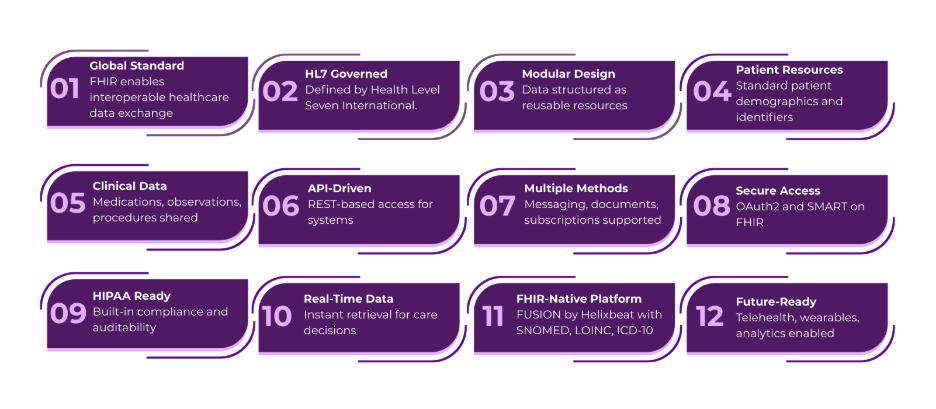
With healthcare technology evolving quickly, FHIR is now a key standard that makes sharing information between systems much easier. Developed by Health Level Seven International (HL7), FHIR facilitates the electronic transfer of health data, enabling providers, patients, and organizations to access and utilize information more efficiently. This approach addresses longstanding issues in interoperability, where disparate systems often struggle to communicate effectively.
What is FHIR?
FHIR represents a modern framework designed specifically for health care data exchange. Published by HL7, it structures data across five levels of abstraction: a basic framework, implementation support, real-world concept linking, record-keeping, and advanced reasoning about healthcare processes. At its core, FHIR uses modular “resources” to represent health information, such as patient demographics, medications, observations, and procedures.
These resources form the building blocks of FHIR data exchange, facilitating granular control over data elements. This modularity contrasts with older standards like HL7 v2 or C-CDA, which often require bulk data transfers.
Current versions include FHIR Release 5 (R5), which is in Standard for Trial Use (STU) status, alongside earlier iterations like R4 and R4B. Each version builds on the previous, incorporating feedback from global implementations to refine data models and exchange mechanisms. Since FHIR uses an open CC0 license, it’s much easier for everyone to use it, and translations help it work globally.
How FHIR Data Exchange Works
FHIR data exchange operates through several methods, each tailored to different scenarios in healthcare environments. The primary approach involves a RESTful API, which supports Create, Read, Update, Delete (CRUD) operations, along with search and custom operations. This client-server model allows systems to push or pull data asynchronously, integrating with tools like GraphQL for complex queries.
Messaging provides another pathway for FHIR data exchange, routing information between systems, often across organizations with limited trust. It can layer on top of the RESTful API or use other technologies, ideal for event-driven notifications. Documents wrap content in a Composition resource, offering context and fixed presentations for human readers, commonly used in cross-border clinical sharing.
Services within a Service-Oriented Architecture (SOA) leverage FHIR for broader enterprise integrations, while database storage enables persistent resource management. Subscriptions facilitate proactive notifications, where systems receive updates on specific events via defined topics.
In practice, FHIR data exchange begins with resource creation or retrieval. For example, a hospital system might query a patient’s medication list from an external pharmacy database using a RESTful GET request. Security layers, including OAuth and SMART on FHIR, protect these interactions, aligning with regulations like HIPAA.
Key Benefits of FHIR Data Exchange
Switching to FHIR data exchange comes with a lot of benefits that actually make healthcare better. First, it promotes interoperability by allowing diverse systems to communicate without custom interfaces. This flexibility is possible because FHIR is easy to set up and brings a patient’s entire history into one clear view.
Real-time data access is another major benefit, enabling providers to retrieve information instantly for better decision-making. Likewise, FHIR reduces administrative burdens by streamlining measure implementation and promoting scalable solutions for quality reporting. Security and privacy improve through granular controls, where data elements can be accessed selectively. Cost efficiencies arise from lower administrative overheads and improved compliance, particularly for payers. Enhanced scalability supports modular expansions, while better patient outcomes result from tailored data sharing.
Security and privacy improve through granular controls, where data elements can be accessed selectively. Cost efficiencies arise from lower administrative overheads and improved compliance, particularly for payers. Enhanced scalability supports modular expansions, while better patient outcomes result from tailored data sharing. Overall, these benefits position FHIR as a catalyst for modern, efficient healthcare ecosystems.
Unlock Seamless Healthcare Interoperability with FUSION
Imagine a platform that not only meets modern healthcare standards like FHIR but actually pushes your operations forward. That’s FUSION: the FHIR server designed to make interoperability effortless and impactful. Whether you’re a hospital administrator streamlining workflows or a payer optimizing reimbursements, FUSION bridges the gap.
Built on FHIR, it leverages RESTful APIs for plug-and-play integration, enabling seamless connectivity with legacy systems, modern EHRs, and emerging tools like wearable devices and telehealth platforms. This isn’t just compliance, it’s acceleration.
FUSION goes deeper by embedding critical medical coding systems like SNOMED CT, LOINC, and ICD-10 directly into its architecture. This built-in intelligence maintains data consistency and accuracy, transforming raw information into actionable insights ready for clinical decisions, regulatory reporting, and advanced analytics. No more wrestling with mismatched formats or manual mappings: FUSION handles the heavy lifting!
Organizations using FUSION report up to 70% faster data sharing, slashing referral delays by 60% and reducing redundant tests by 25%. That’s not hype; it’s a measurable impact, with providers saving $1,000–$2,000 per patient annually through streamlined claims and operations.
How FUSION Ignites Data-Driven Innovation
The true magic of healthcare FHIR lies in its potential to fuel innovation, and FUSION amplifies this like no other. As a reliable engine for standardized data flows, it powers downstream applications that were once out of reach.
Take chronic disease management, for example. By integrating real-time data from wearables and EHRs, FUSION enables continuous monitoring and proactive interventions, potentially cutting hospital readmissions and optimizing therapies. Or, imagine a telehealth consultation that’s instantly better because the doctor has the patient’s full history right there. FUSION makes that happen, giving virtual care a huge boost in quality and making patients much happier.
Certified Excellence
FUSION is officially certified by the Drummond Group for FHIR-based interoperability, validating its conformance with healthcare data exchange standards HL7, FHIR, and SMART on FHIR. This certification demonstrates that FUSION meets industry-recognized benchmarks for secure, standardized data exchange — giving you the confidence to integrate seamlessly across systems.
What This Means for You
In a complex healthcare ecosystem, FUSION simplifies connectivity and safeguards data integrity. With enterprise-grade uptime (99.99%) and secure authentication powered by OAuth2 and encrypted endpoints, it supports trusted, real-time collaboration between hospitals, labs, and payers.
Whether you’re mapping USCDI elements for regulatory reporting or automating data flows for public-health initiatives, FUSION keeps you compliant with current interoperability frameworks and ready for future mandates.
Final Thoughts
FHIR data exchange has made interoperability simpler, faster, and more reliable. FUSION builds on that foundation, transforming the promise of FHIR into tangible results. By connecting systems seamlessly, embedding medical coding standards, and supporting advanced analytics, FUSION empowers providers, payers, and administrators to deliver better care, reduce costs, and drive data-driven decisions.
Frequently Ask Questions
1. Why is health information exchange important in healthcare?
It improves care coordination, reduces duplicate tests, minimizes errors, and helps providers make timely, data-driven decisions across different healthcare settings.
2. What are the main models of health information exchange?
3. Which standards guide health information exchange?
Standards like FHIR and HL7 define consistent data formats, making it easier for EHRs, HIEs, and other healthcare platforms to exchange information.
4. What are the benefits of using health information exchange?
HIE improves care coordination, reduces healthcare costs, supports population health management, enhances research, and increases operational efficiency.
5. How does AERIS enhance healthcare information exchange?
AERIS leverages FHIR standards, connects legacy systems, automates workflows, reduces manual errors, and provides real-time access to patient records and lab results.
1. How does FHIR handle security and privacy?
FHIR uses OAuth2 and SMART on FHIR for secure authentication, with granular access controls for sensitive data.
2. Can FHIR integrate with legacy systems?
Yes, FHIR APIs allow seamless integration with older EHRs, databases, and enterprise applications.
3. What methods exist for FHIR data exchange?
Common methods include RESTful APIs, messaging, document sharing, service-oriented architectures, and subscriptions.
4. How does FUSION enhance FHIR data exchange?
FUSION embeds medical coding systems, supports plug-and-play integration, and enables real-time, actionable insights.
5. Is FUSION certified for interoperability?
Yes, FUSION is Drummond Group-certified for HL7, FHIR, and SMART on FHIR compliance.