


Testing and QA services
Get Started with a Free Demo
New Keyword Page
New Keyword Page
"*" indicates required fields
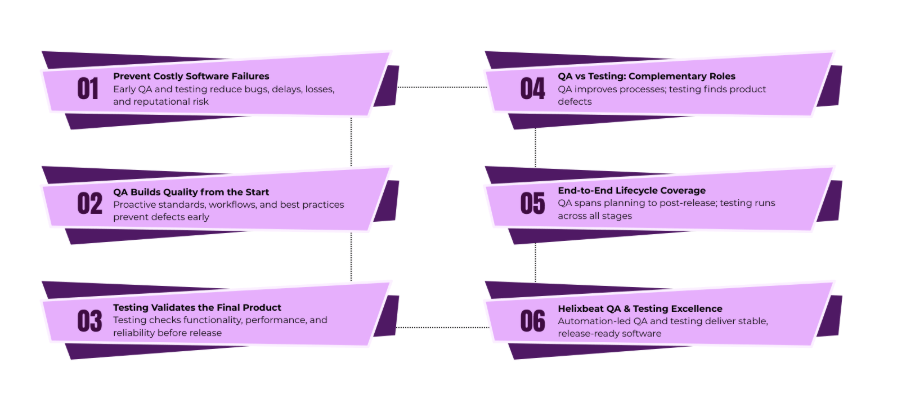
Did you know that software failures cost businesses billions every year, with small bugs sometimes leading to huge financial losses and reputational damage? Many companies invest in development but overlook structured quality checks, resulting in delayed releases, frustrated users, and costly fixes.
The real solution is integrating testing and qa services into your software lifecycle. By combining proactive quality assurance with thorough software testing, businesses can catch issues early, streamline releases, and deliver reliable software that meets user expectations. Investing in the right QA approach isn’t optional- it’s essential for sustainable success.
What Is Quality Assurance (QA)?
Quality Assurance (QA) is a proactive process that ensures software is built correctly from the start. It focuses on planning, standards, and processes to prevent defects before they happen, rather than just finding them later.
QA involves reviewing workflows, defining best practices, and continuously monitoring development to make sure the final product meets both business and user expectations. With effective QA, companies can reduce errors, save time, and deliver reliable software every time.
What Is Software Testing?
Software Testing is the process of evaluating a software product to identify bugs, errors, or gaps before it reaches users. Unlike QA, which focuses on preventing issues, testing is reactive – it checks whether the software works as intended under different conditions.
By running test cases, verifying functionality, and reporting defects, software testing ensures that the final product is reliable, user-friendly, and free from critical issues.
Quality Assurance vs Software Testing: Core Differences Explained
Aspect | Quality Assurance (QA) | Software Testing |
Objective | QA is preventive: focuses on improving processes to avoid defects during development. | Testing is detective: focuses on identifying and reporting defects in the finished product. |
Approach | Process-oriented: defines standards, workflows, and quality guidelines to ensure consistent outcomes. QA often works hand-in-hand with quality assurance and testing services to maintain overall product integrity. | Product-oriented: executes test cases, validates functionalities, and finds errors in code. Modern teams often use qa automation testing services to speed up testing cycles without compromising accuracy. |
Timing | Begins at the project planning stage and continues through development until deployment. | Happens after development at different stages (unit testing, integration testing, system testing, UAT). |
Scope | Broad: covers process audits, documentation, code reviews, risk management, and compliance checks. | Narrower: targets specific features, functions, and performance of the software. |
Responsibility | QA engineers focus on building quality into the process, ensuring standards are followed. | Software testers focus on detecting defects, executing test cases, and reporting issues. |
Tools & Techniques | QA uses process management tools, guidelines, and methodologies like ISO standards, Six Sigma, and TQM. | Testing uses tools like Selenium, JIRA, TestRail, and methodologies like manual and automated testing. |
When Does Quality Assurance Start and End?
Quality Assurance (QA) is a continuous process that spans the entire software development lifecycle. Here’s how it works in practice:
Step 1: Planning & Requirement Analysis
QA begins before a single line of code is written. During project planning, QA engineers define quality standards, review requirements, identify potential risks, and create software quality assurance services strategies. Early involvement ensures the development process is aligned with business objectives and reduces costly rework later.
Step 2: Development & Process Monitoring
QA continues throughout the coding phase, monitoring adherence to best practices, coding standards, and workflow processes. This step often works alongside software testing outsourcing companies, combining process audits with early-stage defect detection to prevent issues from escalating.
Step 3: Pre-Release & Post-Release Oversight
QA extends beyond development, overseeing release readiness, regression testing, and compliance checks. Even after deployment, QA monitors software performance, gathers feedback, and suggests improvements for future updates, ensuring long-term reliability and user satisfaction.
When Does Software Testing Take Place?
Software testing is a reactive process that occurs after development begins, focusing on verifying that the software works as intended. It is carried out at multiple stages, including unit testing, integration testing, system testing, and user acceptance testing (UAT). By leveraging qa automation testing services, teams can accelerate test execution, quickly identify defects, and ensure consistent results across different environments.
Testing doesn’t end at pre-release. Ongoing verification, regression testing, and performance checks are part of comprehensive quality assurance and testing services, ensuring that updates and new features do not break existing functionality. This stage ensures the software is reliable, stable, and ready for real-world use.
Is Quality Assurance Possible Without Software Testing?
In theory, Quality Assurance (QA) can exist without software testing because it focuses on processes, standards, and preventing defects. For example, a team can implement strict coding guidelines, conduct regular code reviews, and enforce workflow audits to maintain high-quality outputs. These measures improve development quality, but they cannot guarantee a bug-free product without actual testing.
However, in practice, QA is most effective when paired with testing. Consider a mobile app developed by a company: even if QA ensures coding standards and documentation are perfect, real users may still encounter crashes or glitches. By combining QA with testing – manual or through qa automation testing services – businesses can catch hidden issues, ensuring the software is fully reliable before release.
Roles and Responsibilities: QA Engineer vs Software Tester
Understanding the distinct roles of QA engineers and software testers is key to building a robust software quality strategy.
Roles and Responsibilities: QA Engineer
- Process Design & Improvement: Develops and enforces software development standards, testing frameworks, and workflow protocols to minimize defects across the project lifecycle.
- Risk Assessment & Audit: Analyzes potential risks in code, architecture, and third-party integrations, conducting audits and implementing mitigation strategies before testing begins.
- Tool & Metrics Management: Implements QA tools for tracking process efficiency, defect trends, and quality KPIs; uses metrics to continuously refine quality assurance and testing services.
Roles and Responsibilities: Software Tester
- Test Case Design & Execution: Creates detailed test plans and test cases for functional, integration, performance, and regression testing to verify software against specifications.
- Defect Identification & Reporting: Detects bugs or anomalies, documents them with technical details, and collaborates with developers to ensure accurate resolution.
- Automation & Performance Testing: Uses qa automation testing services to accelerate testing cycles, run repeated test scenarios, and validate software performance under varying loads.
Together, QA engineers and software testers ensure that both processes and products meet the highest standards, forming the backbone of reliable testing and qa services.
Which Is More Important: Quality Assurance or Software Testing?
Both Quality Assurance (QA) and Software Testing are equally important, but they serve different purposes. QA focuses on preventing defects through process improvement, while testing focuses on detecting defects in the product. Ignoring either can lead to costly mistakes.
For example, take an e-commerce platform preparing for a festive sale. QA makes sure that coding standards, workflows, and release processes are optimized to prevent errors. Meanwhile, testing verifies that features like payment processing, product search, and checkout function correctly under heavy user load. Without QA, the platform might face repeated glitches; without testing, users could encounter critical errors at launch.
Combining both ensures a smooth, reliable experience, which is exactly what businesses achieve with comprehensive testing and qa services.
Common Myths About QA and Software Testing
Myth 1: QA is the same as testing
Many believe QA and testing are identical, but QA is process-driven, focusing on preventing defects, while testing is product-driven, identifying bugs after they occur. Relying on one without the other can compromise software quality.
Myth 2: Automated testing can replace QA entirely
Some think using qa automation testing services eliminates the need for QA. In reality, automation accelerates testing but cannot replace process audits, workflow monitoring, and quality strategy that QA provides. Both are essential for reliable software delivery.
Why Choose Helixbeat for Testing and QA Services?
Many businesses face delays, unexpected bugs, and software that doesn’t perform as expected because QA and testing aren’t handled properly. Helixbeat offers testing and qa services that combine smart quality checks with thorough testing, helping catch issues early and ensuring your software runs smoothly.
With expertise in automation and full-service quality checks, Helixbeat helps you speed up development, reduce errors, and deliver software that is stable, user-friendly, and ready for real-world use. Partnering with us means fewer surprises, faster releases, and confidence that your software meets high-quality standards.
Frequently Ask Questions
1. Why is health information exchange important in healthcare?
It improves care coordination, reduces duplicate tests, minimizes errors, and helps providers make timely, data-driven decisions across different healthcare settings.
2. What are the main models of health information exchange?
3. Which standards guide health information exchange?
Standards like FHIR and HL7 define consistent data formats, making it easier for EHRs, HIEs, and other healthcare platforms to exchange information.
4. What are the benefits of using health information exchange?
HIE improves care coordination, reduces healthcare costs, supports population health management, enhances research, and increases operational efficiency.
5. How does AERIS enhance healthcare information exchange?
AERIS leverages FHIR standards, connects legacy systems, automates workflows, reduces manual errors, and provides real-time access to patient records and lab results.
1. Can a software product pass all tests but still fail in real-world use?
Yes. If QA processes aren’t strong, the software might meet technical test cases but fail under real user conditions. QA ensures processes prevent these issues.
2. How does QA improve team productivity, not just software quality?
By standardizing processes, reviewing workflows, and preventing defects early, QA reduces rework and confusion, letting developers and testers work more efficiently.
3. Is manual testing still needed if automation is implemented?
Absolutely. Automation speeds up repetitive tests, but manual testing is essential for exploratory testing, user experience evaluation, and handling scenarios automation might miss.
4. Can outsourcing QA and testing reduce software costs without compromising quality?
Yes. Partnering with software testing outsourcing companies provides access to expertise, advanced tools, and scalable resources, reducing costs while maintaining high-quality outputs.
5. How early should QA be involved in the software development lifecycle?
QA should start from the requirement and planning stage, not after coding begins. Early involvement prevents defects, improves workflow efficiency, and ensures smoother releases.