


HIPAA Compliant Payment Methods: Essential Guide for Modern Healthcare
When a patient checks out after their appointment, they expect the same seamless payment experience they get everywhere else—quick, convenient, and secure. But healthcare isn’t like buying groceries. Medical payments involve Protected Health Information (PHI), making HIPAA compliant payment methods not just a nice-to-have, but a legal requirement.
Here’s a sobering reality: healthcare data breaches cost an average of $10.93 million per incident—the highest of any industry. One misstep with patient payment data can devastate your practice financially and reputationally. This guide shows you how to accept payments safely while staying compliant.
Streamline billing, reduce delays, and improve cash flow with secure, compliant health payment services built for US healthcare providers.
What Are HIPAA Compliant Payment Methods?
HIPAA compliant payment methods are payment processing systems specifically designed to protect patient information during financial transactions. When patients pay for healthcare services, they’re not just sharing credit card numbers—they’re linking payment data to sensitive medical information.
Standard payment processors used by retail stores aren’t built for this complexity. Healthcare requires specialized HIPAA compliant payment methods for healthcare transactions that address unique regulatory requirements.
The Core Components of Compliance
True compliance involves multiple layers working together:
Business Associate Agreements (BAAs)
Any vendor handling PHI must sign a BAA, making them legally accountable for protecting patient data. Without a signed BAA, you’re personally liable for any breaches occurring in their systems. Generic payment processors typically refuse to sign BAAs, leaving healthcare providers dangerously exposed.
End-to-End Encryption
Every piece of sensitive data—from the moment a patient enters their payment information until it reaches your account—must be encrypted. This includes credit card numbers, bank account details, and any patient identifiers linked to the transaction.
Access Controls
Only authorized personnel should access payment data. Secure HIPAA compliant payment methods for patient billing implement role-based access controls, ensuring front desk staff, billing specialists, and administrators see only what they need.
Comprehensive Audit Trails
Who accessed what information, when, and from where? Detailed logging creates an audit trail that demonstrates your due diligence during regulatory investigations or security incidents.
Don’t risk million-dollar penalties and reputation damage. Secure Your Practice with PayNova’s Compliant Solutions and protect your patients today.
The High Cost of Non-Compliance
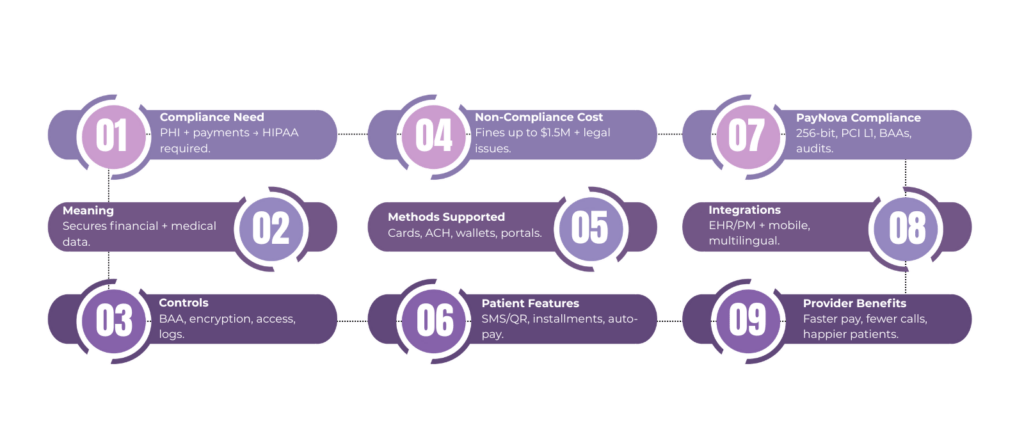
HIPAA violations aren’t minor infractions. The Office for Civil Rights imposes penalties based on violation severity:
- Tier 1 (Unknowing): $100-$50,000 per violation
- Tier 2 (Reasonable cause): $1,000-$50,000 per violation
- Tier 3 (Willful neglect, corrected): $10,000-$50,000 per violation
- Tier 4 (Willful neglect, not corrected): $50,000 per violation
Annual maximums can reach $1.5 million per violation category. But financial penalties are just the beginning. Consider:
- Mandatory breach notifications to every affected patient
- Two years of free credit monitoring for breach victims
- Legal fees defending against class-action lawsuits
- Reputation damage that takes years to rebuild
- Patient loss to competitors with better security
- Operational disruption during federal investigations
In 2023 alone, healthcare data breaches affected over 133 million individuals. Don’t let your practice become a statistic.
Types of HIPAA Compliant Payment Methods
Modern patients expect payment flexibility. The good news? You can offer multiple payment options while maintaining full compliance.
Credit and Debit Card Processing
Credit and debit cards remain the most popular payment method, with 68% of patients preferring card payments for medical bills. HIPAA compliant payment methods supporting credit and debit cards must include:
Point-of-Sale Terminals
Modern countertop terminals with encrypted card readers accept chip cards, magnetic stripe cards, and contactless payments. The best systems prevent card data from ever touching your practice’s computers—it goes directly from the terminal to the secure payment processor.
Virtual Terminals
Accept payments over the phone without storing card numbers. Staff enters payment information into a secure web portal that encrypts data in real-time. This is essential for HIPAA compliant payment methods supporting credit and debit cards in telehealth and phone payment scenarios.
Tokenization
After processing a transaction, the actual card number is replaced with a unique token. Your system stores the token for future payments, but even if your database were compromised, hackers would find useless tokens instead of real card numbers.
EMV Chip Card Support
Chip cards generate unique transaction codes, preventing fraud from stolen card data. Accepting chip cards also shifts fraud liability from your practice to the card issuer—provided you have compliant terminals.
ACH and Bank Transfers
For large payments or patients who prefer direct bank payments, ACH (Automated Clearing House) offers a cost-effective solution. Secure HIPAA compliant payment methods for patient billing via ACH provide:
- Lower processing fees (typically 0.5-1.5% vs 2.5-3.5% for cards)
- Higher transaction limits suitable for expensive procedures
- Reduced chargeback risks compared to credit cards
- Perfect for payment plans with automated recurring charges
PayNova’s ACH processing handles both one-time and recurring payments while maintaining bank-level security and full HIPAA compliance.
Digital Wallets and Mobile Payments
Apple Pay, Google Pay, and Samsung Pay have transformed how consumers pay. Healthcare can leverage these technologies through HIPAA compliant digital payment methods for hospitals that offer:
Enhanced Security
Digital wallets don’t transmit actual card numbers. Instead, they use device-specific tokens and dynamic security codes for each transaction. Even if intercepted, the data is useless to fraudsters.
Biometric Authentication
Fingerprint and facial recognition provide stronger security than PINs or signatures while speeding up checkout.
Patient Convenience
Patients simply tap their phone or watch to pay—no fumbling for wallets or entering card numbers. This modern experience meets patient expectations while maintaining security.
Online Patient Portals
Self-service portals give patients 24/7 access to view statements and make payments. HIPAA compliant online payment methods for medical practices through patient portals deliver:
Secure Login Systems
Multi-factor authentication ensures only legitimate patients access their accounts. After entering a password, patients verify identity through SMS codes, email links, or authenticator apps.
Encrypted Data Transmission
All communication between patients’ devices and your servers travels through encrypted connections (TLS 1.2 or higher), preventing interception.
Payment History Access
Patients view complete payment histories, download receipts, and track insurance claims—all within a secure, compliant environment.
Stored Payment Methods
Patients can securely save payment methods (via tokenization) for one-click future payments. This convenience dramatically increases collection rates. Studies show practices offering patient portals collect payments 50% faster than those relying on mailed statements.
Reduce administrative costs while staying compliant. See PayNova’s transparent pricing and calculate your savings today.
Mobile Payment Solutions
Healthcare increasingly happens outside traditional offices. Home health visits, mobile clinics, and bedside hospital payments require HIPAA compliant payment methods that travel with care providers:
Tablet-Based POS Systems
Nurses and home health aides carry tablets with secure payment apps, accepting payments at point of care. These systems work online or offline, syncing when connectivity returns.
SMS Payment Links
After telehealth appointments, automatically send secure payment links via text message. Patients click the link, enter payment information on an encrypted page, and complete payment in seconds.
QR Code Payments
Print QR codes on paper statements. Patients scan codes with their smartphones, automatically opening secure payment pages with their balance pre-loaded.
Payment Plans and Recurring Billing
With average annual deductibles exceeding $4,500 for family plans, many patients simply can’t afford to pay in full. Payment plans aren’t optional—they’re essential for maximizing collections.
HIPAA compliant payment methods for healthcare transactions must support:
Flexible Installment Schedules
Offer 3, 6, 12-month payment plans customized to patient financial situations. PayNova’s system automatically calculates installment amounts and schedules payments.
Automated Recurring Charges
Once patients enroll in payment plans, the system automatically charges saved payment methods on scheduled dates. This eliminates manual billing work and dramatically reduces missed payments.
Smart Payment Retry Logic
If a payment fails (insufficient funds, expired card), the system automatically retries on alternate dates and notifies patients to update payment information.
Zero-Interest Options
Offering no-interest payment plans encourages patients to enroll while preserving your full revenue. PayNova makes this affordable by reducing administrative costs through automation.
How PayNova Ensures Complete HIPAA Compliance
PayNova isn’t a generic payment processor adapted for healthcare—it’s purpose-built for medical practices. Our HIPAA compliant digital payment methods for hospitals and practices of all sizes provide:
Comprehensive Security Infrastructure
256-Bit Encryption
Military-grade encryption protects all data transmission. Even if intercepted, encrypted data is computationally impossible to decrypt without the proper keys.
PCI-DSS Level 1 Certification
The highest payment card security certification available. This demonstrates our infrastructure meets the strictest standards for processing, storing, and transmitting card data.
Secure Data Centers
Multiple geographically distributed data centers with 24/7 monitoring, biometric access controls, and redundant systems ensure your data stays secure and available.
Regular Security Audits
Independent third-party auditors regularly test our systems, identifying and addressing potential vulnerabilities before they become problems.
Automatic Security Updates
Security patches and updates deploy automatically without service interruptions, keeping your payment processing protected against emerging threats.
Seamless Integration with Healthcare Systems
HIPAA compliant online payment methods for medical practices must work with existing software. PayNova integrates with:
Electronic Health Records (EHRs)
Epic, Cerner, Athenahealth, eClinicalWorks, NextGen, and dozens more. Payments automatically post to patient accounts, eliminating manual data entry.
Practice Management Systems
Kareo, AdvancedMD, DrChrono, CareCloud, TherapyNotes, and others. Billing staff see real-time payment status without switching between systems.
Medical Billing Platforms
For practices using third-party billing services, PayNova provides APIs and batch processing tools ensuring smooth data flow between systems.
Accounting Software
QuickBooks, Xero, and other accounting platforms automatically receive transaction data for accurate financial reporting.
Most integrations complete within 2-3 weeks with dedicated support managing technical details.
Patient-Friendly Experience
Compliance shouldn’t create friction. PayNova’s secure HIPAA compliant payment methods for patient billing prioritize user experience:
Intuitive Interfaces
Clear instructions, large buttons, and logical workflows make payments simple for patients of all technical skill levels.
Mobile-Responsive Design
Payment pages automatically adapt to smartphones, tablets, and desktop computers, providing optimal experiences on any device.
Multiple Language Support
Serve diverse patient populations with interfaces available in Spanish, Chinese, Vietnamese, and other languages common in your community.
Accessibility Compliance
ADA-compliant design ensures patients with disabilities can complete payments independently using screen readers and other assistive technologies.
Real-World Results: Statistics That Matter
Let’s examine data showing why HIPAA compliant payment methods transform healthcare revenue cycles:
- 87% of patients say payment options influence their provider choice
- Practices offering multiple payment methods collect 4x faster than those accepting only checks
- 72% of patients prefer online bill payment to mailed statements
- Digital payment adoption in healthcare grew 156% from 2019 to 2023
- Automated payment reminders increase collection rates by 25-40%
- Practices using patient portals reduce phone call volume by 35%
- 65% of patients with bills over $500 request payment plans
- Offering payment plans increases successful collections by 45%
Making the Switch to PayNova
Transitioning to comprehensive HIPAA compliant payment methods for healthcare transactions is straightforward:
Phase 1: Discovery (Week 1)
Our team analyzes your current payment processes, identifies pain points, and designs a custom solution matching your workflow and patient demographics.
Phase 2: Integration (Weeks 2-3)
Technical integration with your EHR and practice management systems. We handle the heavy lifting while your team continues normal operations.
Phase 3: Training (Week 3)
Comprehensive staff training ensures everyone understands how to process payments, handle exceptions, and answer patient questions.
Phase 4: Launch (Week 4)
Go live with dedicated support monitoring transactions and addressing any issues immediately. Most practices experience seamless transitions.
Ongoing: Optimization
Monthly performance reviews identify opportunities to improve collection rates, reduce costs, and enhance patient satisfaction.
Why Healthcare Providers Choose PayNova
Built for Healthcare Complexity
We understand co-pays, deductibles, insurance adjustments, secondary insurance, and the dozens of other variables making medical billing uniquely complex.
Transparent, Fair Pricing
No hidden fees, no long-term contracts, no surprise charges. Healthcare-specific pricing that makes sense for your revenue cycle.
Exceptional Support
Healthcare-specialized support team available when you need help. No scripted responses—just knowledgeable professionals who understand your challenges.
Proven Compliance Record
Thousands of healthcare providers trust PayNova. We maintain perfect compliance records through proactive monitoring and continuous improvement.
Continuous Innovation
Regular platform updates add new features, payment methods, and security enhancements at no additional cost. Stay ahead of industry changes automatically.
Take Control of Your Revenue Cycle
Every day without optimal HIPAA compliant payment methods costs your practice money. Delayed collections, compliance risks, administrative inefficiencies, and patient frustration add up quickly.
PayNova’s comprehensive payment solutions transform billing from an administrative burden into a competitive advantage. Whether you operate a solo practice or multi-hospital system, our solutions scale to meet your needs.
Stop leaving money on the table. Start collecting faster, staying compliant, and delighting patients.
Reduce administrative costs while staying compliant
What Users Say About AERIS
Dr. Sarah L.
Hospital Administrator
John T.
Telemedicine Provider
Emily P.
Healthcare Executive
Frequently Asked Questions
Q: What’s the difference between HIPAA compliant and regular payment processing?
A: HIPAA compliant payment methods include signed Business Associate Agreements (BAAs), enhanced encryption protecting PHI linked to transactions, comprehensive audit trails, and healthcare-specific security controls. Regular processors lack these protections and refuse legal accountability for healthcare data.
Q: Can we accept payments without storing any patient card data?
A: Yes. PayNova uses tokenization, replacing actual card numbers with secure tokens. Your systems never store sensitive card data, dramatically reducing your security risk and compliance burden while still enabling saved payment methods for patient convenience.
Q: How do HIPAA compliant payment methods handle payment disputes?
A: PayNova maintains complete transaction records with audit trails showing exactly what happened. Our support team assists with dispute resolution while ensuring all communications and documentation maintain HIPAA compliance throughout the process.
Q: What happens if we have a data breach despite using compliant payment methods?
A: While no system eliminates all risk, using HIPAA compliant payment methods with signed BAAs provides legal protection. The payment processor shares liability for breaches occurring in their infrastructure. PayNova also carries comprehensive insurance protecting clients from breach-related costs.
Q: Do patients need to create accounts to use HIPAA compliant online payment methods?
A: Not necessarily. PayNova offers both guest checkout for one-time payments and optional account creation for patients who want to save payment methods, view history, or manage payment plans. The choice is theirs, ensuring maximum convenience.