


Analytics Warehouse
Get Started with a Free Demo
New Keyword Page
New Keyword Page
"*" indicates required fields
Data drives success—but are Indian businesses truly unlocking its potential?
Helixbeat’s analytics warehouse solutions turn scattered, siloed data into clear, actionable insights, helping companies make smarter, faster, and more confident decisions. From bustling retail chains in Bangalore to ambitious startups in Mumbai, organizations are realizing that traditional storage isn’t enough anymore.
With Helixbeat, analytics warehouses do more than store data—they unify multiple sources, deliver advanced reporting, and power predictive analytics. Our fusion analytics warehouse solutions go even further, merging diverse datasets to uncover hidden patterns and opportunities. Meanwhile, data analytics in warehouse management allows businesses to track operations in real-time, optimize inventory, and boost efficiency.
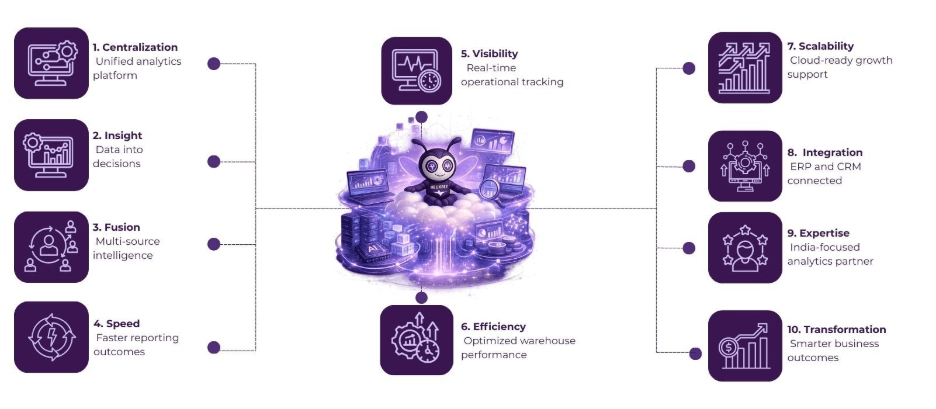
But What Exactly Is an Analytics Warehouse?
An analytics warehouse is a centralized platform that stores, processes, and analyzes data from multiple sources. Unlike traditional storage systems, it is optimized for complex queries and advanced reporting, helping Indian businesses gain actionable insights.
How It Differs from Regular Data Storage
Regular data storage handles raw data but lacks analytical capabilities. Data warehouse analytics supports dashboards, reporting, and predictive analysis, making it essential for Indian organizations looking to compete effectively in a data-driven market.
Why Indian Organizations Need It Now
As digitization accelerates across India, companies face increasing volumes of operational data. An analytics warehouse ensures efficient data management, faster reporting, and informed decision-making—critical for sectors like retail, logistics, banking, and healthcare.
Fusion Analytics Warehouse – Integrating Data for Better Insights
For organizations dealing with diverse datasets, a fusion analytics warehouse combines information from multiple sources into a single view. This integration allows Indian businesses to make faster, data-driven decisions and reduces inefficiencies.
Benefits for Indian Businesses
- Consolidated reporting across departments enhances transparency and planning
- Reduced data silos improve operational efficiency
- Forecasting trends for inventory, sales, and logistics supports strategic decision-making
Stats That Show Its Value
Companies using a fusion analytics warehouse report up to 35% faster reporting and a 25% improvement in decision-making efficiency. For Indian businesses, this translates to better supply chain planning, optimized operations, and revenue growth.
Data Analytics in Warehouse Management – Optimizing Operations
Modern warehouses generate vast amounts of operational data, but this data is only valuable when actionable insights can be extracted. Data analytics in warehouse management consolidates inventory tracking, shipments, and order fulfillment information to reduce operational gaps and improve performance.
Improving Efficiency Through Analytics
Analyzing warehouse data enables Indian organizations to optimize stock levels, reduce delays, forecast demand, and allocate resources efficiently—saving both time and costs.
Example: Real-Time Reporting
A retail chain in Delhi leveraged data analytics in warehouse management to monitor stock movements in real-time. This resulted in a 20% reduction in stockouts and improved fulfillment rates across multiple locations.
Choosing the Right Analytics Warehouse Solution
Selecting the right platform is key to maximizing the benefits of an analytics warehouse. Understanding business needs, scalability, and integration options ensures long-term efficiency.
Assessing Business Needs
Indian businesses should evaluate data volume, number of users, and reporting requirements before choosing a solution. A proper assessment ensures alignment with organizational goals and prevents future inefficiencies.
Cloud vs On-Premises Options
Cloud-based analytics warehouses provide scalability and lower upfront costs, while on-premises solutions offer greater control and security. Many Indian SMEs prefer cloud solutions to minimize infrastructure investment while maintaining flexibility.
Integration Capabilities
Seamless integration with ERP, CRM, and accounting systems is critical. Proper integration reduces errors, minimizes manual work, and improves reporting speed for Indian organizations, ensuring effective data warehouse analytics.
Comparing Analytics Warehouse Types for Indian Businesses
Feature | Cloud Analytics Warehouse | On-Premises Analytics Warehouse | Fusion Analytics Warehouse |
Setup Cost | Low to Moderate | High | Moderate |
Scalability | High | Limited | High |
Maintenance | Vendor-managed | Self-managed | Vendor + Self-managed |
Data Security | High | Very High | High |
Best For | SMEs, Startups | Large Enterprises | Multi-source data organizations |
Helixbeat – The Best Analytics Warehouse Partner for Indian Businesses
Indian businesses today need a partner who can transform scattered data into actionable insights. Helixbeat combines technology expertise and industry knowledge to help organizations leverage data effectively.
Expertise in Analytics Warehouse Solutions
Helixbeat has extensive experience helping Indian businesses implement analytics warehouse solutions tailored to their industry, size, and operational needs. By utilizing data warehouse analytics, we ensure that every solution aligns with organizational goals, supporting smarter decision-making.
Customized Fusion Analytics Warehouse
We design fusion analytics warehouse solutions that integrate multiple data sources, providing consolidated insights for better decision-making. Our approach ensures seamless connectivity between diverse datasets, allowing businesses to gain comprehensive visibility into their operations.
Data Analytics in Warehouse Management
Our solutions optimize warehouse operations, reduce inefficiencies, and support real-time reporting. With data analytics in warehouse management, Indian businesses can track inventory, monitor performance, and enhance operational efficiency.
Dedicated Support and Training
Helixbeat provides hands-on training for teams and continuous support to maximize adoption, ensuring Indian businesses leverage the full potential of their analytics warehouse. Our experts help teams understand and implement best practices, making sure insights are actionable and consistent.
Implementing Analytics Warehouse in Indian Organizations
Implementing an analytics warehouse requires careful planning and execution to ensure data integrity and usability. Helixbeat guides Indian organizations through every step to ensure smooth adoption.
Planning and Data Assessment
Audit existing data sources, define key metrics, and plan workflows for Indian businesses to ensure smooth implementation. This foundational step guarantees that the data warehouse analytics system addresses the organization’s unique requirements.
ETL Process – Extract, Transform, Load
Data is extracted, transformed into a unified format, and loaded into the analytics warehouse, ensuring accuracy and reliability. The ETL process is essential for building a robust fusion analytics warehouse that delivers actionable insights.
Training and Adoption
Employees are trained to use dashboards, analytics tools, and reporting features, ensuring full utilization of the warehouse. Proper adoption empowers teams to make data-driven decisions confidently.
Monitoring and Optimization
Continuous monitoring of performance, reporting speed, and data quality ensures actionable insights remain consistent for Indian organizations. Data analytics in warehouse management supports ongoing optimization, helping businesses adapt to evolving operational needs.
Take Action with Helixbeat Analytics Warehouse
Your data holds the key to smarter decisions. Don’t let it sit idle—transform it into actionable insights today.
Frequently Ask Questions
1. Why is health information exchange important in healthcare?
It improves care coordination, reduces duplicate tests, minimizes errors, and helps providers make timely, data-driven decisions across different healthcare settings.
2. What are the main models of health information exchange?
3. Which standards guide health information exchange?
Standards like FHIR and HL7 define consistent data formats, making it easier for EHRs, HIEs, and other healthcare platforms to exchange information.
4. What are the benefits of using health information exchange?
HIE improves care coordination, reduces healthcare costs, supports population health management, enhances research, and increases operational efficiency.
5. How does AERIS enhance healthcare information exchange?
AERIS leverages FHIR standards, connects legacy systems, automates workflows, reduces manual errors, and provides real-time access to patient records and lab results.
1. What is the difference between a data warehouse and an analytics warehouse?
A data warehouse stores raw data, while an analytics warehouse is optimized for analysis, reporting, and actionable insights.
2. How does fusion analytics warehouse benefit Indian businesses?
It merges multiple data sources, providing a consolidated view for faster, informed decision-making.
3. Can analytics warehouse support real-time data analytics?
Yes, modern solutions allow real-time dashboards and predictive reporting.
4. What is the average cost of implementing an analytics warehouse in India?
Costs vary, but cloud-based solutions are generally affordable for SMEs.
5. How long does it take to implement an analytics warehouse?
Typically, 2–6 months depending on data complexity and integration needs.
6. Can existing ERP or CRM systems be integrated with analytics warehouses?
Yes, most solutions support seamless integration with popular business systems.
7. Is data security a concern for Indian organizations using cloud analytics warehouses?
Cloud providers comply with global and local data security standards to protect sensitive information.