


Handling Errors, Consent, and Data Quality in FHIR Payer-to-Payer Exchange
Get Started with a Free Demo
New Keyword Page
New Keyword Page
"*" indicates required fields
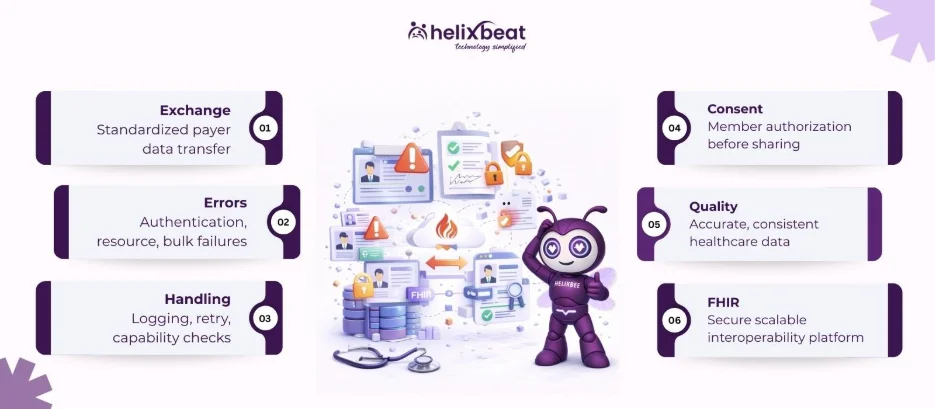
In modern healthcare, FHIR payer-to-payer exchange enables health plans to seamlessly transfer clinical, claims, and administrative data when members switch coverage. As regulators and industry bodies require standardized interfaces for connecting disparate payer systems, it’s important to confront three core aspects of this exchange: error handling, consent workflows, and data quality control. Doing this effectively helps payers move beyond mere regulatory compliance and toward operational reliability and patient‑centric data sharing.
What Is FHIR Payer‑to‑Payer Exchange?
FHIR payer‑to‑payer exchange refers to the standardized transfer of health information — typically US Core Data for Interoperability (USCDI) — between health plans via FHIR APIs. These transfers are triggered when a member requests that their clinical and administrative history be shared with another payer. The goal is to maintain continuity of care, support administrative processes like prior authorizations, and uphold rights under the CMS Payer‑to‑Payer Data Exchange mandate.
This exchange can occur for a single member or in bulk for multiple members using the Bulk FHIR API framework defined under the Da Vinci Payer Data Exchange IG.
The Landscape of Errors in FHIR Payer‑to‑Payer Exchange
When multiple systems interact via APIs, error responses are inevitable. Errors in FHIR payer‑to‑payer exchange can occur at various stages — from initial authentication challenges to data retrieval failures and post‑exchange processing issues.
1. Authentication and Authorization Errors
Authentication errors typically arise when FHIR OAuth 2.0 tokens are invalid, expired, or lack the correct scopes. Under the FHIR model, payers authenticate using standardized token flows before they can query another payer’s resources. These errors often manifest as HTTP 401 or 403 responses with descriptive FHIR OperationOutcome details that indicate security or permissions issues.
For example, missing or insufficient OAuth scopes may block access to vital resources, leading to forbidden responses even when credentials are valid. Therefore, implementations must check that access tokens contain all required resource scopes before issuing requests.
2. Resource‑Level Errors
Once authorized, payers may encounter resource‑level errors. These arise from malformed FHIR resource requests, incorrect query parameters, or unsupported operations on a target server. FHIR servers return structured error information using the OperationOutcome resource, which provides machine‑readable details about the nature of the problem, affected elements, and suggested corrections.
Examples include:
- Invalid search parameters
- Unsupported resource interactions
- Timeouts or system overloads from requesting large datasets
3. Bulk Data‑Specific Failures
When using the Bulk FHIR API for payer‑to‑payer exchange, errors can occur in asynchronous export jobs, such as failures in job initiation, corrupt data bundles, or incomplete payloads. These issues often lead to partial data availability and require job tracking and retry mechanisms to achieve complete transfers.
Error Handling Best Practices for FHIR Payer‑to‑Payer Exchanges
Proactive handling of errors reduces operational friction and improves data exchange reliability:
Structured Response Logging
Capture and persist FHIR OperationOutcome responses as part of API logging. These standardized error messages provide rich detail for debugging and can be fed into monitoring dashboards to highlight recurring issues.
Retry and Back‑Off Logic
For intermittent server or network failures, implement back‑off strategies in API clients. This means progressively delaying retries after transient failures, which mitigates unnecessary load on payer servers during peak exchange windows.
Capability Discovery
Before executing exchange operations, clients should verify server capabilities using FHIR CapabilityStatement resources. This minimizes attempts to execute unsupported interactions that lead to resource‑level errors.
Test Environment Validation
Payers should develop robust test harnesses simulating various error conditions. This allows developers to validate system responses without impacting production traffic, helping identify edge cases early in the implementation cycle.
Member Consent in FHIR Payer‑to‑Payer Exchange
Consent is foundational to any FHIR payer‑to‑payer exchange. Under the Da Vinci Payer Data Exchange Implementation Guide, the requesting (new) payer must obtain member consent before attempting to retrieve data from a prior payer.
How Consent Is Handled
Consent in this context refers to explicit authorization from the member to release their protected health information (PHI) from one payer to another. The exchange workflow mandates inclusion of a FHIR Consent resource with at least minimal content sufficient to validate the request.
Key elements in a consent record typically include:
- Member identity confirmation
- Type of data permitted for release (e.g., everything or limited segments)
- Valid time period for the consent
- The requesting payer’s identity
Consent Revocation
Consent is dynamic. Members may choose to withdraw their authorization after initial granting. The guide specifies that consent revocation workflows should be managed by the new payer, who acts as the primary point of contact during the exchange process. The previous payer retains the right to honor revocation directives provided directly by the member, though this is less common in practice.
Informed Consent Language
Consistent, clear language presented to members when obtaining consent helps reduce misunderstandings and future disputes. This also supports downstream processing because consent resources become a reliable signal in API exchanges that a data request is valid.
Data Quality Considerations in FHIR Payer‑to‑Payer Exchange
Data quality is a pervasive concern in healthcare interoperability, and FHIR payer‑to‑payer exchange is no exception. Poor‑quality data can impair clinical decisions, affect analytics outcomes, and lead to regulatory non‑conformance.
Common Data Quality Issues
Incomplete or Missing Data
Payers often store data in diverse internal formats (e.g., X12 EDI for claims) that must be mapped to FHIR resources. Mapping errors can result in missing or partial FHIR resources, which complicates exchange and downstream consumption.
Inconsistent Identification
Member matching relies on consistent identifiers (like member ID, name, DOB). Inconsistent identifiers across payer systems can lead to mismatches or duplicates and undermine data integrity.
Non‑Standard Implementation Variances
Even with standards like US Core and Da Vinci PDex, slight variances in profile interpretations can cause discrepancies in how data fields are populated or validated.
Temporal and Versioning Issues
Long-term health histories and overlapping coverage often produce conflicting data, which necessitates reconciliation tools to identify the most authoritative records.
Approaches to Improve Data Quality in FHIR Exchanges
Profile Conformance Validation
Before accepting external data, receiving payers should run validation checks against FHIR profiles (e.g., US Core or PDex). This highlights missing fields and incompatibilities.
Mapping and Transformation Governance
Establish governance over how internal formats (like X12 EDI claim feeds) map to FHIR resources. This includes maintaining transformation templates and updating them with evolving implementation guide versions.
Normalization and Standardization
Normalize identifiers and select canonical representation for names and codes. For example, using standardized coding systems (SNOMED CT, LOINC) improves consistency when aggregating data from different sources.
Cross‑Payer Quality Benchmarking
Peer benchmarking with partner payers can expose systematic disparities. Joint exercises — like shared test suites — help align expectations and reduce exchange friction.
The Power of FHIR Servers in Payer-to-Payer Exchange
A FHIR server is the backbone of FHIR payer-to-payer exchanges. It manages how information flows between payers, which helps reduce errors, respect member consent, and maintain data quality.
With a strong FHIR server in place, payers can handle large volumes of data efficiently, track issues quickly, and provide consistent, accurate information to other systems. This creates a streamlined, trustworthy exchange environment that supports better operational outcomes and improved collaboration across healthcare networks.
How FUSION Contributes to the Process
FHIR servers, like FUSION, built on RESTful APIs, are the backbone of FHIR Payer-to-Payer interoperability. It enables seamless data exchange between payers and providers by utilizing modern web technologies and secure data-sharing protocols.
Here’s how FUSION contributes to FHIR Payer-to-Payer:
Fast Data Exchange
FHIR RESTful APIs enable fast, efficient data exchange. By using simple HTTP methods (GET, POST, PUT, DELETE), healthcare organizations can request or update data as needed. This reduces delays and ensures that payers have access to the most current patient information in real time.
Simplified Integration
FUSION offers easy integration with existing healthcare systems, including EHRs, payer platforms, and telemedicine applications. This allows payers to exchange data seamlessly without needing to overhaul their entire infrastructure.
Secure Communication
With OAuth 2.0 and SMART on FHIR, FUSION protects sensitive health data during transmission. These security mechanisms help prevent unauthorized access and ensure that patient information is kept safe while being exchanged between payers.
Certified Excellence
FUSION is officially certified by the Drummond Group for FHIR-based interoperability, validating its conformance with healthcare data exchange standards HL7, FHIR, and SMART on FHIR. This certification demonstrates that FUSION meets industry-recognized benchmarks for secure, standardized data exchange — giving you the confidence to integrate seamlessly across systems.
Implementing FHIR payer‑to‑payer exchange involves thoughtful integration of error‑handling protocols, robust consent workflows that respect member authorization, and ongoing attention to data quality across interconnected systems.
If you’re ready to bring FHIR Payer-to-Payer interoperability into your healthcare ecosystem, it’s time to leverage the power of FUSION.
Frequently Ask Questions
1. Why is health information exchange important in healthcare?
It improves care coordination, reduces duplicate tests, minimizes errors, and helps providers make timely, data-driven decisions across different healthcare settings.
2. What are the main models of health information exchange?
3. Which standards guide health information exchange?
Standards like FHIR and HL7 define consistent data formats, making it easier for EHRs, HIEs, and other healthcare platforms to exchange information.
4. What are the benefits of using health information exchange?
HIE improves care coordination, reduces healthcare costs, supports population health management, enhances research, and increases operational efficiency.
5. How does AERIS enhance healthcare information exchange?
AERIS leverages FHIR standards, connects legacy systems, automates workflows, reduces manual errors, and provides real-time access to patient records and lab results.
1. What is FHIR payer-to-payer exchange?
FHIR payer-to-payer exchange is the standardized transfer of health and administrative data between health plans, allowing continuity of care when a member changes coverage.
2. How does a FHIR server support payer-to-payer exchange?
A FHIR server stores and serves health data while managing errors, validating consent, and maintaining data quality to enable smooth and reliable exchanges.
3. Why is consent important in FHIR payer-to-payer exchanges?
Consent authorizes the transfer of a member’s health information from one payer to another. It protects patient privacy and helps comply with regulatory requirements.
4. What are common errors in FHIR payer-to-payer exchange?
Common errors include authentication failures, malformed queries, unsupported operations, and incomplete or invalid data bundles. These are communicated via FHIR OperationOutcome resources.
5. How can payers maintain data quality in FHIR exchanges?
Payers maintain data quality by validating resources against profiles, normalizing identifiers, standardizing coding systems, and performing cross-payer data verification.