


Electronic Health Record API
Get Started with a Free Demo
New Keyword Page
New Keyword Page
"*" indicates required fields
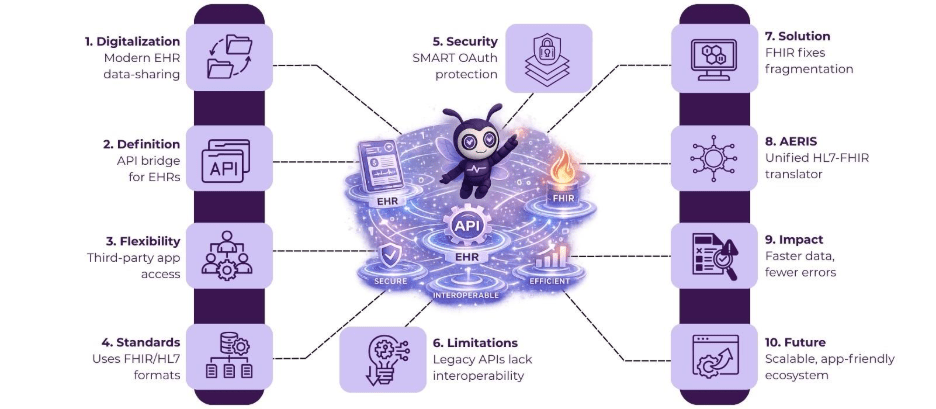
As healthcare goes digital, EHR APIs have become the go-to way for doctors and hospitals to share patient info quickly and securely. By acting as a universal translator, this interface enables different systems to share data smoothly, so patients and their doctors are always on the same page. Adopted widely since the 2010s through regulations like the Health IT Certification Criteria, this technology has become integral to modern electronic health records (EHRs). With standards guiding its implementation, the electronic health record API addresses long-standing challenges in data silos.
What is an Electronic Health Record API?
An electronic health record API serves as a bridge between EHR systems and other software applications. It enables developers to build tools that interact with patient records without disrupting core EHR functionality. For example, APIs integrated into EHRs permit third-party apps to pull data for patient portals or analytics platforms, building a connected ecosystem. Technically, an electronic health record API operates through protocols like RESTful services, supporting formats such as JSON or XML for data transmission.
Many modern EHR APIs provide endpoints for querying patient conditions or demographics, structured as URLs that specify namespaces and paths. Likewise, cloud-based healthcare APIs support standardized formats like FHIR, HL7v2, and DICOM, providing managed capabilities for data ingestion, normalization, and secure storage. In addition, universal EHR APIs simplify integrations across multiple systems. In practice, an electronic health record API empowers patients to share records via mobile apps, aligning with regulations that mandate API access in certified health IT.
Key Standards for Modern Electronic Health Record API
FHIR, developed by HL7, is a leading standard for exchanging healthcare data electronically. It uses RESTful APIs and supports JSON, XML, or RDF formats, making implementation straightforward. FHIR combines features from prior HL7 versions while emphasizing web technologies for rapid adoption.
HL7, established in 1987, provides foundational messaging protocols. Version 2 focuses on real-time transfers, while FHIR modernizes it for apps and analytics. CMS and ONC rules since 2020 require FHIR APIs for data exchange between providers, payers, and patients.
SMART on FHIR enhances security with OAuth, enabling apps to launch directly from EHR interfaces. These standards facilitate modular data sharing, overcoming legacy system limitations.
Limitations of Traditional EHR APIs
While many EHR platforms expose APIs, not all interfaces are designed for modern interoperability. Some EHR APIs rely on vendor-specific schemas that vary widely between systems. This forces developers to build custom integrations for each platform, which increases development time and long-term maintenance costs. In addition, traditional APIs often focus on internal workflows rather than external data sharing. As a result, exchanging information across organizations, applications, or care settings becomes fragmented.
Similarly, older APIs were not designed for modern, app-based ecosystems. They lack RESTful design patterns, granular resource access, or standardized authentication, which limits their suitability for scalable third-party applications. FHIR resolves many of these challenges by offering a standardized, flexible, and scalable approach to data exchange.
AERIS: Streamlining Electronic Health Record Systems Through FHIR
AERIS, by Helixbeat, acts as a translator for your EHR, using standards like HL7 and FHIR to tie all your data into one neat, unified system. This approach simplifies electronic health record integration by automating data mapping and validation.
Ready to cut delays by 50%, double your ROI, and empower your team with instant access to critical data? Let’s dive into why AERIS is the solution you’ve been waiting for.
Why AERIS is Your Key to Healthcare Innovation
At Helixbeat, we know your challenges: fragmented systems, delayed data, and rising costs. AERIS is here to change that, offering a personalized, scalable, and secure platform that fits your unique needs. Whether you’re a small clinic or a sprawling hospital network, AERIS delivers measurable results that elevate patient outcomes and boost your bottom line.
- 20+ Years of Expertise: Our team brings decades of healthcare IT experience to ensure AERIS works for you.
- 50+ IT Professionals: A dedicated crew powers AERIS, delivering unmatched support and innovation.
- 1,000+ Customers: Join a thriving community of healthcare leaders already transforming with AERIS.
- 10,000+ Projects Completed: Proven success across countless integrations and workflows.
- 95% Returning Customers: Our clients trust AERIS to deliver, time and time again.
Providers adopting AERIS report faster diagnoses, lower costs, and improved outcomes, positioning it as the go-to tool for future-proof HIE.
The AERIS Advantage: Numbers That Speak for Themselves
Metric | Without AERIS | With AERIS | Your Benefit |
Data Exchange Delays | Frequent bottlenecks | Reduced by 50% | Faster care in emergencies |
Return on Investment | Slow, costly overhauls | 100% faster ROI | Grow without breaking the bank |
Operational Costs | High redundancies | Cut by 30% | Save thousands annually |
Error Rates | Up to 20% manual errors | Slashed by 90% | Precision for better patient outcomes |
Your Benefits, Amplified
- 50% Fewer Delays: Real-time data means critical information is always at your fingertips, turning hours into seconds.
- 100% Faster ROI: Plug-and-play integration maximizes your investment without expensive system replacements.
- 30% Cost Savings, 90% Fewer Errors: Automation eliminates waste, saving resources and ensuring accuracy.
How AERIS Works: Your 3-Step Path to Success
- Connect Seamlessly: Integrate AERIS effortlessly into your existing systems, from legacy EHRs to modern platforms.
- Share Securely: Activate real-time data exchange with HIPAA-compliant encryption. Watch your teams and partners collaborate effortlessly.
- Optimize and Grow: Because AERIS evolves with your organization, it’s set up to help you succeed for the long haul.
Final Thoughts
Electronic health record APIs have become a foundational component of modern healthcare interoperability. However, as healthcare ecosystems expand and patient expectations rise, the limitations of traditional, proprietary APIs are becoming increasingly evident. Standards such as FHIR address these gaps by offering a flexible, scalable framework that supports real-time access, modern app development, and regulatory alignment.
AERIS offers a practical way forward. Built around FHIR and HL7 standards, AERIS simplifies electronic health record integration, accelerates data exchange, and delivers measurable operational gains without disruptive system overhauls.
Ready to reduce delays, improve ROI, and unlock real-time access to critical healthcare data?
Frequently Ask Questions
1. Why is health information exchange important in healthcare?
It improves care coordination, reduces duplicate tests, minimizes errors, and helps providers make timely, data-driven decisions across different healthcare settings.
2. What are the main models of health information exchange?
3. Which standards guide health information exchange?
Standards like FHIR and HL7 define consistent data formats, making it easier for EHRs, HIEs, and other healthcare platforms to exchange information.
4. What are the benefits of using health information exchange?
HIE improves care coordination, reduces healthcare costs, supports population health management, enhances research, and increases operational efficiency.
5. How does AERIS enhance healthcare information exchange?
AERIS leverages FHIR standards, connects legacy systems, automates workflows, reduces manual errors, and provides real-time access to patient records and lab results.
1. How does FHIR improve electronic health record APIs?
FHIR provides standardized data models and RESTful APIs, making integrations easier to build, maintain, and scale across systems.
2. Are all EHR APIs based on FHIR?
No. While most modern EHR APIs are FHIR-based, some older systems still rely on proprietary or legacy interfaces.
3. What challenges do traditional EHR APIs present?
Traditional APIs often use vendor-specific schemas, lack standardized authentication, and require custom integrations for each system.
4. How does AERIS support EHR interoperability?
AERIS uses HL7 and FHIR standards to automate data mapping, validation, and exchange across diverse healthcare systems.