


Data Analytics for Healthcare Providers
Get Started with a Free Demo
New Keyword Page
New Keyword Page
"*" indicates required fields
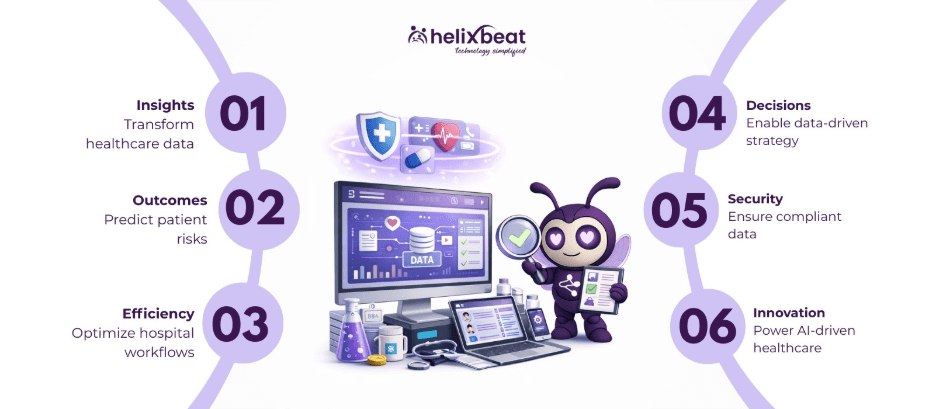
Imagine a healthcare system where every decision is backed by precise, actionable data. With data analytics for healthcare providers, this is no longer a distant dream—it’s a reality. Helixbeat DaaS empowers hospitals, clinics, and healthcare organizations to consolidate, analyze, and act on massive volumes of patient and operational data. From streamlining workflows to predicting patient outcomes, the potential of analytics transforms how care is delivered and how decisions are made.
Healthcare providers can now move beyond reactive care and adopt a proactive, data-driven approach. With the right tools, insights from patient records, treatment histories, and operational metrics become clear, helping providers improve quality, reduce costs, and enhance overall patient satisfaction.
Why Healthcare Provider Analytics is Essential
Healthcare organizations generate massive amounts of data daily and leveraging it effectively can transform care delivery. Healthcare provider analytics enables clinicians and administrators to turn this data into actionable insights for better patient outcomes and operational efficiency.
Enhancing Patient Outcomes
With healthcare provider analytics, clinicians can identify patterns and predict outcomes, enabling timely interventions. Predictive analytics for healthcare companies help manage chronic diseases, reduce readmissions, and monitor high-risk patients efficiently.
Streamlining Hospital Operations
Data analytics highlight operational inefficiencies such as patient wait times, bed utilization, and staff allocation. Addressing these areas leads to smoother workflows, reduced bottlenecks, and higher patient satisfaction.
Supporting Strategic Decisions
Data-driven dashboards allow hospital leadership to make informed decisions on resource allocation, budgeting, and growth planning, improving overall operational strategy and patient care.
Key Use Cases of Data Analytics Healthcare Companies Rely On
Modern healthcare organizations rely on insights from structured and unstructured data to make informed decisions. Data analytics for healthcare providers provides actionable intelligence across clinical, operational, and administrative functions.
Predictive Analytics for Patient Care
Predictive analytics for healthcare companies identifies potential health risks before they escalate, reducing complications and improving patient outcomes.
Population Health Management
By analyzing demographic and historical patient data, hospitals can design targeted interventions that improve community health and reduce long-term costs.
Fraud Detection and Billing Accuracy
Data analytics detect irregularities in claims and billing, helping prevent fraud while ensuring accurate reimbursement for healthcare providers.
Real-Time Operational Insights
Providers can monitor performance metrics in real-time, from ER efficiency to surgical team effectiveness, enabling timely adjustments and improved patient experiences.
Helixbeat DaaS – Transforming Healthcare Data Analytics
A unified platform simplifies the complexities of managing healthcare data, making insights accessible and actionable. Helixbeat DaaS, one of the best predictive analytics healthcare companies, empowers organizations to consolidate, analyze, and act on critical information.
Centralized Data Platform
Helixbeat DaaS integrates data from multiple sources—including EHRs, lab systems, and claims databases—into a single platform, ensuring consistent, accurate reporting across the organization.
Scalable Cloud Architecture
Our cloud-based insurance and healthcare data analytics model scales with organizations of any size, supporting both small clinics and large hospital networks without compromising performance.
Advanced Predictive Analytics
Helixbeat DaaS leverages AI and machine learning to forecast patient risks, identify operational bottlenecks, and optimize resource allocation, empowering proactive, data-driven decisions.
Compliance and Security
Strict adherence to HIPAA and GDPR standards ensures that sensitive patient data is protected while remaining accessible to authorized personnel for analytics and operational use.
Types of Analytics for Healthcare Providers
Healthcare organizations use multiple types of analytics to convert data into meaningful insights. Each type serves a unique purpose, helping providers improve outcomes and operational performance.
Analytics Type | Purpose | Example in Healthcare |
Descriptive Analytics | Understand historical trends and performance | Monthly readmission rates |
Diagnostic Analytics | Analyze why certain events occurred | Investigating spikes in ER visits |
Predictive Analytics | Forecast potential outcomes | Predicting high-risk patients |
Prescriptive Analytics | Suggest actions to optimize outcomes | Recommending treatment plans based on predictive models |
Descriptive Analytics
Descriptive analytics provides a clear snapshot of past performance, helping providers understand trends in patient care, resource utilization, and operational efficiency.
Diagnostic Analytics
By identifying the root cause of operational or clinical issues, diagnostic analytics enables hospitals to reduce inefficiencies and prevent recurring problems.
Predictive Analytics
Predictive analytics for healthcare companies anticipates patient risks and operational challenges, allowing proactive interventions that save time, costs, and improve patient outcomes.
Prescriptive Analytics
Prescriptive analytics goes beyond prediction, recommending the best courses of action based on predictive models and real-time operational data, helping providers optimize treatment plans and workflows.
Benefits of Implementing Healthcare Provider Analytics
Healthcare organizations are leveraging insights from data to enhance patient care and operational efficiency. Healthcare provider analytics allows providers to make informed, proactive decisions that improve outcomes and reduce costs.
Improved Clinical Decisions
By using data analytics for healthcare providers, clinicians gain accurate insights into patient conditions, enabling better diagnostics and personalized treatment plans. This empowers care teams to act promptly and effectively.
Cost Reduction and Resource Optimization
Analyzing operational and financial data helps identify unnecessary expenditures, streamline processes, and optimize staff allocation, ultimately reducing costs across the organization.
Enhanced Patient Engagement
Understanding patient behavior, history, and treatment adherence allows providers to tailor communications, reminders, and interventions, fostering higher engagement and improving health outcomes.
Performance Monitoring and Insights
Analytics dashboards track key metrics, including patient satisfaction, readmission rates, and operational efficiency. Providers can benchmark performance, identify improvement areas, and implement evidence-based strategies.
Challenges Healthcare Providers Face with Analytics
While analytics offers tremendous benefits, healthcare organizations encounter challenges in implementation. Recognizing these hurdles ensures successful adoption and measurable impact.
Data Quality and Integration
Multiple systems and inconsistent data formats can limit the accuracy of insights. Consolidating data through data analytics healthcare companies like Helixbeat DaaS addresses integration issues and improves reliability.
Privacy and Compliance
Handling sensitive patient data requires strict adherence to HIPAA, GDPR, and other regulations. Helixbeat DaaS incorporates robust security protocols to maintain compliance and protect privacy.
Staff Adoption
For analytics to be effective, clinicians and administrative staff must adopt it. User-friendly dashboards and intuitive tools encourage engagement, enabling widespread adoption and optimal results.
Scaling Analytics Efforts
As healthcare organizations grow, analytics solutions must scale seamlessly to handle increasing volumes of patient and operational data without sacrificing speed or performance.
Future Trends in Healthcare Data Analytics
The healthcare industry is evolving rapidly, and emerging technologies are shaping the next generation of analytics. Predictive analytics for healthcare companies is central to driving innovation and better patient outcomes.
AI and Machine Learning
AI-powered models enhance predictive accuracy for diagnostics, risk assessment, and hospital operations, enabling clinicians to anticipate challenges and intervene proactively.
Real-Time Monitoring
Wearables, IoT devices, and smart sensors provide continuous patient data, enabling immediate decision-making and more responsive care delivery.
Personalized Medicine
Advanced analytics allows for precision treatments tailored to an individual’s genetics, medical history, and lifestyle, improving efficacy and patient satisfaction.
Cloud-Based Healthcare Analytics
Cloud adoption expands access to advanced analytics platforms, allowing providers of all sizes to leverage powerful insights without heavy infrastructure investments.
Act Now With Helixbeat DaaS
Unlock the full potential of your healthcare data with actionable insights from data analytics for healthcare providers. Helixbeat DaaS empowers organizations to transform operations, enhance patient care, and drive measurable results.
Frequently Ask Questions
1. Why is health information exchange important in healthcare?
It improves care coordination, reduces duplicate tests, minimizes errors, and helps providers make timely, data-driven decisions across different healthcare settings.
2. What are the main models of health information exchange?
3. Which standards guide health information exchange?
Standards like FHIR and HL7 define consistent data formats, making it easier for EHRs, HIEs, and other healthcare platforms to exchange information.
4. What are the benefits of using health information exchange?
HIE improves care coordination, reduces healthcare costs, supports population health management, enhances research, and increases operational efficiency.
5. How does AERIS enhance healthcare information exchange?
AERIS leverages FHIR standards, connects legacy systems, automates workflows, reduces manual errors, and provides real-time access to patient records and lab results.
1. What is data analytics for healthcare providers?
Data analytics for healthcare providers involve using data from patient records, operations, and claims to derive insights for better decision-making.
2. How can Helixbeat DaaS help my hospital?
Helixbeat DaaS centralizes data, provides predictive analytics, ensures compliance, and helps optimize operations and patient outcomes.
3. What types of analytics do healthcare providers use?
Healthcare providers use descriptive, diagnostic, predictive, and prescriptive analytics to understand trends, forecast outcomes, and recommend actions.
4. Are there security risks with healthcare analytics?
Helixbeat DaaS maintains strict HIPAA and GDPR compliance, ensuring patient data is secure while remaining accessible to authorized staff.
5. Can small clinics benefit from healthcare analytics?
Absolutely. Cloud-based solutions like Helixbeat DaaS scale with organizations, making analytics accessible and affordable for clinics of all sizes.