


EHR Interoperability
Get Started with a Free Demo
New Keyword Page
New Keyword Page
"*" indicates required fields
In modern healthcare systems, exchanging clinical data across disparate applications and vendors is critical for delivering timely, accurate care. Managing clinical data across disparate applications and vendors is critical for delivering timely, accurate care. EHR interoperability solutions aim to connect electronic health record (EHR) systems so that data flows freely between providers, payers, and patients. However, interoperability involves interpreting and using data consistently across systems. This is where the semantic layer plays a key role.
A semantic layer in EHR interoperability bridges differences in clinical meaning that arise when systems encode data differently. Without a semantic layer, a diagnosis coded in one system may not be interpreted correctly by another, even if technical standards like FHIR or HL7 are followed. Semantic layer implementation focuses on mapping clinical meaning, standardizing terminologies, and aligning data structures so that shared healthcare information is both machine‑readable and clinically interpretable.
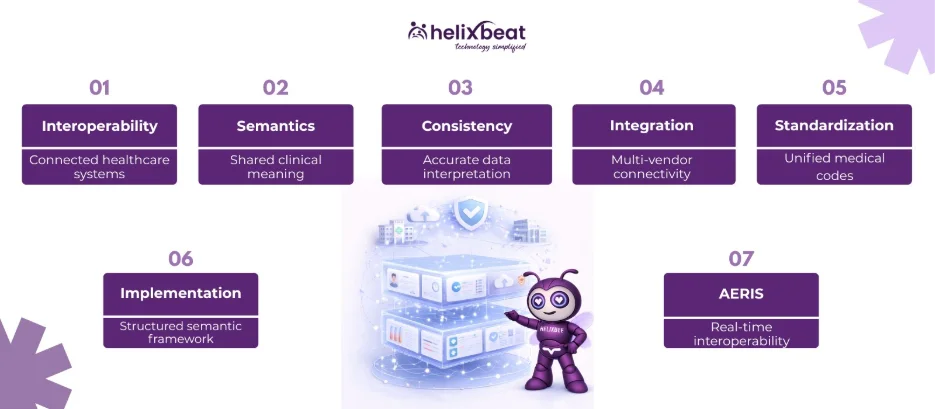
Why Semantic Layer Matters for EHR Interoperability Solutions
When we talk about EHR interoperability solutions, the focus often defaults to transport protocols and APIs. While those technical components are necessary, they only carry the data; they do not define how that data should be interpreted or used.
Here are the key reasons semantic layers matter:
1. Clinical Consistency
Healthcare providers need clinical information that is consistent in meaning across systems. For example, if one system records “SBP” as systolic blood pressure, the receiving system needs to interpret and display it in the same medical context.
2. Data Reuse and Research
Semantic alignment supports the reuse of clinical data for analytics, quality reporting, population health, and research. Without semantic clarity, aggregated data may be inconsistent, misleading, or incomplete.
3. Multi‑Vendor Ecosystems
Health systems often include a mix of EHRs, labs, imaging systems, and specialty apps. Semantic mapping allows these heterogeneous systems to participate in integrated workflows.
4. Patient Safety
Misinterpretation of clinical records due to semantic gaps can introduce patient safety risks, such as incorrect medication lists or missed alerts.
Key Components of a Semantic Layer
Implementing a semantic layer for EHR interoperability solutions typically involves several technical and architectural elements:
1. Terminology Services
Terminology services provide standardized clinical vocabulary and mappings between code systems. These services help transform concepts across different coding schemes, like:
- SNOMED CT (Systematized Nomenclature of Medicine – Clinical Terms)
- LOINC (Logical Observation Identifiers Names, and Codes)
- ICD‑10 (International Classification of Diseases, Tenth Revision)
- RxNorm (Normalized Names for Clinical Drugs)
Terminology servers store these vocabularies and provide APIs to translate, validate, and normalize clinical codes.
2. Ontology and Concept Mapping
Ontologies define relationships between clinical concepts (e.g., “diabetes mellitus” is a type of “endocrine disorder”). A semantic layer uses ontologies to reason about data, derive inferred meanings, and perform complex queries.
3. Metadata Registries
Metadata registries catalog data elements with context, definitions, and relationships. These registries help maintain consistency in how data is interpreted across systems.
4. Semantic Normalization Engines
These systems preprocess incoming records, match terms to standardized vocabularies, and convert them into canonical representations. They help align data from various sources before storage or analysis.
5. Context Management
Clinical context, such as encounter type, patient condition, or lab reference ranges, affects interpretation. Semantic layers often include contextual rules that modify meaning based on the situation.
How to Implement a Semantic Layer for EHR Interoperability
Implementing a semantic layer is a multi‑stage effort that involves planning, technical tooling, testing, and governance. Here is a step‑by‑step approach:
Step 1: Assess Existing Systems and Data
The first phase involves cataloging your current EHR systems, data flows, and clinical data formats. Highlight these:
- EHR vendors and versions
- Types of clinical information exchanged
- Existing standards used (FHIR, HL7 v2, CDA, etc.)
- Data repositories and analytics tools
Conduct a data quality assessment to identify inconsistent terminology, missing values, and incompatible code sets.
Step 2: Define Your Semantic Goals
Clearly state what you want your semantic layer to achieve. Common goals include:
- Standardize laboratory results across systems
- Harmonize problem lists and diagnoses
- Enable population health reporting
- Support clinical decision support workflows
Your goals determine which vocabularies, mappings, and tools are needed.
Step 3: Choose Terminology Services and Tools
Select a terminology server that can host and manage standardized vocabularies. Options include:
- Open‑source servers
- Commercial terminology engines
- Cloud services from major healthcare cloud providers
The chosen platform should support:
- Code validation and lookup
- Cross‑code translations
- Versioning
- Terminology subscriptions and updates
Step 4: Map Local Codes to Standard Codes
This is a technical but critical stage. Local codes (proprietary or system‑specific) need to be mapped to standard codes like SNOMED CT or LOINC. Mapping tasks include:
- Creating equivalence tables
- Handling partial matches
- Tracking data provenance
A combination of automated tools and clinician review is recommended to improve accuracy.
Step 5: Build Semantic Normalization Pipelines
Ingest clinical data and execute normalization tasks such as:
- Transforming local observations to standardized representations
- Harmonizing unit sets for measurements
- Normalizing values to reference models
This pipeline can operate in near‑real time or as batch preprocessing before data storage and analytics.
Step 6: Integrate With Interoperability Frameworks
Once data is semantically normalized, integrate it with your interoperability framework:
- FHIR APIs receive payloads and reference standardized codes
- Terminology servers handle API calls for code translation
- Semantic middleware can transform incoming and outgoing messages
Integrate logging and auditing to track semantic transformations.
Step 7: Test and Validate Semantic Interpretation
Quality assurance is important. Perform the following tests:
- Compare original and normalized data for clinical consistency
- Validate mappings with clinical SMEs (subject matter experts)
- Test API responses for expected semantic output
- Simulate real‑world interoperability scenarios
Testing verifies that consumers of the data, whether apps, analytics engines, or EHR systems, interpret semantic output correctly.
AERIS: Semantic Consistency and Real‑Time EHR Interoperability
What separates basic data transport from intelligent interoperability is the ability to interpret and align the meaning of data across systems — exactly the role AERIS plays in modern healthcare integration.
What Is AERIS?
AERIS is an advanced interoperability platform designed to facilitate real‑time data sharing, transformation, and interpretation across disparate healthcare systems. It operates as a middleware solution that connects systems, harmonizes data semantics, and enables seamless interaction between legacy and modern applications.
Unlike simple API gateways or point‑to‑point connectors, AERIS tackles not just syntax (how data is formatted) but also semantic consistency — meaning it helps different systems interpret the same information in the same way, regardless of their native formats or standards.
How AERIS Helps Semantic Interoperability in EHR Interoperability Solutions
1. Standardized Terminology and Ontology Use
AERIS leverages widely accepted clinical terminologies and ontologies, like SNOMED CT for clinical concepts and LOINC for lab observations, to map various data points into a unified representation. By aligning local vocabularies to global clinical codes, it maintains the intended meaning of patient information across systems.
2. Protocol and Format Versatility
Healthcare environments often contain a mix of legacy systems and modern platforms. AERIS supports multiple data exchange protocols, including HTTP, FTP, MQTT, and SOAP, which allows it to translate and mediate between older, proprietary systems and modern FHIR‑based applications.
3. Real‑Time Semantic Exchange
One of the biggest bottlenecks in healthcare interoperability is time lags. AERIS handles real‑time streaming of normalized, semantically consistent data. This is particularly valuable in critical care scenarios where instant access to patient histories, labs, and clinical events can affect outcomes.
Why AERIS is Your Key to Healthcare Innovation
At Helixbeat, we know your challenges: fragmented systems, delayed data, and rising costs. AERIS is here to change that, offering a personalized, scalable, and secure platform that fits your unique needs. Whether you’re a small clinic or a sprawling hospital network, AERIS delivers measurable results that elevate patient outcomes and boost your bottom line.
- 20+ Years of Expertise: Our team brings decades of healthcare IT experience to ensure AERIS works for you.
- 50+ IT Professionals: A dedicated crew powers AERIS, delivering unmatched support and innovation.
- 1,000+ Customers: Join a thriving community of healthcare leaders already transforming with AERIS.
- 10,000+ Projects Completed: Proven success across countless integrations and workflows.
- 95% Returning Customers: Our clients trust AERIS to deliver, time and time again.
Providers adopting AERIS report faster diagnoses, lower costs, and improved outcomes, positioning it as the go-to tool for future-proof HIE.
Your Benefits, Amplified
- 50% Fewer Delays: Real-time data means critical information is always at your fingertips, turning hours into seconds.
- 100% Faster ROI: Plug-and-play integration maximizes your investment without expensive system replacements.
- 30% Cost Savings, 90% Fewer Errors: Automation eliminates waste, saving resources and ensuring accuracy.
Semantic layer implementation transforms EHR interoperability from basic data transport into meaningful, clinically accurate data exchange. When done well, it unlocks consistent clinical insights across systems, supports advanced analytics, and strengthens workflows within and across healthcare organizations.
Frequently Ask Questions
1. Why is health information exchange important in healthcare?
It improves care coordination, reduces duplicate tests, minimizes errors, and helps providers make timely, data-driven decisions across different healthcare settings.
2. What are the main models of health information exchange?
3. Which standards guide health information exchange?
Standards like FHIR and HL7 define consistent data formats, making it easier for EHRs, HIEs, and other healthcare platforms to exchange information.
4. What are the benefits of using health information exchange?
HIE improves care coordination, reduces healthcare costs, supports population health management, enhances research, and increases operational efficiency.
5. How does AERIS enhance healthcare information exchange?
AERIS leverages FHIR standards, connects legacy systems, automates workflows, reduces manual errors, and provides real-time access to patient records and lab results.
1. How does AERIS support semantic interoperability?
AERIS acts as a middleware platform that harmonizes data semantics, maps local codes to standardized vocabularies like SNOMED CT and LOINC, and enables real-time, semantically consistent exchange across diverse healthcare systems.
2. Why is semantic interoperability important for patient care?
Semantic interoperability ensures that clinical information retains its meaning across systems, supporting accurate decision-making, reducing errors, and improving care coordination.
3. Which standards are essential for semantic layer implementation?
Key standards include FHIR for modular data resources, HL7 and CDA for message structures, SNOMED CT and LOINC for clinical terminology.
4. What are the best practices for semantic layer implementation?
Best practices include collaborating with clinical SMEs, documenting mappings, using standardized vocabularies, measuring semantic quality, and maintaining ongoing governance and version control.