


Healthcare Data Integration Software
Get Started with a Free Demo
New Keyword Page
New Keyword Page
"*" indicates required fields
Today, we’re seeing a ton of data shifting across healthcare platforms daily. From electronic health records (EHRs) to lab results and wearable device metrics, healthcare providers manage an overwhelming volume of data, and healthcare data integration software brings these scattered data points together into one clear, easy-to-reach place. This technology enables organizations to achieve a 360-degree view of patient information. As the industry shifts toward value-based care, understanding healthcare data integration software becomes important for professionals aiming to enhance operational workflows and patient experiences.
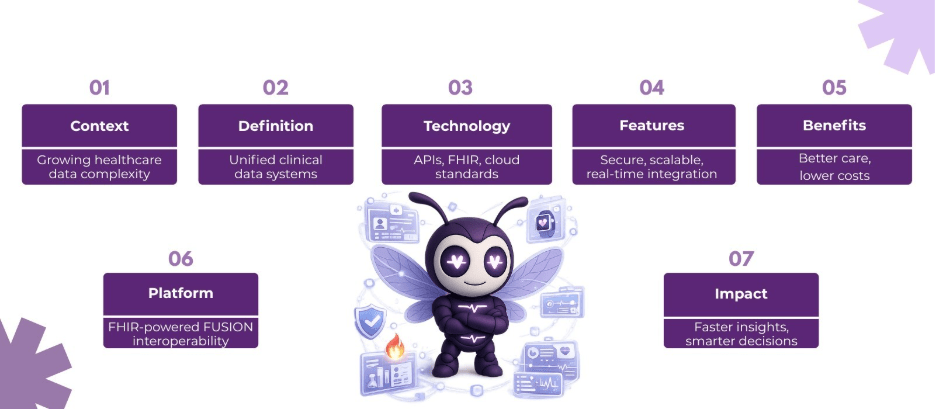
What is Healthcare Data Integration Software?
Healthcare data integration software refers to specialized platforms designed to merge information from multiple sources within the medical ecosystem. These sources include EHRs, enterprise resource planning (ERP) systems, human resources management tools, claims databases, and public health repositories. By unifying this data, the software creates a single source of truth and eliminates silos.
At its core, healthcare data integration software employs technologies such as application programming interfaces (APIs), extract-transform-load (ETL) processes, and cloud-based platforms to facilitate seamless data exchange. Standards like Health Level Seven (HL7) and Fast Healthcare Interoperability Resources (FHIR) play pivotal roles in this process.
This software addresses the fragmentation common in healthcare settings, where data might reside in legacy systems or modern cloud environments. By using automated pipelines, the system processes all your data and delivers clear, actionable insights. Organizations can then leverage this integrated data for analytics, reporting, and predictive modeling, ultimately supporting better clinical and administrative functions.
Key Features of Healthcare Data Integration Software
Effective healthcare data integration software incorporates several features. First, robust data mapping and transformation capabilities allow the software to handle diverse formats, converting them into standardized structures for consistency. This includes support for big data analytics, where large volumes from wearables and imaging devices are aggregated without loss of integrity.
Security and compliance tools form another cornerstone, with built-in encryption, access controls, and adherence to regulations like HIPAA. These features protect sensitive patient information during transfer and storage. Real-time integration is also a key attribute, enabling immediate updates across systems for timely decision-making.
Additionally, scalability through cloud-based solutions stands out, accommodating growing data needs without significant infrastructure investments. User-friendly interfaces, including no-code environments, empower non-technical staff to manage integrations. Other notable features include advanced validation mechanisms, such as those in FHIR servers, which maintain data quality by enforcing profiles and structures.
Benefits of Implementing Healthcare Data Integration Software
Adopting healthcare data integration software yields multiple advantages that directly impact patient care and organizational performance. One primary benefit involves enhanced patient outcomes through comprehensive data access. As a result, providers gain a holistic view of medical histories, enabling accurate diagnoses and personalized treatment plans.
Operational efficiency improves significantly as administrative tasks are streamlined. This leads to cost reductions, with integrated systems minimizing redundant processes and optimizing resource allocation. Studies indicate that such integrations can lower operational expenses by unifying data flows.
Coordination across healthcare teams strengthens, promoting collaboration between specialists, primary care providers, and support staff. In population health management, aggregated data identifies trends, supporting preventive strategies and resource planning.
Moreover, analytics capabilities advance with integrated datasets. Organizations can apply machine learning to predict outcomes, such as identifying at-risk patients for chronic conditions. This data-driven approach not only boosts clinical decision-making but also aids in regulatory compliance and performance reporting.
Unlock Seamless Healthcare Interoperability with FUSION
Imagine a platform that not only meets modern healthcare standards like FHIR but actually pushes your operations forward. That’s FUSION: the FHIR server designed to make interoperability effortless and impactful. Whether you’re a hospital administrator streamlining workflows or a payer optimizing reimbursements, FUSION bridges the gap.
Built on FHIR, it leverages RESTful APIs for plug-and-play integration, enabling seamless connectivity with legacy systems, modern EHRs, and emerging tools like wearable devices and telehealth platforms. This isn’t just compliance, it’s acceleration.
FUSION goes deeper by embedding critical medical coding systems like SNOMED CT, LOINC, and ICD-10 directly into its architecture. This built-in intelligence maintains data consistency and accuracy, transforming raw information into actionable insights ready for clinical decisions, regulatory reporting, and advanced analytics. No more wrestling with mismatched formats or manual mappings: FUSION handles the heavy lifting!
Organizations using FUSION report up to 70% faster data sharing, slashing referral delays by 60% and reducing redundant tests by 25%. That’s not hype; it’s a measurable impact, with providers saving $1,000–$2,000 per patient annually through streamlined claims and operations.
How FUSION Ignites Data-Driven Innovation
The true magic of healthcare FHIR lies in its potential to fuel innovation, and FUSION amplifies this like no other. As a reliable engine for standardized data flows, it powers downstream applications that were once out of reach.
Take chronic disease management, for example. By integrating real-time data from wearables and EHRs, FUSION enables continuous monitoring and proactive interventions, potentially cutting hospital readmissions and optimizing therapies. Or, imagine a telehealth consultation that’s instantly better because the doctor has the patient’s full history right there. FUSION makes that happen, giving virtual care a huge boost in quality and making patients much happier.
Certified Excellence
FUSION is officially certified by the Drummond Group for FHIR-based interoperability, validating its conformance with healthcare data exchange standards HL7, FHIR, and SMART on FHIR. This certification demonstrates that FUSION meets industry-recognized benchmarks for secure, standardized data exchange — giving you the confidence to integrate seamlessly across systems.
What This Means for You
In a complex healthcare ecosystem, FUSION simplifies connectivity and safeguards data integrity. With enterprise-grade uptime (99.99%) and secure authentication powered by OAuth2 and encrypted endpoints, it supports trusted, real-time collaboration between hospitals, labs, and payers.
Whether you’re mapping USCDI elements for regulatory reporting or automating data flows for public-health initiatives, FUSION keeps you compliant with current interoperability frameworks and ready for future mandates.
Final Thoughts
Healthcare data integration software has become a foundational capability for modern healthcare systems. As data volumes grow and care models become more collaborative, the ability to unify information across EHRs, labs, wearables, and administrative platforms directly influences clinical quality, operational efficiency, and strategic decision-making. Integrated data breaks down silos, supports value-based care, and enables healthcare organizations to move from reactive workflows to proactive, insight-driven operations.
FHIR-based platforms are accelerating this shift by standardizing how data is exchanged and consumed across ecosystems. If you’re looking to move beyond fragmented systems and unlock the full potential of your healthcare data, FUSION helps organizations connect systems faster, improve data quality, and drive measurable operational and clinical outcomes.
Explore how FUSION can transform your healthcare data integration strategy and accelerate interoperability today.
Frequently Ask Questions
1. Why is health information exchange important in healthcare?
It improves care coordination, reduces duplicate tests, minimizes errors, and helps providers make timely, data-driven decisions across different healthcare settings.
2. What are the main models of health information exchange?
3. Which standards guide health information exchange?
Standards like FHIR and HL7 define consistent data formats, making it easier for EHRs, HIEs, and other healthcare platforms to exchange information.
4. What are the benefits of using health information exchange?
HIE improves care coordination, reduces healthcare costs, supports population health management, enhances research, and increases operational efficiency.
5. How does AERIS enhance healthcare information exchange?
AERIS leverages FHIR standards, connects legacy systems, automates workflows, reduces manual errors, and provides real-time access to patient records and lab results.
1. What is healthcare data integration software?
Healthcare data integration software connects data from multiple healthcare systems—such as EHRs, labs, claims platforms, and wearables—into a unified, accessible view for clinical and administrative use.
2. Why is healthcare data integration important today?
Healthcare organizations manage growing volumes of data across platforms. Integration improves visibility, supports coordinated care, and helps teams make faster, more informed decisions.
3. Which systems can healthcare data integration software connect?
It can integrate EHRs, ERP systems, HR platforms, laboratory systems, claims databases, public health repositories, and emerging digital health tools like wearables and telehealth platforms.
4. What makes FUSION different from other integration platforms
FUSION is a FHIR-based server that supports real-time data exchange, embeds clinical coding systems like SNOMED CT and ICD-10, and enables faster connectivity across legacy and modern systems.
5. How does FUSION support analytics and innovation?
FUSION delivers standardized, high-quality data that fuels advanced analytics, population health initiatives, chronic disease monitoring, and AI-driven healthcare applications.