


A Complete Guide to Healthcare Software Testing for Safer Digital Health Platform
Get Started with a Free Demo
New Keyword Page
New Keyword Page
"*" indicates required fields
Nearly 60% of healthcare organizations experienced a significant software failure or security incident in the past year, and many of these issues were linked to poor testing practices.
At the same time, digital health platforms are expanding rapidly – from electronic health records to connected medical devices. While these technologies improve care delivery, they also introduce serious risks if the software is not thoroughly validated.
A single bug in a healthcare system can lead to incorrect patient data, delayed treatments, compliance violations, or even compromised patient safety. This growing complexity makes healthcare software testing essential for ensuring that digital health platforms remain secure, reliable, and compliant with strict industry regulations.
This is where structured medical software testing and advanced healthcare software QA practices become critical. By combining functional, security, performance, and compliance testing, organizations can detect issues early and build safer digital healthcare systems.
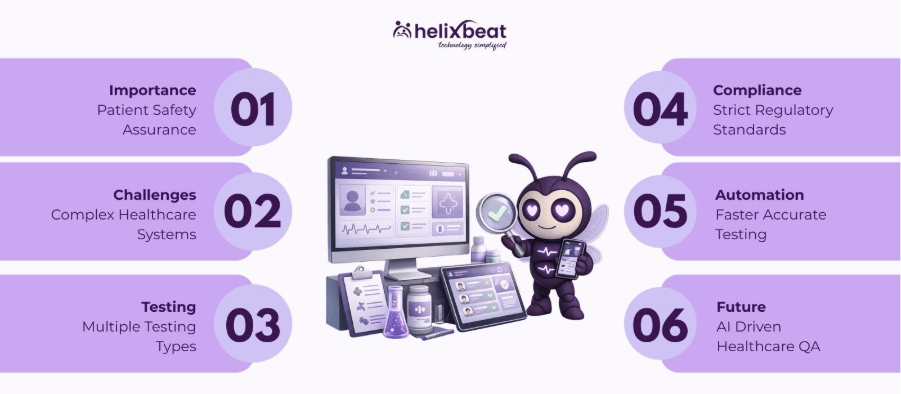
Why Healthcare Software Testing is Very Important in 2026
Healthcare applications handle sensitive patient data and critical clinical workflows, making thorough testing essential.
- Protects patient safety: Proper healthcare software testing ensures that clinical systems work accurately and do not cause treatment or diagnosis errors.
- Ensures data security: Medical software testing helps identify vulnerabilities and protects sensitive patient data from breaches.
- Maintains regulatory compliance: Strong healthcare software QA make sures that systems meet standards like HIPAA, GDPR, and other healthcare regulations.
- Improves system reliability: Effective software testing in healthcare ensures platforms perform consistently even during high patient loads.
- Reduces costly errors: Early testing through professional healthcare software testing services helps detect bugs before deployment, saving time and resources.
Proper testing ultimately helps healthcare organizations deliver safe, reliable, and compliant digital health platforms.
What are the Main Challenges in Healthcare Software Testing
Testing healthcare software comes with unique challenges due to its complexity, sensitivity, and regulatory demands.
- Complex healthcare workflows: Healthcare systems manage patient records, prescriptions, appointments, and billing simultaneously, making testing intricate.
- Integration with multiple systems: Platforms often connect with EHRs, lab systems, medical devices, and insurance software, requiring thorough healthcare software testing services.
- Strict regulatory requirements: Compliance with HIPAA, FDA, GDPR, and other standards adds complexity to medical software testing.
- Data privacy concerns: Ensuring patient data remains secure during testing environments is a significant challenge.
- Real-time performance needs: Healthcare applications must function reliably under heavy loads and emergency situations, demanding robust software testing in healthcare.
Overcoming these challenges is critical for delivering safe, efficient, and compliant digital health solutions.
Different Healthcare Software Testing
Healthcare software is complex and requires specialized testing approaches to ensure patient safety, data security, and regulatory compliance:
- Functional Testing: Confirms that all modules – EHR management, telemedicine interfaces, lab results, and billing – perform accurately and meet clinical requirements.
- Integration Testing: Verifies that healthcare applications work seamlessly with third-party systems, medical devices, and APIs, preventing data inconsistencies.
- Security & Privacy Testing: Goes beyond basic security checks to include encryption validation, access control audits, and protection against ransomware or insider threats.
- Performance & Load Testing: Assesses software behavior under peak usage, including high patient loads, simultaneous appointments, and emergency scenarios, ensuring uninterrupted service.
- Usability & Accessibility Testing: Evaluates whether software is intuitive for diverse users – doctors, nurses, patients and meets accessibility standards for differently-abled users.
- Interoperability & Data Exchange Testing: Ensures accurate communication between systems using HL7, FHIR, and DICOM standards for seamless healthcare data transfer.
- Compliance & Regulatory Testing: Confirms adherence to HIPAA, GDPR, FDA, and ISO standards, including audit readiness and proper documentation.
- AI & Algorithm Testing: Validates predictive analytics, diagnostic algorithms, and AI-driven recommendations to ensure accuracy and prevent clinical errors.
- Mobile & Telehealth Testing: Ensures mobile healthcare apps and telemedicine platforms function reliably on multiple devices and network conditions.
These diverse healthcare software testing services help organizations deliver robust, safe, and future-ready digital health platforms.
List of Healthcare Compliance and Regulations
Healthcare software must comply with strict regulations to protect patient safety and data security:
- HIPAA (Health Insurance Portability and Accountability Act): Ensures privacy and security of patient health information in the U.S.
- FDA (Food and Drug Administration) Regulations: Governs medical software used in diagnosis, treatment, and medical devices.
- GDPR (General Data Protection Regulation): Protects patient data privacy for healthcare organizations operating in the European Union.
- HL7 (Health Level Seven) Standards: Defines protocols for secure and standardized exchange of healthcare information between systems.
- ISO 13485: Specifies requirements for quality management systems in medical device software, ensuring safety and reliability.
These regulations form the backbone of healthcare software QA and compliance testing to ensure safe, secure, and legally compliant platforms.
3 Major Role of Automation in Healthcare Software Testing
Automation is transforming healthcare software testing by increasing speed, accuracy, and reliability across complex systems.
Studies show that healthcare organizations that implement automation in testing reduce defects by up to 40% and cut testing time by 50–60%.
1. Accelerated Testing Cycles
Automated tests can run hundreds of scenarios simultaneously, covering modules like EHR, telemedicine, and lab systems. This speeds up regression testing, allowing healthcare providers to release updates 30–50% faster without compromising quality.
2. Enhanced Accuracy and Coverage
Manual testing can miss critical issues in complex healthcare workflows. Automation ensures 100% coverage of functional paths, data validation, and integration points, reducing the risk of errors that could impact patient safety.
3. Continuous Monitoring and Compliance Validation
Automation tools can continuously monitor security, performance, and compliance. For example, automated audits can detect HIPAA or GDPR violations in real-time, helping organizations achieve up to 95% compliance adherence and generate audit-ready reports instantly.
Integrating automation in healthcare software QA not only reduces errors and costs but also ensures safer, faster, and more compliant digital health platforms.
Future Trends in Healthcare Software Testing
Healthcare software is evolving rapidly, and testing practices must keep pace to ensure safety, reliability, and compliance.
Here are key future trends shaping the field:
1. AI and Machine Learning-Driven Testing
Artificial intelligence is increasingly being used to predict potential defects, automate test case generation, and optimize testing workflows. AI-driven testing can identify high-risk areas in medical software testing, reducing human error and improving accuracy.
2. IoT and Connected Device Testing
With the rise of wearable devices, smart medical equipment, and remote monitoring systems, software testing in healthcare now requires validating connectivity, interoperability, and data accuracy across multiple IoT devices.
3. Cloud-Based and Telehealth Testing
Cloud platforms and telemedicine apps are becoming standard. Future testing will focus on performance, scalability, and security in multi-user cloud environments while ensuring data privacy and uninterrupted service for remote healthcare delivery.
These trends indicate that healthcare software testing services will increasingly rely on automation, AI, and advanced validation methods to meet the growing demands of digital health technologies.
What Makes Helixbeat the Best Healthcare Software Testing Service Provider
When it comes to healthcare software testing, Helixbeat stands out for combining deep domain expertise, advanced testing tools, and regulatory knowledge. We ensure that your digital health platforms are safe, reliable, and fully compliant, helping you deliver quality care without compromise.
Why Choose Helixbeat:
- Healthcare Domain Expertise: Experienced in EHRs, telemedicine, lab systems, and connected devices.
- Comprehensive Testing Services: Functional, security, performance, interoperability, and compliance testing.
- Regulatory Compliance Focus: Ensures adherence to HIPAA, FDA, GDPR, HL7, and ISO standards.
- Automation-Driven Testing: Faster cycles, better coverage, and early defect detection.
- Scalable Solutions: Supports startups, hospitals, and large healthcare enterprises alike.
With Helixbeat, your healthcare software is tested thoroughly to ensure patient safety, data security, and system reliability, giving you confidence in every deployment.
Why Helixbeat is the Best for E-commerce QA Testing
When it comes to preventing checkout failures, we at Helixbeat don’t just test – we ensure every transaction flows smoothly from cart to confirmation.
Our approach combines advanced ecommerce software testing tools with real-world e-commerce expertise, so your customers never experience frustration at the most critical moment: checkout.
What sets Helixbeat apart in E-commerce QA Testing:
- End-to-End Checkout Simulation – We replicate real customer journeys across devices, browsers, and geographies to catch issues no standard testing can.
- Payment Gateway Resilience Testing – Our QA process verifies every gateway, including credit/debit cards, wallets, and UPI, under high load scenarios to prevent transaction failures.
- Smart Automation with Human Insight – Automated scripts handle repetitive checks while our QA experts focus on complex scenarios like discount logic, multi-product flows, and promo stacking errors.
- Rapid Issue Resolution – We identify and fix critical checkout bugs before they go live, reducing cart abandonment by up to 30% in our clients’ stores.
- Continuous Monitoring & Reporting – Real-time dashboards highlight checkout performance trends, so you can act quickly and confidently during sales or campaigns.
With Helixbeat, your checkout isn’t just tested – it’s optimized. We make sure every customer completes their purchase, every time, so you never lose a sale.
Book now for a free website QA review and prevent checkout failures before they happen.
Frequently Ask Questions
1. Why is health information exchange important in healthcare?
It improves care coordination, reduces duplicate tests, minimizes errors, and helps providers make timely, data-driven decisions across different healthcare settings.
2. What are the main models of health information exchange?
3. Which standards guide health information exchange?
Standards like FHIR and HL7 define consistent data formats, making it easier for EHRs, HIEs, and other healthcare platforms to exchange information.
4. What are the benefits of using health information exchange?
HIE improves care coordination, reduces healthcare costs, supports population health management, enhances research, and increases operational efficiency.
5. How does AERIS enhance healthcare information exchange?
AERIS leverages FHIR standards, connects legacy systems, automates workflows, reduces manual errors, and provides real-time access to patient records and lab results.
1. How often should healthcare software be tested?
Healthcare software should undergo regular testing, including after every update or integration, to ensure continuous safety, security, and compliance.
2. Can automated testing fully replace manual testing in healthcare?
While automation improves speed and coverage, manual testing is still essential for usability, clinical judgment validation, and complex workflow scenarios.
3. What role do regulatory audits play in healthcare software testing?
Audits verify that software complies with HIPAA, FDA, GDPR, and other standards, helping organizations avoid penalties and maintain trust.
4. How do mobile health apps differ in testing from hospital systems?
Mobile health apps require testing for device compatibility, connectivity, offline functionality, and data synchronization, whereas hospital systems focus on integration and large-scale performance.
5. Is cloud-based healthcare software safer than on-premise systems?
Cloud platforms offer scalability and centralized updates, but they require strict security, access control, and continuous compliance testing to ensure patient data safety.