


Software Performance Testing Services
Get in Touch
New Lead: Testing as a Service
Testing as a Service Landing Page Form, connected with the Mailchimp.
"*" indicates required fields
Software performance testing services are essential to make sure your application runs smoothly, even under heavy use. It helps you identify how well your software performs in different scenarios, such as high traffic or long periods of use, without slowing down or crashing.
At Helixbeat, we specialize in QA performance testing to uncover and fix any issues before they affect your users. Our goal is to make sure that your software can handle all types of demand, offering a smooth experience every time.
Whether you’re launching a new app or updating an existing one, our software performance testing services are designed to optimize your app’s speed and reliability.
Book a Free Consultation Call with Us
Why Software Performance Testing is Important for Your Business
Every second counts in the digital world. A small delay or glitch can cause users to leave, revenue to drop, and your brand reputation to take a hit. That’s where software performance testing becomes crucial; it helps your business deliver fast, reliable, and seamless digital experiences.
1. Delivers a Smooth and Fast User Experience
Performance testing helps you find how well your software runs under real-world conditions such as multiple users, heavy traffic, or large data loads. A slow app or website directly affects customer satisfaction and conversion rates.
Tools like Apache JMeter, LoadRunner, and Gatling are used to simulate real workloads and test how fast your system responds. For web and mobile apps, frameworks like Selenium, Cypress, and Appium can be integrated for end-to-end performance validation.
2. Prevents Crashes and Downtime During Peak Usage
Imagine an eCommerce website crashing on Black Friday or a banking app freezing during transactions. Performance testing helps prevent such failures. Through stress testing and load testing, QA teams identify the system’s breaking point before users do.
Tech stacks often include AWS CloudWatch, Azure Load Testing, and K6 to monitor performance metrics like response time, throughput, and server CPU usage. This ensures your infrastructure can scale seamlessly during peak demand.
3. Optimizes Resource Utilization and Reduces Costs
Performance testing highlights inefficiencies in your code or architecture such as memory leaks, slow APIs, or database bottlenecks. Using monitoring tools like New Relic, Datadog, and Grafana, businesses can visualize performance data and fine-tune backend systems.
Optimized performance means your cloud or on-premise resources are used effectively, leading to reduced operational costs and better ROI from your infrastructure investments.
4. Strengthens Product Reliability and Brand Reputation
Consistent performance builds trust. If your software crashes or slows down under load, users may switch to competitors instantly. Performance testing, backed by tools like Dynatrace, Prometheus, and Postman API testing, helps validate system reliability and maintain brand credibility.
Especially for industries like fintech, healthcare, and SaaS, reliability is a crucial factor that directly impacts customer retention and loyalty.
5. Supports Continuous Delivery and Scalability
Modern businesses thrive on agility. With CI/CD pipelines using Jenkins, GitLab CI, or CircleCI, performance testing can be automated as part of every release cycle. This proactive approach helps teams detect regressions early and maintain quality even as new features are rolled out.
Scalable testing frameworks like Kubernetes, Docker, and Terraform also help replicate production environments, allowing you to predict scalability more accurately.
Performance testing is not just about speed; it’s about reliability, scalability, and customer satisfaction. Investing in professional QA performance testing ensures your software performs flawlessly, even under pressure.
Different Types of Performance Testing
Performance testing is key to ensuring that your software performs well under various conditions. Here are the most common types of performance testing that can help you optimize your application:
1. Load Testing
Load testing is a type of software performance testing that checks how your software performs when multiple users access it simultaneously. It helps ensure that your software can handle the expected load without slowing down or crashing, providing a smooth user experience.
4. Volume Testing
Volume testing focuses on testing how your software handles large amounts of data. It ensures that your application can process, store, and retrieve large data sets efficiently, making sure it performs well even with significant data growth.
2. Stress Testing
Stress testing is used to push your software to its limits. It helps you understand how your software behaves under extreme conditions, such as a sudden spike in users or data overload. This type of testing identifies weaknesses and ensures your software can recover from unexpected failures.
5. Endurance Testing
Endurance testing involves running your software under normal load for extended periods. It checks for memory leaks, performance degradation, and other issues that may arise over time. With proper software performance testing, you can ensure that your software remains stable and reliable for long-term use. By leveraging various software performance testing services, you can make sure your application is prepared to perform well under any condition, delivering an optimal experience to your users.
3. Scalability Testing
Scalability testing examines how well your software can handle increasing load over time. This is particularly important when your user base or data volume grows. Independent software testing services can help ensure that your application scales without performance issues, maintaining stability as demand increases.
Benefits of Software Performance Testing
Software performance testing is crucial for ensuring your application runs smoothly and efficiently under all conditions. Here are the key benefits:
1. Improves User Experience
Performance testing ensures that your application runs smoothly, even during high traffic or heavy usage. By working with performance testing companies, you can identify and fix performance issues early, providing users with a faster, more responsive experience. This helps keep them engaged and satisfied.
2. Prevents Downtime and Crashes
Performance testing helps you detect potential issues before they cause downtime or crashes. By leveraging the performance testing service offerings from experienced providers, you can ensure that your software handles traffic spikes and usage surges without interruptions, safeguarding your business against revenue loss and reputation damage.
3. Saves Time and Money
By understanding how performance testing works, you can detect issues early in the development process, saving time and money on costly fixes. With performance testing service offerings, you reduce the risk of facing expensive downtime or customer dissatisfaction, making it a wise investment for long-term success.
6 Important Process in Software Performance Testing
Software performance testing is a process that checks how well an application performs under various conditions. It helps identify any bottlenecks or issues that could affect user experience or application stability. Here’s how the process generally works:
1. Define Performance Goals
The first step in performance testing is setting clear goals. This includes identifying the number of users the software should handle, the expected response times, and the maximum acceptable downtime. These goals help create a benchmark for testing.
2. Select the Right Testing Type
Depending on the needs of the application, different types of performance testing are chosen, such as load testing, stress testing, or scalability testing. Each type focuses on different aspects of the software’s performance, such as handling high traffic or working under extreme conditions.
3. Simulate User Traffic
Performance testers simulate user traffic by using testing tools to create virtual users. These virtual users interact with the application just like real users would, allowing the testers to see how the software handles the load in real-time.
4. Monitor and Analyze Results
During the test, various metrics such as response time, server load, and resource usage are monitored. Afterward, the results are analyzed to identify any performance issues, like slow response times or server crashes, and understand the areas that need improvement.
5. Optimize and Retest
Once issues are identified, developers make the necessary optimizations to the software. This could include improving the code, enhancing server capacity, or optimizing databases. After these changes, the software is retested to ensure that the performance has improved.
Through this process, performance testing helps ensure that software can handle real-world use, provide a positive user experience, and perform reliably even under high stress or heavy loads.
Important Tools and Technologies for Software Performance Testing
Tools for Software Performance Testing:
- LoadRunner
LoadRunner is a popular tool that helps test how well your application handles heavy user traffic. It simulates many users accessing your software at once, helping identify performance issues and bottlenecks that could slow it down. - Apache JMeter
Apache JMeter is an open-source tool used for testing the performance of websites and applications. It helps measure how well your application performs under different loads, such as when many users are accessing it at the same time. - NeoLoad
NeoLoad is another performance testing tool that helps simulate user traffic to check how well your software performs under different conditions. It gives clear reports and helps improve your application’s performance by identifying areas that need attention.
Technologies for Software Performance Testing
- Cloud-Based Testing
Cloud-based testing uses cloud platforms like AWS and Microsoft Azure to simulate real-world user traffic. This allows you to test your software’s performance without needing expensive hardware, and it can easily handle large numbers of users. - AI and Machine Learning
AI and Machine Learning are used to analyze performance data and predict potential problems. These technologies can automate testing and help identify issues before they affect users, making the testing process faster and smarter. - Containerization (Docker)
Containerization tools like Docker create isolated environments to test software in a way that’s similar to real-world conditions. It ensures that your application will perform well, no matter the environment, and helps developers spot issues early on.
Helixbeat Staff Augmentation vs. In-House Hiring vs. Other Outsourcing Models
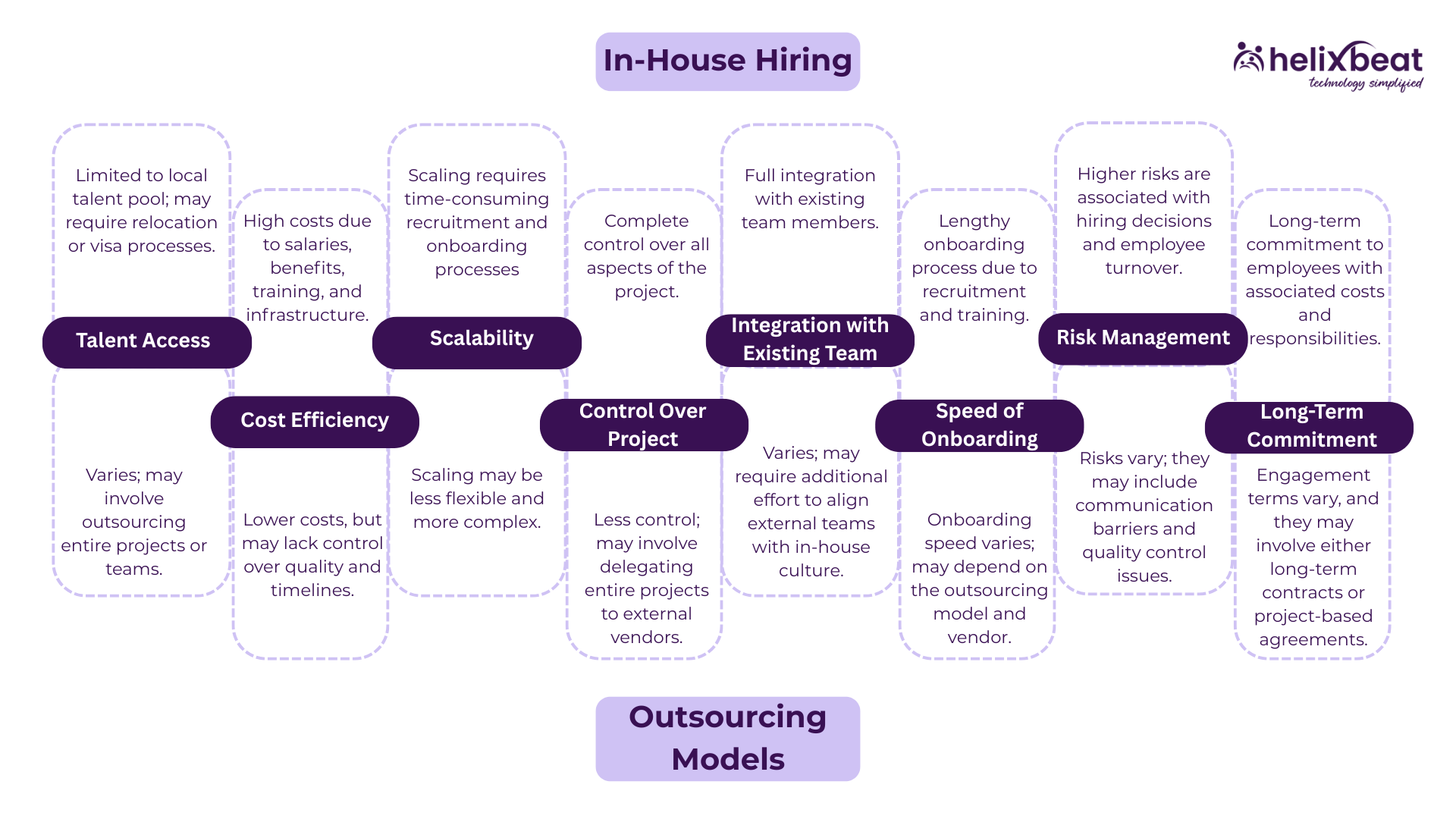
Engagement & Pricing Models That Fit Every Stage of Growth
Not every business wants a bulky, one-size-fits-all deployment. That’s why Helixbeat offers VISTA in a way that’s designed to fit your current scale—and grow with you.
Startup-Ready SaaS Plans
Smaller teams can start with one branch, one tablet, and core features like QR check-ins, host alerts, and NDA signing. No IT support needed.
Mid-Sized Bundles
Includes training, setup assistance, integration support, and access to additional modules like parking, asset, and complaint management.
Enterprise Deployments
Designed for companies with multiple branches and layered security needs. Includes dedicated support, SSO integration, branch-specific dashboards, and SLAs.
White-Labeling Available
Ideal for co-working aggregators or commercial real estate providers looking to offer branded experiences to tenants.
And no matter which model you choose, you get access to our most important feature: predictable pricing. No hidden fees. No feature lock-ins. No “premium” charges to access basic automation.
Under the Hood: How Helixbeat Powers It All
Because the best visitor management system india shouldn’t just be powerful—it should be affordable, too.
Cloud-Native Architecture
VISTA runs on scalable, secure cloud infrastructure. It’s designed for speed, uptime, and zero-maintenance for your IT team.
Mobile-First Interface
From reception tablets to security guard mobiles and admin desktops, the experience is seamless across devices.
Modular API Framework
Need to connect VISTA to your HRMS, access control, or parking boom barriers? VISTA’s APIs allow you to plug into your ecosystem—without vendor lock-ins.
Offline-First Syncing
Spotty internet? VISTA continues capturing data and syncs automatically once you're back online—a must-have for offices in remote or Tier 2/3 locations.
Role-Based Dashboards
From security guards to branch heads to CXOs—everyone sees only what they need. No data overload, just what matters.
When companies want more than a “shiny tablet experience,” and want to understand how visitor management system works at scale—VISTA shows them what enterprise-grade infrastructure truly looks like.
Pricing for Software Performance Testing Services
Service Type | Description | Estimated Cost |
Basic Load Testing | Tests the performance of the application with a standard number of users to see how it handles the load. | $500 – $2,000 per test |
Advanced Load Testing | Involves more complex testing with high traffic simulations to check for scalability and stability. | $2,000 – $5,000 per test |
Stress Testing | Tests how the application performs under extreme conditions, such as sudden spikes in traffic. | $1,000 – $3,000 per test |
Scalability Testing | Ensures the application can scale efficiently as traffic or data increases. | $1,500 – $4,000 per test |
Endurance Testing | Runs tests over long periods to check for issues like memory leaks or performance degradation. | $2,000 – $5,000 per test |
Cloud Performance Testing | Tests performance in a cloud environment to handle cloud-specific load conditions. | $2,500 – $6,000 per test |
Full Performance Testing Package | A comprehensive testing service covering load, stress, scalability, and endurance testing. | $5,000 – $10,000 per package |
Note: The above costs are estimates and can vary depending on the specific requirements and scope of the project. For a more accurate quote, it’s recommended to contact a software performance testing service provider directly.
Test Your Software’s Performance Now
Final Words
Today, software performance can make or break your business. A slow or unreliable application can drive users away and affect your business credibility. At Helixbeat, we focus on ensuring that your software not only meets but exceeds performance expectations, even under the most demanding conditions.
Our software performance testing services are designed to spot potential issues and resolve them before they become a problem.
We understand that every business is unique, and so are its performance needs. That’s why we offer customized testing solutions that help you scale, improve speed, and deliver an outstanding user experience. Book a Free Demo and See How We Can Help
Frequently Asked Questions (FAQs)
1. Why should I hire React Native developer from Helixbeat?ny in India?
Ans: When you hire React Native developer from Helixbeat, you gain access to pre-vetted experts who specialize in building high-performance, scalable apps for both Android and iOS platforms using a single codebase.
2. How can React Native developers in India help my business scale faster?
Ans: React Native developers in India are known for delivering world-class quality at competitive rates. By hiring from Helixbeat, you get skilled professionals who can accelerate development and reduce your time-to-market.
3. Can I hire React Native developers in India for remote projects?
Ans: Absolutely. You can hire React Native developers in India for remote projects through Helixbeat’s flexible staff augmentation model. Our developers work in your timezone and communicate seamlessly with your team.
4. Is it possible to hire React Native developer from Helixbeat for full-time roles?
Ans: Yes. Helixbeat allows you to hire React Native developer for both full-time and part-time positions. You get dedicated resources who work exclusively on your project, ensuring continuity and accountability.
5. What are the benefits of hiring React Native developers from India through Helixbeat?
Ans: Hiring React Native developers from India via Helixbeat gives you cost efficiency, top-tier technical skills, flexible engagement models, and access to a global talent pool—all without recruitment overhead.
6. How fast can I hire React Native developer from Helixbeat?
Ans: You can hire React Native developer from Helixbeat within 72 hours of sharing your project requirements. We ensure quick onboarding with developers who perfectly match your skill and experience needs.
7. What type of apps can Helixbeat’s React Native developers build?
Ans: Our developers specialize in ecommerce, fintech, healthcare, SaaS, and on-demand apps. When you hire React Native developers in India from Helixbeat, you get experts who can handle complex, data-driven applications efficiently.
8. How does Helixbeat ensure quality when I hire React Native developer remotely?
Ans: When you hire React Native developer from Helixbeat for remote work, we ensure quality through code reviews, agile sprints, and automated testing. Our project managers maintain complete visibility and accountability throughout.
9. Can I expand my development team by hiring React Native developers in India temporarily?
Ans: Yes. Our staff augmentation model enables you to hire React Native developers in India for short-term or project-based engagements, allowing you to scale your team as needed.
10. What is the cost of hiring React Native developer from Helixbeat?
Ans: The cost of hiring React Native developer depends on the scope and duration of your project. However, Helixbeat’s rates are typically 30–40% more affordable than traditional in-house hiring or agencies.
11. Do React Native developers from Helixbeat work with existing in-house teams?
Ans: Yes, our developers integrate seamlessly into your existing setup. You can hire React Native developers in India from Helixbeat who collaborate directly with your design, QA, and product teams.
12. How do I get started to hire React Native developer from Helixbeat?
Ans:
Getting started is easy! Simply contact Helixbeat, share your project goals, and we’ll help you hire React Native developers in India suited for your remote or full-time projects within a few days.