


Best Big Data Warehousing & DAAS Services | Difference Between Big Data and Data Warehouse Explained
Get in Touch
New Lead: DAAS
DAAS Landing Page Form, connected with the Mailchimp.
"*" indicates required fields
90% of the world’s data has been generated in the past two years. Especially in the US, enterprises produce massive volumes of data every second. Managing this data has become mandatory for businesses aiming to stay competitive.
With sleek technology and big data warehousing solutions, companies can now organize and utilize their data effectively. However, Many organizations struggle with fragmented systems and scattered datasets, but our approach in big data in warehouse management ensures that all information is consolidated and easily accessible.
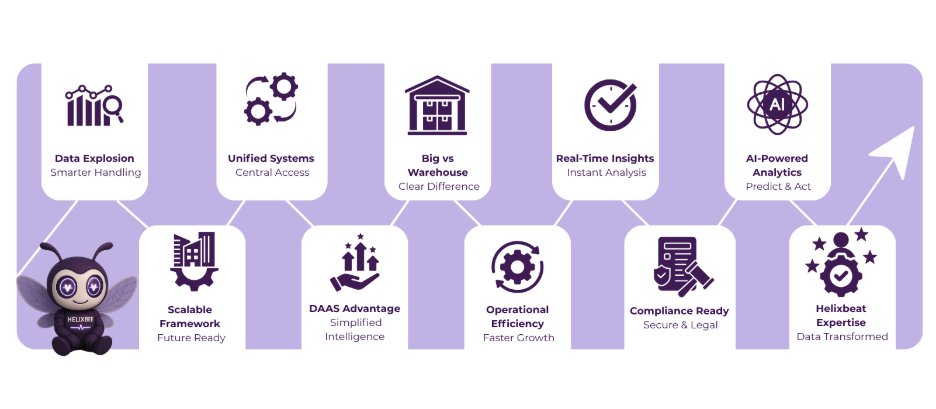
Understanding the difference between big data and data warehouse helps businesses leverage both raw data and structured analytics. By integrating big data with data warehouse systems, Helixbeat enables real-time insights, smarter decision-making, and measurable business outcomes for US-based enterprises.
As a leading DAAS agency, Helixbeat specializes in big data warehousing, helping enterprises across industries consolidate, manage, and analyze their data efficiently. Our services are designed to make your data an asset, empowering smarter decisions and better business outcomes.
CTA 1: Transform Your Data into Business Insights – Get a Custom Quote
Why Big Data Warehousing Matters
Many enterprises in the US struggle with scattered and siloed data across multiple platforms. Traditional databases often fail to handle the volume, variety, and velocity of modern datasets. Big data warehousing centralizes storage and optimizes analytics so that businesses can extract value from every data point.
With big data in warehouse management, companies can:
- Consolidate multiple data sources into a single, easily accessible platform
- Uncover hidden patterns and actionable trends in massive datasets
- Optimize operations and improve customer experience
By leveraging big data warehousing, organizations transform raw information into strategic insights that drive growth and efficiency.
What is Big Data Warehousing?
Big data warehousing is the process of collecting, storing, and managing large and complex datasets in a centralized repository—called a data warehouse—so that companies can efficiently analyze and extract actionable insights. Unlike traditional databases, which handle smaller, structured data, big data in warehouse management allows businesses to process massive volumes of structured, semi-structured, and unstructured data from multiple sources, such as:
- Customer interactions (apps, websites, social media)
- Sales and transaction records
- IoT devices and sensors
- Operational and supply chain systems
The difference between big data and data warehouse lies in their roles: big data represents the enormous, varied datasets that businesses generate, while a data warehouse is a structured system designed for analyzing and reporting that data. Integrating big data with data warehouse systems enables organizations to combine the scale of big data with the analytical power of a warehouse, providing real-time insights for smarter decisions.
Why Big Data Warehousing is Important for a Company
Implementing big data warehousing is essential for businesses that want to leverage their data effectively. Here’s why:
1. Centralized Data Access
By consolidating multiple sources, big data in warehouse management ensures accurate and consistent data is available to decision-makers across the organization.
2. Informed Decision-Making
Understanding the difference between big data and data warehouse allows companies to analyze both historical and real-time information, forecast trends, and optimize operations.
3. Enhanced Customer Insights
With big data and data warehouse solutions, businesses can track customer behavior, preferences, and feedback, enabling personalized experiences and targeted marketing.
4. Operational Efficiency
Integrating big data with data warehouse systems streamlines processes, reduces redundancies, and improves supply chain and resource management.
5. Scalability for Growth
As data volumes grow, big data in warehouse management systems can scale without compromising performance, ensuring continuous support for business expansion.
6. Competitive Advantage
Companies using big data and data warehouse technologies gain faster, data-driven decision-making capabilities, keeping them ahead of competitors.
7. Regulatory Compliance and Reporting
Centralized warehouses simplify compliance with data regulations like HIPAA, or CCPA, ensuring integrating big data with data warehouse meets legal requirements.
Understanding the Difference Between Big Data and Data Warehouse
A common question we encounter is about the difference between big data and data warehouse.
Aspect | Big Data | Data Warehouse |
Type of Data | Structured, semi-structured, unstructured | Structured, optimized for reporting |
Purpose | Store and process massive datasets | Centralized analytics and reporting |
Analytics | Predictive and real-time analytics | Historical and business intelligence reporting |
Technology | Hadoop, Spark, NoSQL | SQL-based relational databases |
Helixbeat helps US enterprises bridge this gap by integrating big data with data warehouse systems, combining the scalability of big data with the analytical power of a data warehouse. Our DAAS solutions allow businesses to focus on insights without managing complex infrastructure.
CTA 2: Learn How to Integrate Your Big Data – Book Your Consultation
Helixbeat’s DAAS Approach to Big Data Warehousing
Our big data warehousing services go beyond storage. With our DAAS model, you gain access to advanced analytics and real-time insights. Key offerings include:
- Descriptive Analytics: Understand historical data patterns to make informed business decisions.
- Predictive Analytics: Forecast future trends using machine learning and advanced data modeling.
- Prescriptive Analytics: Recommend actions to optimize operations and improve outcomes.
- Data Visualization: Interactive dashboards make complex data easy to interpret.
- Big Data Solutions: Manage and analyze large datasets to uncover critical insights.
- Real-Time Analytics: Access actionable insights instantly for agile decision-making.
With Helixbeat, your big data warehousing platform becomes more than a storage solution—it’s a tool to drive growth and competitiveness.
Helixbeat’s Data-Driven Methodology
Our structured approach ensures enterprises get measurable results from big data and data warehouse systems:
- Understanding Your Needs
We explore your business objectives to design analytics strategies tailored to your goals.
- Data Collection Strategy
Identify and gather relevant structured and unstructured data for comprehensive analysis.
- Advanced Analytical Models
Leverage AI and machine learning to transform raw data into actionable insights.
- Interactive Dashboards
Provide real-time visualization for decision-makers across departments.
- Scalable Solutions
Ensure analytics frameworks grow as your enterprise scales.
- Continuous Optimization
Refine analytics models based on evolving trends and insights for sustained impact.
By integrating big data with data warehouse frameworks, Helixbeat ensures US businesses can analyze historical and real-time data seamlessly.
CTA 3: Get a Proposal for Custom Big Data Warehousing Solutions – Start Today
Benefits of Helixbeat Big Data Warehousing
Choosing Helixbeat for big data warehousing provides significant advantages:
- Faster Insights Delivery: Access analytics results 40% faster than traditional methods.
- Smarter Decisions: Leverage reliable data for strategic business planning.
- Operational Efficiency: Optimize processes using predictive and prescriptive analytics.
- Tailored Solutions: Frameworks designed to address unique business challenges.
- Regulatory Compliance: Fully compliant with US data laws, including CCPA and HIPAA.
Helixbeat ensures that big data in warehouse management drives measurable business outcomes rather than operational complexity.
Helixbeat Staff Augmentation vs. In-House Hiring vs. Other Outsourcing Models
Case Study 1: FinTech Firm in Pune
This 110-member startup was drowning in manual entries, with over 100 visitors weekly. After implementing VISTA, they enabled visitor management system India workflows like QR-based check-ins, WhatsApp host alerts, and badge printing. Result? 80% drop in front desk congestion and instant compliance during quarterly audits.
Case Study 2: Co-Working Space in Bangalore
With 40+ startups under one roof, the facility needed visitor segregation, real-time logs, and multilingual check-in. VISTA helped them implement customized workflows, generate gate passes, and manage how visitor management system works for internal vs external visitors.
Case Study 3: Healthcare Facility in Delhi NCR
Visitor logs weren’t just about entry—they were about accountability. With VISTA, the hospital digitized patient attendant logs, installed self-check-in kiosks, and introduced NDA signing for pharmaceutical reps. The admin now calls it their “invisible security guard.”
From tech startups to health systems, VISTA is proving that the best visitor management system in India isn’t just functional—it’s transformational.

Engagement & Pricing Models That Fit Every Stage of Growth
Not every business wants a bulky, one-size-fits-all deployment. That’s why Helixbeat offers VISTA in a way that’s designed to fit your current scale—and grow with you.
Startup-Ready SaaS Plans
Smaller teams can start with one branch, one tablet, and core features like QR check-ins, host alerts, and NDA signing. No IT support needed.
Mid-Sized Bundles
Includes training, setup assistance, integration support, and access to additional modules like parking, asset, and complaint management.
Enterprise Deployments
Designed for companies with multiple branches and layered security needs. Includes dedicated support, SSO integration, branch-specific dashboards, and SLAs.
White-Labeling Available
Ideal for co-working aggregators or commercial real estate providers looking to offer branded experiences to tenants.
And no matter which model you choose, you get access to our most important feature: predictable pricing. No hidden fees. No feature lock-ins. No “premium” charges to access basic automation.
Under the Hood: How Helixbeat Powers It All
Because the best visitor management system india shouldn’t just be powerful—it should be affordable, too.
Cloud-Native Architecture
VISTA runs on scalable, secure cloud infrastructure. It’s designed for speed, uptime, and zero-maintenance for your IT team.
Mobile-First Interface
From reception tablets to security guard mobiles and admin desktops, the experience is seamless across devices.
Modular API Framework
Need to connect VISTA to your HRMS, access control, or parking boom barriers? VISTA’s APIs allow you to plug into your ecosystem—without vendor lock-ins.
Offline-First Syncing
Spotty internet? VISTA continues capturing data and syncs automatically once you're back online—a must-have for offices in remote or Tier 2/3 locations.
Role-Based Dashboards
From security guards to branch heads to CXOs—everyone sees only what they need. No data overload, just what matters.
When companies want more than a “shiny tablet experience,” and want to understand how visitor management system works at scale—VISTA shows them what enterprise-grade infrastructure truly looks like.
Customer Testimonials
Helixbeat’s big data warehousing solution transformed our operations. By integrating big data with our data warehouse, we can now make real-time, data-driven decisions that significantly improve efficiency. Their DAAS model and analytics tools are unmatched.”
— Sarah J., CTO, US-Based Finance Company
“Managing large datasets was always challenging, but Helixbeat simplified big data in warehouse management for our retail operations. Their solution connects all data sources, making analytics faster and more reliable.”
— David L., CIO, US-Based Retail Enterprise
“Before Helixbeat, we struggled to understand the difference between big data and data warehouse, and our analytics were scattered. Their DAAS services unified our data infrastructure, providing actionable insights that improved decision-making.”
— Emily R., VP of Operations, US-Based Healthcare Provider
“Helixbeat helped us bridge multiple systems by integrating big data with data warehouse solutions. Real-time analytics and predictive modeling now drive our operational performance and customer satisfaction.”
— Michael T., Director of Analytics, US-Based E-Commerce Company
Frequently Asked Questions (FAQs)
1. What is big data warehousing?
Ans: A centralized system to store, manage, and analyze large datasets, optimized for performance and scalability.
2. How does Helixbeat integrate big data with data warehouse?
Ans: Through automated ETL pipelines, AI-driven analytics, and real-time dashboards, providing seamless integration and actionable insights.
3. What is the difference between big data and data warehouse?
Ans: Big data refers to massive, often unstructured datasets, while a data warehouse is structured and optimized for analysis and reporting.
4. Why should US enterprises adopt DAAS for big data warehousing?
Ans: DAAS provides access to advanced analytics, scalability, and real-time insights without the burden of managing infrastructure.
5. Is Helixbeat’s big data warehousing secure?
Ans: Yes. Helixbeat services comply with CCPA, HIPAA, and include multi-layer encryption and access controls.
Helixbeat’s big data warehousing and DAAS services empower US enterprises to unlock the value of their data. By integrating big data with data warehouse systems, organizations can streamline operations, make informed decisions, and maintain a competitive edge in today’s data-driven market.
Contact Helixbeat today to transform your data into actionable insights and measurable business outcomes.