


Cloud Software Testing
Get Started with a Free Demo
New Keyword Page
New Keyword Page
"*" indicates required fields
When Businesses Need to Choose Cloud Software Testing Over On-Premise Testing
If your testing process feels heavier with every release, you’re not imagining it. On-premise testing setups often struggle to keep up as products grow, teams go remote, and release cycles tighten. Environments aren’t always available, infrastructure costs keep rising, and scaling tests, especially for performance or cross-browser coverage, start feeling more painful than productive. What once worked well now slows you down, making quality assurance feel like a bottleneck instead of a safety net.
This is where cloud software testing changes the equation. With cloud based software testing, you can spin up environments instantly, test at scale without hardware limits, and support modern DevOps workflows without constant maintenance overhead.
Whether it’s cloud testing in software testing for faster releases or software testing on cloud to support distributed teams, cloud-driven approaches replace friction with flexibility. The real question isn’t if cloud testing works—it’s when it makes more sense than staying on-premise.
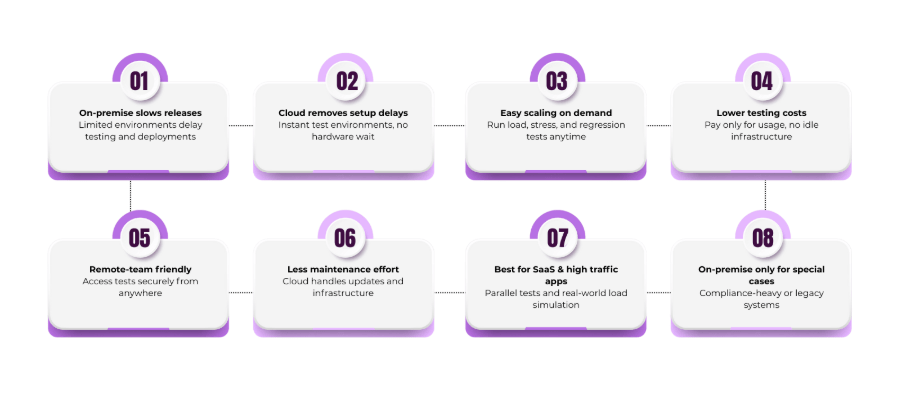
Cloud Software Testing vs On-Premise Testing
Aspect | Cloud Software Testing | On-Premise Testing |
Infrastructure Setup | With cloud software testing, test environments are available on demand—no hardware purchases or setup delays. You use cloud based testing software and start testing immediately. | Requires upfront hardware investment, manual setup, and long provisioning cycles before testing can even begin. |
Scalability & Performance Testing | Cloud based software testing lets you scale tests instantly for load, stress, and regression testing without capacity limits. | Scaling is restricted by physical infrastructure, making large-scale or peak-load testing difficult and costly. |
Cost Model | You pay only for what you use. Software testing on cloud eliminates idle infrastructure and reduces long-term maintenance costs. | High capital expenditure, ongoing maintenance, and underutilized resources increase total cost of ownership. |
Team Accessibility | Ideal for distributed teams. Cloud testing in software testing allows secure access from anywhere without VPN dependency. | Remote access is complex, often slow, and dependent on internal networks and VPN configurations. |
Maintenance & Upgrades | Maintenance, updates, and environment management are handled by the cloud provider, letting QA teams focus purely on testing. | Teams spend significant time maintaining servers, updating tools, and fixing environment issues instead of testing. |
7 Clear Signs You’ve Outgrown On-Premise Testing
If testing feels slower, costlier, and more frustrating than it should, it’s not just your imagination—your on-premise setup might be holding you back. Here are 7 clear signs that it’s time to consider a modern approach.
1. Your Release Cycles Are Getting Slower, Not Faster
High-performing DevOps teams deploy 46x more frequently than low performers, yet many on-premise setups move in the opposite direction. Limited environments create queues, slowing automated tests and delaying releases.
2. Testing Infrastructure Costs Keep Rising
Up to 60% of on-premise test infrastructure remains idle outside peak usage, yet companies still pay for hardware, licenses, power, cooling, and support. Hardware refresh cycles every 3–5 years further drive costs up.
3. Your QA Team Struggles with Environment Availability
30–40% of QA time is often lost to waiting for test environments or fixing broken configurations. Shared environments slow parallel testing and increase the chance of human error.
4. You Need to Test at Scale—But Can’t
A 1-second delay can reduce conversions by 7%, yet teams often skip realistic load testing because on-premise systems can’t handle thousands of simultaneous users.
5. Remote Teams Can’t Access Testing Systems Easily
With 70%+ of tech teams distributed, on-premise systems reliant on VPNs create latency and access issues, slowing collaboration between developers and QA teams.
6. Cross-Browser and Device Testing Feels Painful
There are 9,000+ unique device, browser, and OS combinationsin use today. Most internal labs cover only a handful, leaving many real-world scenarios untested.
7. Maintenance Is Eating More Time Than Testing
QA teams spend 25–35% of their time on infrastructure maintenance – patching servers, upgrading tools, and troubleshooting, taking focus away from actual testing.
These challenges show why relying solely on on-premise testing is no longer sustainable. When speed, scalability, and accessibility start blocking quality, it’s time to explore cloud software testing as a faster, more flexible alternative.
What Cloud Software Testing Solves Instantly
Cloud software testing removes the biggest bottlenecks of traditional QA almost immediately. No more waiting for test environments, juggling limited hardware, or coordinating shared resources – teams can spin up fully configured environments in minutes. Parallel test execution, instant scaling, and on-demand access mean faster releases without compromising coverage, whether you’re running regression suites, performance tests, or cross-browser validations.
Beyond speed, cloud testing solves collaboration and accessibility challenges. Remote teams can access environments securely from anywhere, and modern cloud based testing software keeps test data consistent across locations. Automated updates, tool integration, and maintenance handled by the cloud free your QA team to focus purely on quality, making software testing on cloud a reliable, low-friction solution for modern DevOps workflows.
How Cloud Based Software Testing Supports Modern DevOps Teams
Cloud based software testing integrates seamlessly into modern DevOps workflows, enabling continuous testing at every stage of the CI/CD pipeline. For example, a SaaS team can automatically spin up multiple test environments on the cloud, run parallel regression and performance tests, and get instant feedback—all without waiting for hardware or manual setup.
This means faster releases, fewer bottlenecks, and a smoother collaboration between developers, QA, and operations teams, making software testing on cloud a core enabler of agile delivery.
Real Testing Scenarios Where Cloud Software Testing Wins SaaS Products
SaaS products demand frequent releases, multi-tenant support, and consistent performance across regions. With on-premise testing, replicating multiple tenant environments or simulating hundreds of simultaneous users is difficult and expensive. Cloud software testing solves this instantly by allowing QA teams to spin up isolated, configurable environments on demand.
For example, a CRM platform can test new features for thousands of customers in parallel without affecting production data. Automated regression, cross-browser, and API tests can run continuously in the cloud, ensuring every release meets quality standards before deployment.
High-Traffic Applications
Applications handling high user traffic, such as e-commerce platforms or online gaming services, face sudden load spikes that on-premise setups struggle to simulate. Cloud based testing software enables large-scale load and stress testing by dynamically allocating hundreds or thousands of virtual users.
For instance, an online retail website preparing for a seasonal sale can simulate peak traffic from multiple regions, monitor response times, and detect bottlenecks before real users experience delays. This approach not only improves performance but also reduces downtime risk, which is nearly impossible with static, on-premise infrastructure.
When On-Premise Testing Still Makes Business Sense
While cloud software testing solves most modern QA challenges, there are scenarios where on-premise testing remains relevant. Organizations with strict data security or regulatory requirements, such as healthcare, finance, or government applications—may need full control over test environments and sensitive data. In these cases, hosting infrastructure on-premise ensures compliance with data residency and privacy regulations.
On-premise testing also works well for legacy systems that rely on hardware or software configurations not easily replicated in the cloud. If applications have highly specific dependencies or are tightly coupled with internal systems, testing on cloud may introduce integration challenges. Finally, teams with stable workloads and predictable releases may find that maintaining on-premise environments is still cost-effective compared to shifting to cloud infrastructure.
Final Words
On-premise testing can slow your releases, raise costs, and frustrate teams, especially when scaling or handling remote workflows. If delays, maintenance, and limited environments are holding you back, it’s a clear sign your testing approach has outgrown traditional setups.
HelixBeat’s cloud testing service solves these challenges instantly. With scalable, on-demand environments, parallel test execution, and secure remote access, you can focus on quality, speed, and reliability – turning software testing on cloud into a seamless part of your DevOps workflow.
Frequently Ask Questions
1. Why is health information exchange important in healthcare?
It improves care coordination, reduces duplicate tests, minimizes errors, and helps providers make timely, data-driven decisions across different healthcare settings.
2. What are the main models of health information exchange?
3. Which standards guide health information exchange?
Standards like FHIR and HL7 define consistent data formats, making it easier for EHRs, HIEs, and other healthcare platforms to exchange information.
4. What are the benefits of using health information exchange?
HIE improves care coordination, reduces healthcare costs, supports population health management, enhances research, and increases operational efficiency.
5. How does AERIS enhance healthcare information exchange?
AERIS leverages FHIR standards, connects legacy systems, automates workflows, reduces manual errors, and provides real-time access to patient records and lab results.
1. How quickly can I set up a cloud testing environment compared to on-premise?
Most cloud testing platforms allow you to provision full test environments in minutes, whereas on-premise setups often take days or weeks for hardware, software, and configurations.
2. Can cloud testing handle peak loads better than on-premise testing?
Yes. Cloud platforms can dynamically scale thousands of virtual users to simulate real-world traffic spikes, which is difficult and expensive to achieve on fixed on-premise infrastructure.
3. Is cloud software testing secure for sensitive applications?
Modern cloud testing services provide enterprise-grade encryption, isolated test environments, and compliance certifications, making them safe for regulated industries like finance or healthcare.
4. Will moving to cloud testing impact my existing CI/CD pipelines?
Not at all. Most cloud testing solutions integrate seamlessly with popular CI/CD tools, allowing automated builds, tests, and deployments without changing your existing workflow.
5. Can distributed QA teams collaborate efficiently using cloud testing?
Absolutely. Cloud testing enables secure remote access, real-time reporting, and shared environments, so teams across locations can test, debug, and monitor simultaneously without conflicts.