


Custom Enterprise Software Development in 2026
Most businesses struggle with software that feels “one-size-fits-all.” Off-the-shelf tools often create more headaches than they solve – disconnected systems, slow workflows, and constant workarounds waste time and money. For growing enterprises, these limitations can stall innovation and block growth.
That’s where custom enterprise software development changes the game. With tailored solutions built specifically for your business processes, you can automate tasks, unify systems, and scale seamlessly. By working with a reliable custom enterprise software development company offering advanced custom enterprise application development services, you get software designed to solve real problems – not just generic features.
What is Custom Enterprise Software Development?
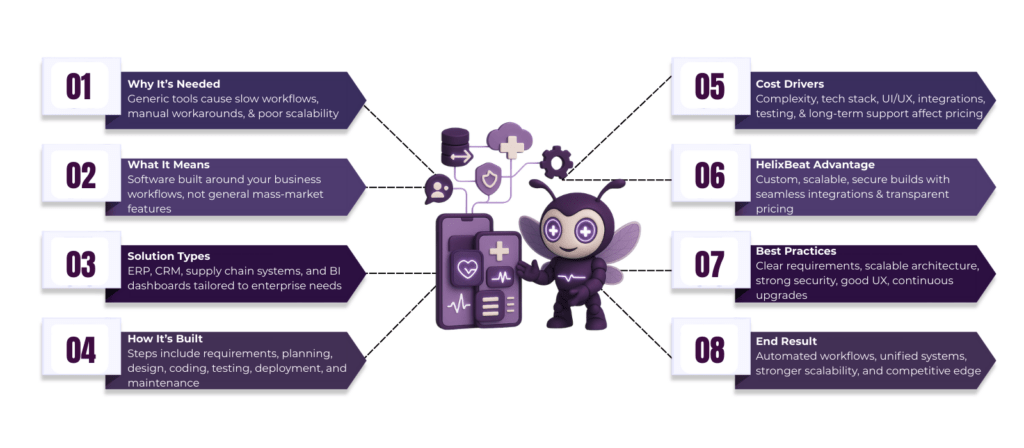
Custom enterprise software development is the process of creating software solutions specifically designed to meet the unique needs of a business. Unlike off-the-shelf software, which offers the same features to everyone, custom enterprise software is built to match your workflows, processes, and goals, making your operations smoother and more efficient.
Businesses usually hire a custom enterprise software development company or use custom enterprise software development services to build these solutions. From automating daily tasks to integrating multiple systems, custom software ensures that every feature works exactly the way your business needs, helping you save time, reduce errors, and scale effectively.
Different Types of Custom Enterprise Software Development
When it comes to custom enterprise software development, businesses have several options to build solutions that truly fit their unique needs.
- ERP (Enterprise Resource Planning) Systems: Integrates core business functions like finance, HR, inventory, and operations into a single platform to improve efficiency.
- CRM (Customer Relationship Management) Software: Helps businesses manage customer data, track interactions, and improve customer relationships.
- Supply Chain Management Solutions: Custom software to optimize inventory, logistics, and supplier management, ensuring smooth operations.
- Business Intelligence & Analytics Tools: Provides real-time data insights, dashboards, and reporting to support informed decision-making.
Choosing the right type of solution is key in custom enterprise software development, ensuring your software aligns perfectly with your business goals and processes.
7 Important Stages Involved in Custom Enterprise Software Development
Building robust custom enterprise software requires a structured, step-by-step approach. Here are the seven key stages that ensure your solution is scalable, secure, and aligned with your business needs:
1. Requirement Analysis & Business Understanding
The first stage involves gathering detailed information about your business processes, pain points, and goals. Developers and business analysts work together to document functional requirements, technical constraints, and user expectations. This step ensures the software will solve real problems rather than just adding generic features.
2. Feasibility Study & Technology Planning
Here, the technical team evaluates the feasibility of the project in terms of architecture, technology stack, integrations, and scalability. Decisions are made regarding programming languages, frameworks, cloud infrastructure, and third-party integrations, ensuring the solution can evolve with future business growth.
3. UI/UX Design & Prototyping
User interface (UI) and user experience (UX) design focus on creating intuitive, easy-to-navigate interfaces. Wireframes and interactive prototypes are developed to visualize workflows, ensuring that employees can use the software efficiently with minimal training.
4. Development & Coding
This is the core stage where developers build the application using secure, modular, and maintainable code. Best practices in custom enterprise application development services are applied, including API integration, microservices architecture, and automated testing to ensure high performance and flexibility.
5. Quality Assurance & Testing
Comprehensive testing is performed at multiple levels – unit testing, integration testing, performance testing, and security audits. This stage ensures that the software is stable, secure, and free from critical bugs before deployment.
6. Deployment & System Integration
Once tested, the software is deployed in a live environment. Integration with existing enterprise systems such as ERP, CRM, or supply chain software is carefully managed to prevent disruption. Cloud or on-premises deployment strategies are chosen based on business needs.
7. Maintenance, Monitoring & Continuous Improvement
Post-deployment, ongoing maintenance is crucial. Updates, patches, and feature enhancements are rolled out regularly. Monitoring tools track system performance, user activity, and potential issues, allowing continuous optimization and ensuring long-term reliability.
Following these stages carefully ensures that your business gets a high-performing solution tailored for growth and efficiency, making custom enterprise software development a strategic investment rather than just a project.
Estimated Cost of Building a Custom Enterprise Software
Factors Affecting Cost | Description | Estimated Cost Range |
Project Complexity | More complex software with advanced features, integrations, and custom workflows costs more. | $50,000 – $300,000 |
Technology Stack | The choice of programming languages, frameworks, and cloud infrastructure affects development cost. | $20,000 – $100,000 |
Design & UI/UX | Custom interfaces, responsive design, and interactive prototypes add to the cost. | $10,000 – $50,000 |
Integrations | Connecting the software with ERP, CRM, supply chain, or other enterprise systems increases cost. | $15,000 – $80,000 |
Testing & Quality Assurance | Comprehensive testing for security, performance, and reliability ensures stable software. | $5,000 – $30,000 |
Maintenance & Support | Post-deployment updates, patches, and continuous support. | $5,000 – $25,000 per year |
Note: The total cost varies based on your business size, requirements, and choice of a custom enterprise software development company.
Why Choose Helixbeat for Custom Enterprise Software Development
Choosing the right partner for custom enterprise software development can make or break your project. At HelixBeat, we specialize in creating tailored solutions that align perfectly with your business goals, workflows, and growth plans. With our expertise, you get software that not only works efficiently today but also adapts as your business evolves.
Our team combines technical excellence with deep business understanding, delivering reliable, scalable, and secure solutions. By leveraging our custom enterprise software development services, businesses can automate processes, improve productivity, and gain a competitive edge in their industry.
Why HelixBeat Stands Out:
- Customized Solutions: Every software is designed to match your unique workflows and business requirements.
- Expert Developers: Our team has experience in enterprise custom software development, using modern frameworks and technologies.
- Scalable Architecture: Solutions built to grow with your business, avoiding costly future upgrades.
- Seamless Integration: Easily connects with ERP, CRM, and other enterprise systems.
- Ongoing Support: Continuous maintenance, updates, and monitoring to keep your software reliable.
- Transparent Pricing: No hidden costs, flexible models, and clear ROI for your investment.
With HelixBeat, your business doesn’t just get software; it gets a strategic partner for long-term growth and efficiency in custom enterprise software development.
Testimonials:
HelixBeat completely transformed how we manage our operations. Their custom enterprise software development services fit our workflows perfectly and made our processes much more efficient.
– Rohit Sharma, CEO, Tech Innovators
From design to deployment, HelixBeat’s expertise in enterprise custom software development was evident. Their solutions are reliable, secure, and tailored to our needs.
– Anil Kapoor, CTO, FinTech Solutions
Our custom enterprise application handles complex workflows seamlessly. HelixBeat’s team is professional, responsive, and truly understands enterprise software development.
– Neha Verma, IT Director, RetailCorp
5 Best Practices for Custom Enterprise Software Development
Implementing custom enterprise software development effectively requires following proven best practices to ensure your solution is scalable, secure, and aligned with business goals.
- Clearly Define Requirements Upfront:Start with a detailed analysis of your business processes, workflows, and goals. Clear requirements help your custom enterprise software development company build solutions that truly address your pain points and avoid costly revisions later.
- Choose a Scalable Architecture:Build software with a flexible and modular architecture. This ensures your enterprise application can grow with your business, integrate new features easily, and adapt to changing market needs.
- Prioritize Security & Compliance:Security should be built into every stage of development. Implement encryption, role-based access, and compliance with industry standards to protect sensitive business and customer data.
- Focus on User Experience (UX):A user-friendly interface ensures employees adopt the software quickly and efficiently. Conduct usability testing and gather feedback during development to refine workflows and reduce training time.
- Plan for Continuous Maintenance & Upgrades:Custom enterprise software is a long-term investment. Schedule regular updates, performance monitoring, and feature enhancements to keep the system reliable, secure, and aligned with evolving business goals.
Following these best practices ensures your investment delivers maximum value, making custom enterprise software development a strategic advantage rather than just a tool.
Final Thoughts
Many businesses struggle with generic software that doesn’t match their workflows, slows down operations, and limits growth. Off-the-shelf solutions often force companies to adapt their processes to the software, creating inefficiencies and missed opportunities.
With HelixBeat’s custom enterprise software development, you can finally have software designed around your unique business needs. Our solutions streamline operations, integrate seamlessly with existing systems, and scale as your business grows – giving you the efficiency, control, and competitive advantage your enterprise deserves.
What Users Say About AERIS
Dr. Sarah L.
Hospital Administrator
John T.
Telemedicine Provider
Emily P.
Healthcare Executive
Frequently Asked Questions
- How long does it take to develop custom enterprise software?
The development timeline depends on the complexity, features, and integrationsrequired. Most enterprise solutions take 3–9 months, while highly complex systems may take longer. Working with an experienced custom enterprise software development company can help optimize delivery without compromising quality. - Can custom enterprise software integrate with existing systems?
Yes. One of the biggest advantages of custom solutions isseamless integration with ERP, CRM, supply chain, and other enterprise systems, allowing data to flow smoothly across your organization. - How secure is custom enterprise software?
Security is a top priority. Custom software can includeadvanced security measures, encryption, role-based access, and compliance with industry standards, ensuring your sensitive business data remains protected. - What industries benefit most from custom enterprise software development?
Any industry with complex workflows can benefit, includingfinance, healthcare, manufacturing, retail, logistics, and technology. Custom solutions adapt to industry-specific requirements, making processes more efficient. - How much does it cost tomaintaincustom enterprise software?
Maintenance costs vary depending on the software’s complexity and required updates. Typically, businesses spend 5–10% of the initial development cost annually for updates, bug fixes, and performance improvements, ensuring the system stays efficient and scalable.