


How to Develop Financial Software: A Comprehensive Guide for FinTech Companies
Get Started with a Free Demo
New Lead: Product Development Services
"*" indicates required fields
Nearly 70% of FinTech startups struggle or shut down within three years due to poor technology and outdated tools. Generic systems simply can’t manage the demands of modern finance — from complex transactions to ever-changing compliance rules. As a result, companies face errors, data breaches, and customer churn.
The solution lies in custom financial software development — technology built around your exact business model. With automation, real-time analytics, and end-to-end encryption, it simplifies operations while keeping you compliant with KYC, AML, and PCI DSS. Whether you’re in digital banking, lending, or payments, software development for financial services empowers you to innovate faster and scale securely.
This guide walks you through the essentials of building robust FinTech systems — the process, features, costs, and why partnering with the right financial software development company can shape your next big financial success.
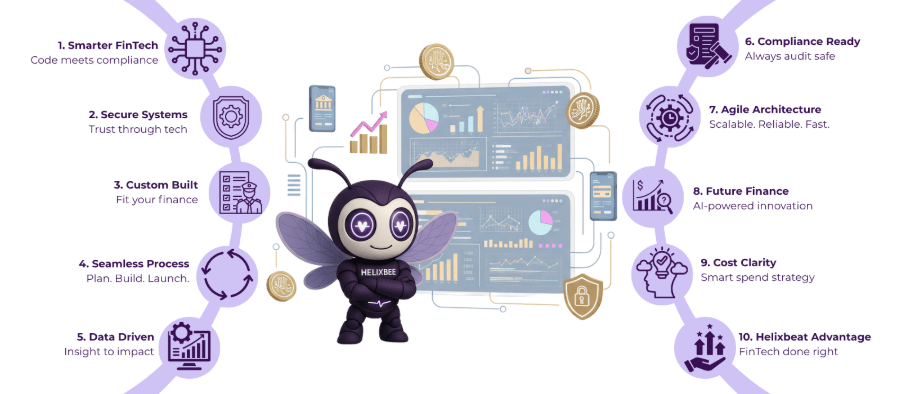
What is Custom Financial Software Development?
Custom financial software development is the process of designing and building tailored digital solutions specifically for banks, FinTech startups, and other financial institutions. Unlike generic tools, it focuses on creating platforms that meet unique business needs — from transaction management and fraud detection to compliance automation and customer analytics.
Developed by expert financial software developers, these systems integrate advanced technologies like AI, blockchain, and API-driven architectures to ensure security, scalability, and performance.
In short, it’s how financial companies turn complex operations into smooth, automated, and regulation-ready digital experiences.
Why One-Size-Fits-All Tools Don’t Work in Finance
Finance isn’t a one-size-fits-all industry – every bank, lending platform, or FinTech startup operates under different compliance rules, risk models, and customer workflows. Generic tools often fail to meet these unique demands, leading to data silos, security gaps, and inefficient transaction handling.
For instance, a digital lending app might require credit scoring and fraud detection, while an investment firm needs real-time portfolio analytics — needs that standard software simply can’t fulfill.
That’s why businesses turn to custom financial software development, which allows them to design secure, scalable systems built around their exact operational, regulatory, and customer requirements.
Step-by-Step Process of Developing Financial Software
Building robust financial software isn’t just about coding, it’s about creating a secure, compliant, and scalable system tailored for the evolving finance landscape. Here’s how leading financial software development companies approach it:
1. Requirement Gathering and Compliance Mapping
The journey begins with defining business goals, customer workflows, and compliance frameworks like KYC, AML, and PCI DSS. This ensures your system aligns with both operational needs and financial regulations.
At this stage, experts in software development for financial services identify risk zones and data flow structures to ensure transparency and traceability.
2. System Architecture and Design
A strong foundation is essential. Using banking & financial software development frameworks, architects design scalable systems, usually microservices or modular-based, that can handle millions of transactions securely.
UX/UI designers also focus on simple, intuitive dashboards that make complex financial data easier to manage.
3. Security Planning and Data Protection
Security is non-negotiable in finance. Financial software developers implement advanced encryption, two-factor authentication, and secure data storage.
Every module goes through penetration testing and vulnerability checks to protect against fraud, breaches, or unauthorized access; ensuring your financial data stays private and protected.
4. Core Development and Integrations
Developers now start coding, integrating APIs for payment gateways, CRMs, and regulatory systems.
This is where financial software development services come into play — connecting different systems to create seamless transactions, automated reconciliations, and real-time reporting. Integrations also enable instant communication with banks and third-party platforms.
5. Testing and Quality Assurance
Before launch, the system undergoes unit, performance, and compliance testing to guarantee accuracy and reliability.
Teams simulate real financial transactions to ensure error-free operations. Continuous quality assurance ensures the software meets both regulatory and customer expectations.
6. Deployment and Monitoring
Once tested, the application is deployed in a secure cloud or on-premise environment. Modern financial software development companies use continuous deployment pipelines and monitoring tools to track uptime, performance, and user activity. Real-time alerts help detect and fix issues instantly.
7. Maintenance and Continuous Updates
Post-launch, software needs ongoing updates for security patches, new financial regulations, or added features.
With managed financial software development services, businesses receive long-term support, system audits, and performance optimization, ensuring stability and compliance even as the market evolves.
Each of these steps plays a critical role in shaping a secure, high-performing financial platform. Whether you’re building a digital bank, a payment gateway, or an investment app, partnering with an experienced financial software development company ensures your system meets both business goals and global compliance standards.
5 Key Features Every Financial Software Must Include
Modern FinTech solutions demand security, speed, and user trust. To meet these expectations, here are five essential features that every financial platform, whether for banking, payments, or investment – must include:
1. Multi-Layer Security and Data Encryption
Security is the backbone of all banking & financial software development. Every transaction should pass through multiple verification layers, including multi-factor authentication, SSL encryption, and tokenization.
Data must be encrypted both in transit and at rest, ensuring complete protection against breaches and unauthorized access.
2. Real-Time Analytics and Reporting
Financial institutions thrive on data. Financial software developers integrate real-time analytics dashboards that track transactions, revenue, credit scores, and fraud alerts instantly.
These dashboards enable smart decision-making, reduce operational risks, and offer transparency to users and auditors.
3. Regulatory Compliance and Audit Trails
Regulatory adherence is crucial in software development for financial services. Your software should support automated compliance updates for frameworks like KYC, AML, GDPR, and PCI DSS.
Detailed audit trails allow you to trace every action, meeting legal requirements and ensuring accountability.
4. API Integrations and Payment Gateways
A must-have for any FinTech platform, financial software development services should include seamless API integrations with banks, third-party apps, CRMs, and payment gateways (like Stripe, Razorpay, or PayPal).
This flexibility allows faster onboarding, smoother data exchange, and effortless expansion into new services.
5. Scalable Architecture and Cloud Support
To handle rapid growth, your system needs cloud-native scalability. A leading financial software development company designs architectures that grow with your business, capable of managing thousands of concurrent users and transactions without downtime.
Features like load balancing, auto-scaling, and disaster recovery ensure continuous uptime.
These five features form the foundation of reliable, compliant, and high-performing financial platforms that customers can trust, helping your FinTech business stand strong in a competitive digital landscape.
Real Example: How a FinTech Startup Scaled from 100 to 1M Users
SoLo Funds began as a community-lending platform in 2018, focused on peer-to-peer transactions where borrowers set their own terms and members loan directly to other members. Starting from modest beginnings, it leveraged a clever combination of community trust, mobile-first onboarding, and automation to meet underserved short-term lending needs.
Within a few years, SoLo Funds crossed the 1 million registered-user mark by focusing deeply on the unique needs of its target audience, delivering a customized experience rather than a generic financial product.
This demonstrates what custom financial software development can enable: when your platform is optimized for the real workflows, compliance needs, and user behaviours of your niche, growth becomes a by-product of fit, not just marketing.
Cost Factors in Custom Financial Software Development
Cost Factor | Estimated Cost (USD) | What It Covers |
1. Core Development | $25,000 – $90,000 | Includes backend systems, APIs, and database setup. This is where most of the work happens during custom financial software development. |
2. Security & Compliance | $10,000 – $30,000 | Covers data encryption, authentication, and frameworks like KYC, AML, and PCI DSS – a must for software development for financial services. |
3. Design & User Experience (UI/UX) | $8,000 – $20,000 | Focuses on creating simple, user-friendly dashboards and smooth digital journeys for both customers and admins. |
4. Maintenance & Support | $2,000 – $5,000/month | Ongoing updates, bug fixes, and feature improvements managed by your financial software development company. |
Why Helixbeat is the Best Choice for Custom Financial Software Development Services
Helixbeat is a trusted financial software development company known for building secure, compliant, and user-friendly financial platforms. Our team of skilled financial software developers understands how complex financial systems work — from digital banking to payments.
We design every solution with a focus on performance, scalability, and data protection, using modern technologies that keep your business ahead in the FinTech race.
What sets Helixbeat apart is our end-to-end approach. Our financial software development services are built to meet your specific needs, whether it’s integrating payment gateways, automating compliance checks, or creating real-time dashboards. With our expertise in banking & financial software development, we turn complex financial operations into smooth and reliable systems that help your business grow.
Frequently Ask Questions
1. Why is health information exchange important in healthcare?
It improves care coordination, reduces duplicate tests, minimizes errors, and helps providers make timely, data-driven decisions across different healthcare settings.
2. What are the main models of health information exchange?
3. Which standards guide health information exchange?
Standards like FHIR and HL7 define consistent data formats, making it easier for EHRs, HIEs, and other healthcare platforms to exchange information.
4. What are the benefits of using health information exchange?
HIE improves care coordination, reduces healthcare costs, supports population health management, enhances research, and increases operational efficiency.
5. How does AERIS enhance healthcare information exchange?
AERIS leverages FHIR standards, connects legacy systems, automates workflows, reduces manual errors, and provides real-time access to patient records and lab results.
1. What’s the biggest mistake FinTech startups make when developing financial software?
Many startups jump into development without proper compliance or data-security planning. This often leads to costly redesigns later. Starting with a strong regulatory and architecture strategy saves time and money in the long run.
2. Can financial software be customized for different countries’ regulations?
Yes. A good financial software development company builds flexible frameworks that adapt to country-specific rules, whether it’s RBI in India, FCA in the UK, or FINRA in the U.S. Compliance can be automated using rule-based engines.
3. How long does it take to build a full-featured FinTech platform?
Depending on complexity, it usually takes 4 to 8 months. A simple lending app may take less time, while a digital banking platform with multiple integrations could take longer due to extensive testing and security certifications.
4. Is it possible to integrate AI or analytics into financial software?
Absolutely. Many financial software developers now add AI-driven fraud detection, customer insights, and predictive analytics. These features enhance decision-making and improve operational efficiency.
5. How often should financial software be updated after launch?
Ideally, every 3–6 months. Regular updates not only fix bugs but also keep your platform compliant with evolving financial regulations and new technology standards, ensuring long-term stability and trust.