


How Data Exchange Standards Work in Real Healthcare Systems (With Architecture & Workflow Examples)
Get Started with a Free Demo
New Keyword Page
New Keyword Page
"*" indicates required fields
Modern healthcare depends on accurate, timely, and secure data exchange. From patient records and lab reports to imaging and prescriptions, every piece of information must move seamlessly between systems. This is where data exchange standards in healthcare play a key role.
Here, we explain how data exchange standards in healthcare operate in real-world systems, with practical workflows, architecture breakdowns, and implementation insights.
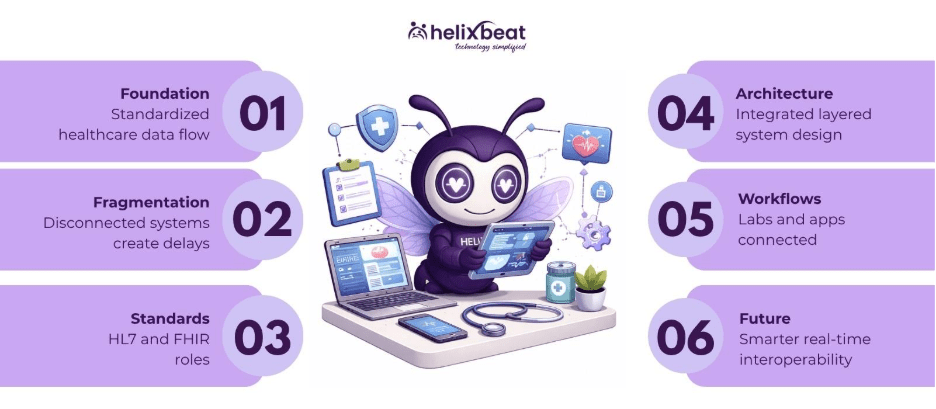
What Are Data Exchange Standards in Healthcare?
Data exchange standards in healthcare are frameworks that define how medical data is structured, formatted, and transmitted between different systems.
These standards address three key challenges:
- Data structure: How information is organized (e.g., patient demographics, lab values)
- Data format: How the data is encoded (XML, JSON, etc.)
- Data transmission: How systems send and receive data
Without standardization, healthcare systems would lead to delays, duplication, or potential errors.
Why Real Healthcare Systems Struggle Without Standards
Healthcare ecosystems are highly fragmented. A single patient journey may involve:
- Electronic Health Record (EHR) systems
- Laboratory Information Systems (LIS)
- Radiology Information Systems (RIS)
- Pharmacy systems
- Insurance platforms
Each system may use different data formats and technologies. Without data exchange standards in healthcare, integration becomes complex and unreliable.
Common Challenges Without Standards
- Inconsistent data formats across systems
- Manual data entry and duplication
- Delayed communication between departments
- Increased risk of clinical errors
- Difficulty in scaling digital health solutions
Standards solve these problems by creating a common language for systems to communicate.
Core Data Exchange Standards Used in Real Systems
To understand how data exchange standards in healthcare work in practice, it’s important to briefly review the most widely used standards.
HL7 (Health Level Seven)
HL7 is one of the oldest and most widely adopted standards for healthcare data exchange.
- Primarily used for system-to-system messaging
- Common in hospital integrations
- Formats include HL7 v2 and HL7 v3
FHIR (Fast Healthcare Interoperability Resources)
FHIR is a modern standard designed for web-based healthcare applications.
- Uses RESTful APIs
- Supports JSON and XML
- Modular structure using “resources”
FHIR is widely used in mobile apps, patient portals, and cloud-based systems.
Real Healthcare System Architecture for Data Exchange
To understand how data exchange standards in healthcare function, let’s look at a simplified architecture used in many hospitals.
Key Components in the Architecture
- EHR System
Central repository for patient data - Integration Engine (AERIS)
Translates and routes messages between systems - Specialized Systems
- LIS (Lab systems)
- RIS (Radiology systems)
- Pharmacy systems
4. API Layer (FHIR Server)
Enables modern applications to access data
5.mExternal Systems
Insurance providers, health apps, and national registries
How the Architecture Works
- Systems generate data in their native format
- The integration engine converts data into standard formats (HL7, FHIR)
- Data is routed to the appropriate system
- APIs allow real-time access to structured data
This layered approach allows different technologies to coexist while maintaining interoperability.
Workflow Example 1: Lab Test Result Exchange
Let’s explore a real-world example of how data exchange standards in healthcare work.
Step-by-Step Workflow
Step 1: Doctor Orders a Test
- The doctor enters a lab test request in the EHR
- The system generates an HL7 message
Step 2: Message Sent to Lab System
- The integration engine routes the HL7 message to the LIS
Step 3: Lab Processes the Test
- The LIS performs the test and generates results
Step 4: Results Sent Back
- The LIS sends an HL7 result message to the integration engine
Step 5: EHR Updates Patient Record
- The integration engine maps the data and updates the EHR
Key Insight
HL7 is ideal for this workflow because it supports structured messaging between internal systems.
Workflow Example 2: Patient Data Access via FHIR API
Now let’s look at a modern workflow using FHIR.
Scenario: Patient Mobile App Accessing Health Records
Step 1: Patient Logs into App
- The app connects to a FHIR server
Step 2: API Request Sent
- The app requests patient data using the REST API
Step 3: FHIR Server Processes Request
- Data is retrieved from the EHR
Step 4: Data Returned in JSON Format
- The app displays structured patient information
Example Data Structure (Simplified)
- Patient name
- Age
- Medications
- Lab results
Key Insight
FHIR enables real-time, flexible data access, making it ideal for digital health applications.
How Integration Engines like AERIS Power Data Exchange
AERIS is the backbone of data exchange standards in healthcare.
What AERIS Does
- Converts data formats (HL7 ↔ FHIR)
- Routes messages to the correct systems
- Handles data transformation and validation
Functions
- Message parsing
- Data mapping
- Error handling
- Workflow orchestration
Without AERIS, connecting multiple systems would require complex, custom integrations.
Future of Data Exchange Standards in Healthcare
The evolution of data exchange standards in healthcare is shaping the future of digital health.
Key Trends
- Increased adoption of FHIR APIs
- Growth of cloud-based healthcare platforms
- Integration with AI and analytics tools
- Expansion of global interoperability frameworks
Healthcare systems are moving toward real-time, patient-centered data exchange models.
Best Practices for Implementing Data Exchange Standards
To build efficient systems, healthcare organizations should focus on:
- Choosing the right standard for each use case
- Designing scalable architectures
- Investing in integration platforms like AERIS
- Prioritizing data quality and consistency
- Aligning with regulatory frameworks
Final Thoughts
Understanding how data exchange standards in healthcare work in real systems requires more than theoretical knowledge. It involves analyzing workflows, system architecture, and real-world challenges.
From HL7-based messaging in hospitals to FHIR-powered APIs in modern applications, these standards form the foundation of healthcare interoperability. When implemented effectively, they enable faster communication, better coordination, and improved patient outcomes.
Are you ready to simplify your healthcare data exchange?
Frequently Ask Questions
1. Why is health information exchange important in healthcare?
It improves care coordination, reduces duplicate tests, minimizes errors, and helps providers make timely, data-driven decisions across different healthcare settings.
2. What are the main models of health information exchange?
3. Which standards guide health information exchange?
Standards like FHIR and HL7 define consistent data formats, making it easier for EHRs, HIEs, and other healthcare platforms to exchange information.
4. What are the benefits of using health information exchange?
HIE improves care coordination, reduces healthcare costs, supports population health management, enhances research, and increases operational efficiency.
5. How does AERIS enhance healthcare information exchange?
AERIS leverages FHIR standards, connects legacy systems, automates workflows, reduces manual errors, and provides real-time access to patient records and lab results.
1. What are data exchange standards in healthcare?
They are frameworks that define how healthcare data is structured, formatted, and shared between systems.
2. Why are data exchange standards important?
They enable interoperability, reduce errors, and improve efficiency in healthcare systems.
3. What is the difference between HL7 and FHIR?
HL7 focuses on messaging, while FHIR uses APIs for real-time data exchange.
4. Where is FHIR used?
FHIR is commonly used in mobile apps, patient portals, and cloud-based systems.
5. What is an integration engine?
It is middleware that connects different healthcare systems and manages data exchange.
6. Can multiple standards be used together?
Yes, most healthcare systems use a combination of HL7, FHIR, and DICOM.
7. What are the main challenges in implementation?
Legacy systems, data mapping, and regulatory compliance are key challenges.
8. Is FHIR replacing HL7?
FHIR is gaining adoption, but HL7 is still widely used in many systems.
9. What is the future of healthcare data exchange?
The future focuses on API-driven, real-time, and patient-centered data exchange.