


Supercharge Your Business with Database and Data Warehousing Solutions
In an age where data drives success, the ability to store, manage, and analyze information effectively can make or break a business. Whether you’re a dynamic startup, a scaling mid‑sized company, or a global enterprise — adopting robust database and data warehousing solutions can be the difference between ad‑hoc decisions and data‑driven strategy.
With Helixbeat’s expertise in enterprise data services and cloud infrastructure, your business can access world‑class database and data warehousing capabilities — enabling better analytics, seamless integration, stronger governance, and scalable growth.
Request a free consultation and see how Helixbeat’s database and data warehousing solutions can transform your business insights and decision-making.
Understanding the Essentials: What is Database and Data Warehousing?
To appreciate the power of database and data warehousing, it’s important to understand what each term signifies — and why combining them unlocks real value.
- A database is designed to handle real-time, transactional data — maintaining records of customers, transactions, logs, or any ongoing operational data. This supports daily business operations such as order processing, user management, customer interactions, and more.
- A data warehouse serves a different purpose: it gathers, consolidates, and stores historical or aggregated data from multiple sources — databases, external apps, logs, analytics, third‑party tools — and optimizes that data for reporting, analytics, and business intelligence.
By marrying these two — leveraging both real‑time databases and a strategic warehouse layer — businesses gain a holistic data infrastructure. Helixbeat builds and manages this infrastructure, enabling you to focus on insights rather than plumbing.
Why Database and Data Warehousing Are Critical for Businesses Today
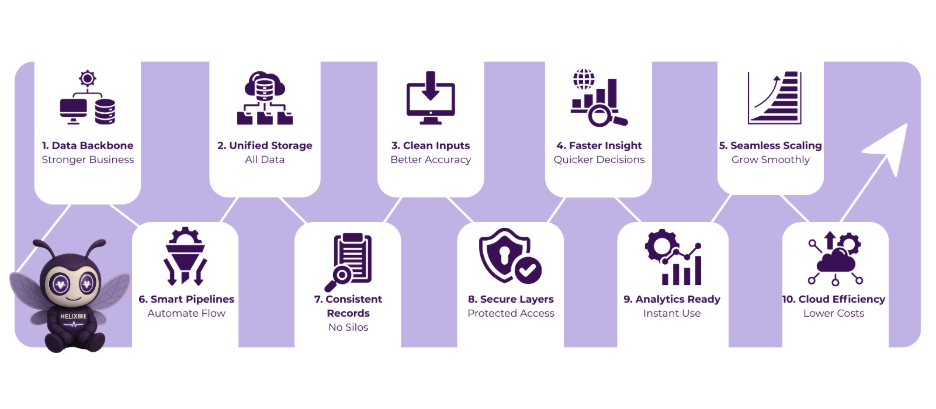
Modern businesses face ever‑growing volumes of data from multiple channels: web applications, mobile apps, CRM systems, marketing tools, customer support logs, IoT devices, and more. Without proper structure, this data quickly becomes fragmented, inconsistent, and hard to leverage.
Implementing database and data warehousing delivers several critical advantages:
Centralized Data Management & Single Source of Truth
Rather than having multiple isolated databases, spreadsheets, and application siloes — a unified warehouse ensures all data lives in one place. This means consistent definitions, clean data, and accurate cross‑department reporting. Microsoft Azure+2Exasol+2
Improved Data Quality, Governance & Compliance
With a robust warehouse, you can apply validation rules, data cleansing, deduplication, metadata management, and governance. This ensures data accuracy, traceability, and readiness for audits or regulatory compliance. Exasol+1
Scalability & Elasticity — Grow Without Limits
As data volume grows — whether due to more customers, more events, more applications — a cloud‑backed database and data warehousing solution scales effortlessly. You don’t need to worry about server capacity, hardware upgrades, or infrastructure overhead. Google Cloud+2Datahub Analytics+2
Faster Time-to-Insights & Business Intelligence
Because data is consolidated, cleaned, and optimized for analytics, teams can run queries, generate dashboards, and derive insights rapidly. This accelerates decision cycles and enables proactive business strategy rather than reactive responses. Aegis Softtech+2itbroker.com+2
Cost Efficiency & Reduced Operational Overhead
Cloud‑based warehousing eliminates the need for large upfront investments in servers, reduces maintenance burden, and shifts costs from CapEx to OpEx. Organizations only pay for what they use. itbroker.com+2Nous+2
Flexibility & Integration with Modern Data Ecosystem
From CRM and ERP systems to SaaS tools, logs, IoT feeds, and third‑party services — a modern warehouse can integrate data from varied sources. This enables unified analytics across business units and data types. Google Cloud+2DICEUS+2
Taken together, these benefits make database and data warehousing not just a nice-to-have — but a strategic necessity for businesses aiming to stay competitive, agile, and data-driven.
Helixbeat’s Database and Data Warehousing Services — What You Get
Helixbeat delivers enterprise-grade database and data warehousing services that meet U.S. market standards: scalable, secure, compliant, and optimized for modern analytics workloads. Here’s how:
Managed Cloud Data Warehouse (DWaaS)
Helixbeat provides a fully managed, cloud-based data warehouse as a service (DWaaS). This means you don’t have to worry about infrastructure — hardware setup, software configuration, scaling, backups, or performance tuning are all handled by Helixbeat’s team.
You benefit from a warehouse database management system that’s elastic — capable of dynamically scaling storage and compute resources to match your data volume and usage patterns. The system supports large datasets, complex queries, and analytics workloads with performance and reliability.
Robust Data Integration & ETL/ELT Pipelines
Helixbeat’s service includes building and managing data ingestion pipelines — bringing together data from multiple sources: transactional databases, application logs, third‑party SaaS platforms, IoT devices, and more. The ETL (Extract, Transform, Load) or ELT (Extract, Load, Transform) processes ensure data is cleaned, standardized, transformed, and loaded into the warehouse in analytics‑ready form.
This ensures data consistency, quality, and reliability — making downstream analytics trustworthy and meaningful.
Analytics, BI & Advanced Insights Layer
Once your data is consolidated, Helixbeat connects the warehouse to business intelligence tools, dashboards, and reporting platforms. Whether you need real-time dashboards, historical trend analysis, predictive analytics, or AI/ML‑driven insights — the infrastructure supports it. Cloud warehouse architecture often enables support for ML frameworks, data mining, and statistical analysis directly on warehouse data.
This empowers your business teams — product, marketing, operations, finance — to leverage data for strategy, forecasting, performance tracking, and optimization.
Scalability, Performance & Cost Optimization
With database and data warehousing provisioned via cloud, your system scales with your needs. Helixbeat’s offering ensures you never overpay for idle infrastructure — compute and storage scale up during peaks, and scale down during quieter periods.
This gives you enterprise-level performance and flexibility, with predictable and manageable costs.
Security, Governance & Compliance
Given today’s data privacy and compliance landscape — particularly for U.S. businesses — data security and governance are non-negotiable. Helixbeat’s warehouse database management system includes data governance practices: metadata management, access control, encryption, audit logging, and compliance with regulatory standards.
This ensures sensitive business data remains secure, while still accessible to authorized stakeholders for analytics and reporting.
Data Warehouse vs Database Management System — Clarifying the Difference
Understanding the data warehouse vs database management system difference is key when evaluating data strategies.
|
Feature / Use Case |
Database (Operational DB) |
Data Warehouse / Warehouse Database Management System |
|
Purpose |
Handles real-time transactional data: orders, user sessions, logs, real-time updates |
Stores aggregated or historical data from multiple sources — optimized for analytics, reporting, business intelligence |
|
Data Type |
Current, up-to-date, transactional records |
Historical, aggregated, transformed, analytics-ready data |
|
Workload Type |
Frequent inserts, updates, deletes (OLTP) |
Complex reads, aggregations, analytics queries (OLAP) |
|
Typical Use |
Application backend, real-time operations, CRUD |
Reporting, trend analysis, BI dashboards, forecasting |
|
Optimization |
Fast transactions, concurrency, integrity |
Fast queries, large-scale data scanning, analytics, historical insight |
Helixbeat helps businesses leverage both — operational databases for real-time workloads, and a robust data warehouse management system for analytics and intelligence. The synergy between the two gives a unified, powerful data strategy.
This clear distinction shows why simply having a database isn’t enough — modern enterprises need the analytical power and historical perspective that only data warehousing adds.
Situations Where Database and Data Warehousing Solutions Bring Maximum Value
- Growing Companies with Multiple Data Sources
As businesses scale — using CRM, eCommerce, marketing tools, SaaS platforms, mobile/web apps — data quickly fragments across systems. A consolidated warehouse enables unified analytics, combining data from sales, marketing, customer support, operations, and more.
- Organizations Needing Historical Trends & Forecasting
For companies that need to track performance over months, quarters, or years — e.g. sales trends, user behavior, growth metrics — a database and data warehousing setup becomes essential. Warehousing stores data longitudinally, enabling trend analysis, forecasting, cohort analysis, and data-driven planning.
- Enterprises Looking to Adopt BI, Reporting & Smart Analytics
For businesses aiming to build dashboards, business intelligence reports, performance metrics, KPIs, or even predictive analytics — a warehouse offers a clean, consistent data backbone. Teams across finance, marketing, operations, and strategy can draw on the same data with trust.
- Companies That Want to Avoid Infrastructure Overhead
Instead of building on-premise data centers, provisioning hardware, maintaining servers, patching software — many companies, especially SMBs and mid-size firms, benefit from a managed cloud database and data warehousing solution — simpler, cost-effective, and maintenance‑free.
- Businesses Requiring Compliance, Security & Governance
Organizations dealing with sensitive data, regulatory compliance, or data audits — such as finance, healthcare, or enterprises with privacy requirements — can leverage the data governance, encryption, access control, and audit capabilities of a managed warehouse to meet compliance needs.
The Strategic Edge: How Database and Data Warehousing Powers Competitive Advantage
Implementing robust database and data warehousing isn’t just about technology — it’s about giving your business a strategic edge.
- Data-Driven Decision Making Across the Organization: With unified, clean data, leadership and teams can make informed strategic decisions rather than relying on gut feelings or siloed reports.
- Faster Insights & Agility: In fast-moving markets — marketing campaigns, sales cycles, customer behavior — the ability to analyze data quickly helps respond faster, iterate strategies, and adapt.
- Scalable Infrastructure for Growth: As business expands — more users, more transactions, more data — your infrastructure doesn’t become a bottleneck. It scales seamlessly, supporting growth without re‑architecture.
- Cost Optimization & Operational Efficiency: Instead of investing upfront in hardware and separate teams for data infrastructure, you streamline costs, reduce operational burden, and focus investments where they matter: product, marketing, and growth.
- Cross-Functional Collaboration & Insight Sharing: Unified data enables cross-department analytics — bridging finance, sales, marketing, operations, and leadership. Everyone gets a consistent “single source of truth.”
- Preparedness for Advanced Analytics & AI/ML: With structured, consolidated data, your business becomes ready for advanced analytics, predictive modeling, machine learning, and data-driven automation.
In short: database and data warehousing transforms data from a byproduct to a core strategic asset — powering growth, efficiency, and competitive advantage.
Why Choose Helixbeat for Your Database and Data Warehousing Needs (for U.S. Businesses)
For U.S. firms — startups, SMEs, or enterprises — Helixbeat offers a compelling, enterprise‑grade solution:
- Managed cloud DWaaS with global standards — meaning no worries about infrastructure, maintenance, or scaling.
- Seamless integration of multiple data sources — transactional DBs, SaaS tools, external APIs, logs, third‑party systems — all unified into one warehouse.
- Analytics‑ready warehouse with BI tool integration, reporting, dashboards, trend analysis, and ML/AI readiness.
- Cost-effective, flexible pricing (pay‑as‑you‑grow), avoiding large upfront investment — ideal for businesses scaling fast.
- Strong data governance, security, encryption, compliance support — critical for U.S. market regulations and data privacy standards.
- Expertise in implementing warehouse setups tailored to varied industries: eCommerce, SaaS, FinTech, healthcare, logistics, etc.
With Helixbeat, you don’t just get technology — you get a partner to build and manage your data backbone, freeing your team to focus on growth, innovations, and business strategy.
Implementation Overview: How Helixbeat Deploys Database and Data Warehousing
Here’s a typical workflow when Helixbeat sets up a database and data warehousing solution for a client:
Assessment & Requirements Gathering
- Understand current data sources (databases, apps, logs, tools).
- Define business goals: reporting, analytics, compliance, scalability.
- Plan data model, warehouse schema, access controls, compliance requirements.
Data Integration & ETL/ELT Pipeline Design
- Build pipelines to extract, transform, cleanse data from multiple sources.
- Standardize and validate data to enforce quality and consistency.
- Load data into warehouse in optimized, analytics-ready format.
Warehouse Deployment & Configuration
- Provision a cloud-based warehouse database management system — scalable storage + compute.
- Configure security settings, access roles, encryption, backups, disaster recovery.
- Set up performance optimization (indexes, in-memory processing, columnar storage, parallel querying).
BI, Analytics & Reporting Setup
- Connect warehouse to BI tools, dashboards, reporting platforms.
- Build KPI dashboards, analytics reports, real-time and historical insights.
- Optionally enable ML/AI tool integration for predictive analytics, anomaly detection, automation.
Ongoing Maintenance, Governance & Scaling
- Continuous monitoring of performance, resource usage, scaling needs.
- Regular data governance, audits, metadata management, compliance checks.
- Ability to add new data sources or analytics modules as business evolves.
This approach ensures a robust, flexible, and future-proof database and data warehousing backbone for your organization.
Testimonials
- “Helixbeat’s database and data warehousing solutions transformed our business operations. Their expertise in implementing a warehouse database management system allowed us to consolidate all our data into one secure, scalable platform. Truly a game-changer!”
— Jessica Miller, CTO, TechNova Solutions - “Thanks to Helixbeat, our data strategy has completely shifted. Their database and data warehousing services provide real-time insights, and the data warehouse management system they implemented is incredibly efficient and reliable.”
— David Lee, Head of Analytics, BrightWave Inc. - “We struggled to understand the data warehouse vs database management system difference until Helixbeat stepped in. Their guidance and solutions made our database and data warehousing seamless and optimized for analytics.”
— Samantha Rogers, VP of IT, NovaCore Technologies - “Helixbeat helped us bridge the database and data warehouse difference with a fully managed warehouse database management system. The clarity, speed, and insight we now have are unparalleled.”
— Michael Thompson, CIO, FusionWorks Ltd. - “Implementing Helixbeat’s database and data warehousing services was one of the best decisions for our company. The data warehouse management system they provided has streamlined our analytics and reporting processes dramatically.”
— Emily Carter, Director of Operations, SkyHigh Solutions - “Helixbeat’s expertise in database and data warehousing allowed us to integrate multiple data sources effortlessly. Their warehouse database management system ensures we have reliable, actionable insights at all times.”
— Robert Johnson, Head of Data, Apex Innovations
Final Thoughts — Why Database and Data Warehousing Is Worth It
In the digital economy, data is more than just a byproduct — it’s a strategic asset. When managed well, data becomes a competitive advantage: enabling smarter decisions, better forecasts, deeper customer insights, operational efficiencies, and innovation.
But only if you have the right infrastructure. Basic databases support operations — but they’re not designed to provide historical context, cross‑system analytics, governance, or scalability. That’s where a database and data warehousing solution becomes invaluable.
Helixbeat’s managed services deliver this infrastructure with enterprise-grade reliability, performance, and flexibility — allowing U.S. businesses to stay agile, data-driven, and future-ready.
If you’re ready to move beyond fragmented data and spreadsheets, embrace data as a core business asset, and unlock insights that drive growth — then investing in database and data warehousing is the strategic decision that will pay off in clarity, speed, and competitive advantage.
Supercharge your business with database and data warehousing solutions — because data done right fuels growth, innovation, and sustainable success.
What Users Say About AERIS
Dr. Sarah L.
Hospital Administrator
John T.
Telemedicine Provider
Emily P.
Healthcare Executive
Frequently Asked Questions
Q1. What is the difference between a database and a data warehouse?
A: A database typically handles real-time, transactional data for ongoing operations. A data warehouse consolidates and stores historical or aggregated data from multiple sources for analytics, reporting, and business intelligence. The database is optimized for transactions (inserts, updates, deletes), while the warehouse is optimized for queries, analytics, and data exploration.
Q2. What is a warehouse database management system?
A warehouse database management system is a platform — typically cloud-based — designed to store, manage, and query large amounts of structured and consolidated data. It supports analytics workloads, enables integrations, and handles scaling, security, and governance.
Q3. What is a data warehouse management system?
This refers to the overall system (software + infrastructure + processes) that enables the collection, storage, transformation, governance, and analysis of warehouse‑ready data across sources. It combines data ingestion, transformation pipelines, storage, querying, and analytics tools in a unified architecture.
Q4. Why should my U.S.-based business adopt database and data warehousing solutions?
Because modern businesses generate data from multiple sources: web/mobile apps, SaaS tools, transaction logs, CRM systems, marketing platforms, etc. A structured warehouse allows you to consolidate that data, maintain cleanliness, run analytics, generate insights, and scale without infrastructure headaches — while staying compliant with privacy, governance, and security standards.
Q5. Is cloud-based warehousing safe and reliable?
Yes. Cloud-based data warehouses — when implemented with proper encryption, access control, governance, and compliance — offer strong security, reliability, high availability, automated backups, and disaster recovery. Providers also manage infrastructure, patches, and maintenance, reducing risk and overhead.
Q6. How quickly can a business start using warehouse-based analytics?
With a managed service like Helixbeat’s database and data warehousing offering, setup can be much faster than traditional on-prem systems. With proper planning and data integration strategy, companies can begin ingesting data and generating analytics — often within weeks rather than months.
Q7. Can warehouse systems support advanced analytics and machine learning?
Absolutely. A well‑built warehouse acts as a foundation for BI, predictive analytics, machine learning, and AI-powered insights. Since data is consolidated, clean, and structured, data scientists and analysts can build models, dashboards, and forecasting tools on top of it.
Q8. What kind of businesses benefit most from database and data warehousing?
Businesses with multiple data sources (ecommerce, SaaS, finance, logistics), companies needing analytics across departments (sales, marketing, operations, finance), fast-growing firms expecting data growth, and companies requiring compliance, governance, or historical analytics — all benefit substantially from a robust warehouse setup.