


AERIS:The Future of EHR Data Integration in Healthcare
Get Started with a Free Demo
New Lead: AERIS
AERIS Landing Page Form, connected with the Mailchimp.
"*" indicates required fields
When patient data flows smoothly, everything in healthcare improves. EHR data integration is the key to unlocking that flow, connecting your electronic health records with all your other systems. As healthcare organizations grapple with fragmented data silos, electronic health record integration emerges as the key to unify disparate sources, from clinical notes to billing systems.
Here, we’ll explore the intricacies of EHR data integration, its benefits, and how specialized EHR data integration software solutions like AERIS can optimize workflows, particularly in EHR data integration with hospital management software.
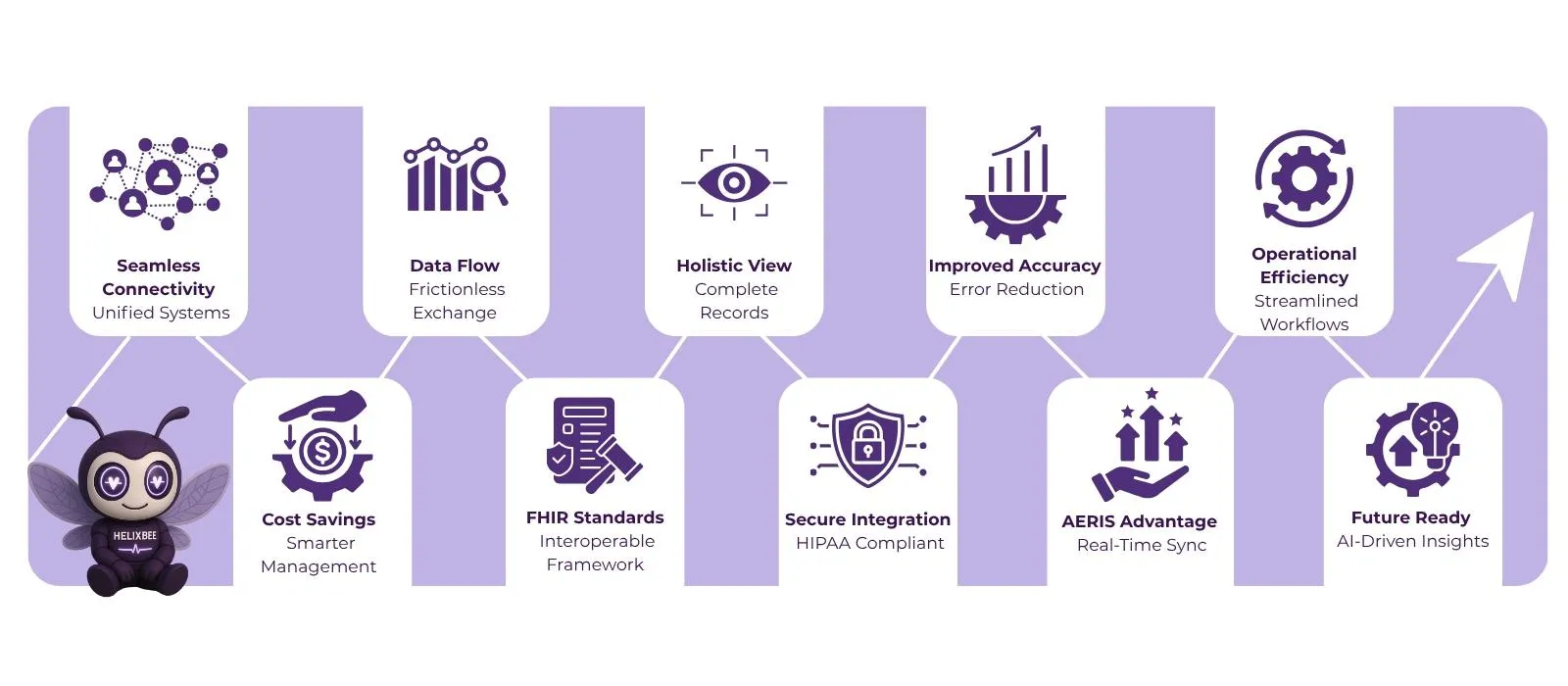
What is EHR Data Integration?
EHR data integration is the process of connecting electronic health record systems with other healthcare applications, databases, and platforms to facilitate the exchange and synchronization of patient data. Electronic health record integration involves mapping data from various sources into a standardized format that multiple systems can understand and utilize. This goes beyond simple data transfer; it includes real-time updates, bidirectional communication, and compliance with industry standards such as HL7 and FHIR.
In practice, EHR data integration bridges gaps between legacy systems and modern tools. The connection reaches out to pharmacies, specialists, and other external partners. That way, doctors get a holistic view of a patient’s health. Even healthcare IT pros agree: getting accurate, up-to-the-minute data to clinicians is a direct path to better patient results.
The evolution of EHR data integration has been driven by regulatory mandates like the HITECH Act, which promotes interoperability to enhance care coordination. Today, solutions focus on cloud-based architectures that scale with growing data volumes, supporting analytics for population health management.
Benefits of EHR Data Integration
When you integrate your EHR data, you see benefits ripple through your entire organization—from the clinic to the front office to the finance department. Right away, you get better patient care simply because the data is easier to find. Clinicians can immediately pull up a patient’s complete history, helping them cut down on mistakes and offer truly personalized treatment. The great part for patients? They skip those unnecessary repeat tests and move through care much faster.
Operational efficiency is another key benefit. By automating data flows, EHR data integration minimizes administrative burdens, such as paperwork and manual reconciliations. As a result, staff spend less time on redundant tasks and focus more on direct patient interactions. Studies indicate that integrated systems boost productivity and reduce clinician burnout.
From a financial perspective, electronic health record integration immediately reduces costs by eliminating inefficiencies. Fewer mistakes mean fewer rejected claims, and smarter resource management drives down your operating expenses. But the real kicker is the analytics: the combined data helps you predict everything from disease trends to staffing needs. For hospitals, linking this clinical data to administrative tools, like scheduling and inventory, unifies the entire operation.
Data security and compliance also improve with proper integration. Standardized protocols protect sensitive information during transfers, aligning with HIPAA requirements. Overall, these benefits position EHR data integration as indispensable for forward-thinking healthcare entities.
Best Practices for Electronic Health Record Integration
To overcome integration obstacles, healthcare leaders should adopt proven strategies for integrating electronic health records. Start by assessing current infrastructure to identify compatibility gaps and prioritize high-impact connections, such as those with lab or imaging systems.
Leverage industry standards like FHIR for flexible, API-driven exchanges. These protocols promote plug-and-play compatibility, meaning you spend less time on custom coding. Also, engage stakeholders early, including clinicians and IT teams, to align on requirements.
Invest in scalable EHR data integration software solutions that support real-time processing. Cloud platforms are great for this because they can instantly grow or shrink to handle any amount of data without getting bogged down by physical hardware. Finally, keep checking your work! Regular audits and feedback loops help you fine-tune the system and track how accurate your data is and how reliable the system is running.
For EHR data integration with hospital management software, focus on bidirectional APIs that sync patient admissions, discharges, and billing in real time. Pilot integrations in non-critical areas before full deployment, and incorporate robust testing to simulate peak loads.
Partnering with specialized providers streamlines this process. Solutions like AERIS excel in this area by embedding interoperability standards directly into workflows. By following these practices, organizations can achieve sustainable, high-performing integrations.
EHR Data Integration Software Solutions: Why AERIS Stands Out
EHR data integration software solutions have evolved to address the complexities of modern healthcare data ecosystems. AERIS, by Helixbeat, acts as a translator for your EHR, using standards like HL7 and FHIR to tie all your data into one neat, unified system. This approach simplifies electronic health record integration by automating data mapping and validation.
Ready to cut delays by 50%, double your ROI, and empower your team with instant access to critical data? Let’s dive into why AERIS is the solution you’ve been waiting for.
Why AERIS is Your Key to Healthcare Innovation
At Helixbeat, we know your challenges: fragmented systems, delayed data, and rising costs. AERIS is here to change that, offering a personalized, scalable, and secure platform that fits your unique needs. Whether you’re a small clinic or a sprawling hospital network, AERIS delivers measurable results that elevate patient outcomes and boost your bottom line.
1. 20+ Years of Expertise
Our team brings decades of healthcare IT experience to ensure AERIS works for you.
2. 50+ IT Professionals
A dedicated crew powers AERIS, delivering unmatched support and innovation.
3. 1,000+ Customers
Join a thriving community of healthcare leaders already transforming with AERIS.
4. 10,000+ Projects Completed:
Proven success across countless integrations and workflows.
5. 95% Returning Customers
Our clients trust AERIS to deliver, time and time again.
Providers adopting AERIS report faster diagnoses, lower costs, and improved outcomes, positioning it as the go-to tool for future-proof HIE.
The AERIS Advantage: Numbers That Speak for Themselves
| Metric | Without AERIS | With AERIS | Your Benefit |
| Data Exchange Delays | Frequent bottlenecks | Reduced by 50% | Faster care in emergencies |
| Return on Investment | Slow, costly overhauls | 100% faster ROI | Grow without breaking the bank |
| Operational Costs | High redundancies | Cut by 30% | Save thousands annually |
| Error Rates | Up to 20% manual errors | Slashed by 90% | Precision for better patient outcomes |
Your Benefits, Amplified
1. 50% Fewer Delays
Real-time data means critical information is always at your fingertips, turning hours into seconds.
2. 100% Faster ROI
Plug-and-play integration maximizes your investment without expensive system replacements.
3. 30% Cost Savings, 90% Fewer Errors
Automation eliminates waste, saving resources and ensuring accuracy.
How AERIS Works: Your 3-Step Path to Success
1. Connect Seamlessly: Integrate AERIS effortlessly into your existing systems, from legacy EHRs to modern platforms.
2. Share Securely: Activate real-time data exchange with HIPAA-compliant encryption. Watch your teams and partners collaborate effortlessly.
3. Optimize and Grow: Because AERIS evolves with your organization, it’s set up to help you succeed for the long haul.
Final Thoughts
Looking ahead, EHR data integration will incorporate AI and machine learning for predictive analytics and automated insights. Advances in edge computing will further enable real-time processing at the point of care. As standards mature, interoperability will become more ubiquitous and democratize access to advanced tools.
Organizations ready to embrace this future should consider AERIS for its forward-thinking design. By prioritizing EHR data integration, healthcare providers can deliver superior outcomes, operate cost-effectively, and adapt to evolving demands. Explore AERIS and unlock the full potential of electronic health record integration.
Frequently Ask Questions
1. Why is EHR data integration important for healthcare organizations?
It helps unify patient data from different sources, improving care coordination, reducing manual errors, and giving clinicians a complete view of each patient’s health history.
2. How does EHR data integration improve patient care?
It provides clinicians with real-time access to accurate patient records, helping them make better decisions, reduce duplicate testing, and deliver more personalized care.
3. What role do HL7 and FHIR standards play in EHR data integration?
HL7 and FHIR are industry standards that make it easier for different systems to communicate by structuring healthcare data in a consistent, interoperable format.
4. How do Health Information Systems maintain data privacy and security?
Yes. By automating data sharing and minimizing administrative tasks, healthcare organizations can cut down on inefficiencies, reduce claim rejections, and improve financial performance.
5. How does AERIS simplify EHR data integration?
AERIS automates data mapping and validation while supporting HL7 and FHIR standards. It connects diverse healthcare systems into a single, unified data ecosystem with secure, high-speed performance.