


Electronic Health Record Information
Electronic health record information sits at the center of modern healthcare delivery, yet many providers still struggle to access, share, and manage it efficiently. Disconnected electronic health records systems, data silos, and limited interoperability often lead to delayed clinical decisions, repeated tests, compliance risks, and increased operational burden.
When electronic medical records systems cannot communicate seamlessly, critical patient information remains fragmented, impacting both care quality and provider efficiency.
The solution lies in moving beyond basic record storage toward intelligent data exchange. Advanced platforms enable electronic health record information to flow securely and in real time across systems, departments, and care settings.
By improving interoperability between electronic health records systems and external applications, providers gain a complete, accurate patient view – supporting faster decisions and scalable healthcare operations.
What Is Electronic Health Record Information?
Electronic health record information is the complete, digital collection of a patient’s medical and administrative data that is created, stored, and updated across their healthcare journey. This includes patient demographics, medical history, diagnoses, medications, treatment plans, lab results, imaging reports, and clinical notes.
Unlike traditional records, electronic health records provide a dynamic and continuously updated view of patient information, ensuring healthcare teams have accurate data whenever and wherever it is needed.
The value of electronic health record information lies in its ability to be shared across multiple electronic health records systems and electronic medical records systems. When properly managed, it supports continuity of care, reduces duplication of tests, and improves clinical decision-making. By connecting data from different systems, providers can create a unified patient view that enhances care coordination, patient safety, and overall healthcare efficiency.
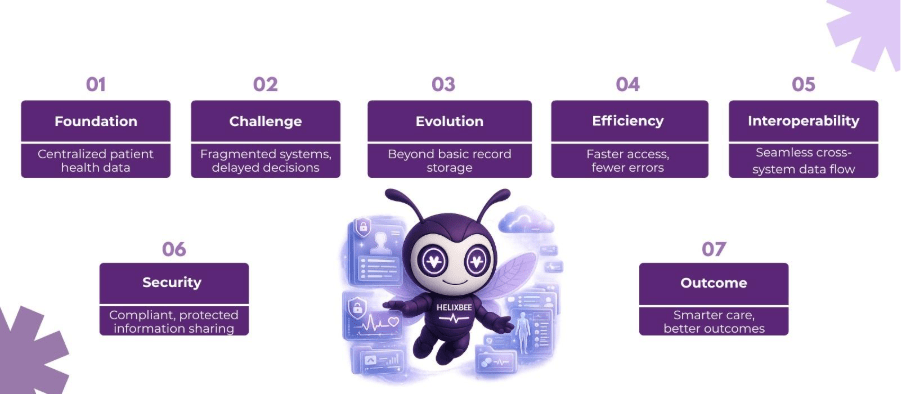
How Electronic Health Records Systems Manage and Deliver This Information
Managing and delivering accurate patient data is one of the biggest challenges for healthcare providers today, and electronic health records systems are designed to solve it efficiently.
1. Collecting and Storing Patient Data Efficiently
Electronic health records systems are designed to gather and store all kinds of patient information in one digital platform. From medical history and lab results to medications and imaging reports, these systems ensure that electronic health record information is organized and easy to access.
Studies show that hospitals using EHR systems reduce manual paperwork by up to 50%, freeing staff to focus on patient care.
By centralizing data from different sources, healthcare providers no longer waste time searching through paper files or multiple systems, which speeds up care and reduces errors.
2. Delivering Real-Time Information to Care Teams
One of the biggest advantages of electronic health records systems is real-time data delivery. Doctors, nurses, and administrative staff can access the latest electronic health record information instantly, no matter where they are.
According to recent reports, clinics with integrated EHR systems can improve patient decision-making speed by 30–40%, helping healthcare teams respond quickly to critical changes in a patient’s condition.
3. Ensuring Security and Compliance
Managing electronic health record information isn’t just about speed—it’s also about keeping sensitive patient data safe. Modern electronic medical records systems and electronic health records systems come with built-in security measures like encryption, role-based access, and audit trails.
Research indicates that healthcare providers using secure EHR platforms experience 25% fewer data breaches compared to traditional systems.
These features help healthcare providers comply with regulations while protecting patient privacy, ensuring data is shared safely across departments and care facilities.
With the right electronic health records systems, providers can streamline operations, secure patient information, and deliver faster, smarter care.
Electronic Medical Records Systems vs Electronic Health Records Information
Feature | Electronic Medical Records Systems (EMR) | Electronic Health Record Information (EHR Info) | Key Benefit |
Scope of Data | Focuses on patient data within a single clinic or hospital | Combines data from multiple sources, including labs, pharmacies, and hospitals | Provides a complete, longitudinal view of patient health |
Data Sharing | Limited sharing, usually within one facility | Easily shared across electronic health records systems and care settings | Improves care coordination and reduces duplicate tests |
Purpose | Primarily used for documentation and billing | Supports clinical decisions, analytics, and care continuity | Enhances patient outcomes and operational efficiency |
Interoperability | Often isolated, with minimal external connections | Designed for seamless integration and real-time updates | Enables secure, timely access to electronic health record information for all care teams |
Choosing a solution that prioritizes electronic health record information over isolated EMR systems ensures your care teams have the full, real-time patient picture – improving decisions, outcomes, and operational efficiency.
The Role of Interoperability in Electronic Health Record Information
Interoperability plays a crucial role in ensuring that electronic health record information flows seamlessly across systems, providers, and care settings. Here’s how it makes a difference:
- Seamless Data Exchange Across Systems
Interoperable electronic health records systems allow patient information to move smoothly between hospitals, clinics, labs, and pharmacies. This reduces delays and ensures providers have the latest data for accurate care decisions. - Improved Patient Safety
Whenelectronic health record information is accessible in real-time across systems, the risk of errors such as duplicate tests or incorrect prescriptions – drops significantly. Studies show interoperability can reduce medical errors by up to 20%. - Enhanced Care Coordination
Interoperability ensures that all members of a care team, from primary care doctors to specialists – have access to the same electronic health records information, improving collaboration and treatment planning. - Compliance and Regulatory Support
Sharing electronic health record information securely between systems helps providers meet regulatory requirements like HIPAA. Interoperable systems include encryption, audit trails, and role-based access to safeguard sensitive patient data. - Data-Driven Insights and Analytics
When electronic health records systems are interoperable, providers can combine data from multiple sources to analyze trends, predict outcomes, and make better operational and clinical decisions. This supports value-based care and population health initiatives.
By prioritizing interoperability, healthcare providers can unlock the full potential of electronic health record information, improving care quality, patient safety, and operational efficiency across the entire organization.
4 Common Challenges Every Providers Faces While Managing Electronic Health Record Information
Even with advanced electronic health records systems, healthcare providers face real challenges when managing electronic health record information. Here are four key issues from a provider’s perspective:
- Fragmented Data Across Systems
Providers often deal with patient information scattered across multiple electronic health records systems or electronic medical records systems. This fragmentation makes it difficult to get a complete view of a patient’s history, leading to repeated tests, delayed diagnoses, and frustration for both doctors and patients. - Time-Consuming Data Entry
Doctors spend a significant portion of their day entering data manually into electronic health records systems. According to studies, clinicians spend nearly 16 minutes per patient on EHR documentation, reducing time available for direct patient care and increasing the risk of burnout. - Challenges in Data Sharing and Interoperability
Even with digital systems, not all electronic health record information flows seamlessly between hospitals, labs, and pharmacies. Poor interoperability can result in missing or outdated information, forcing providers to rely on phone calls, faxes, or manual reconciliation to get critical patient data. - MaintainingCompliance and Security
Managing sensitive electronic health record information requires strict adherence to regulations like HIPAA. Providers face the constant challenge of securing patient data while ensuring it remains accessible to authorized care teams, balancing efficiency with legal and ethical responsibilities.
Managing these challenges effectively is critical for providers who want to deliver high-quality care, reduce errors, and optimize the use of electronic health record information across their practice.
How Advanced Data Exchange Platforms Like AERIS Improve Electronic Health Record Information Flow
Advanced data exchange platforms like AERIS make managing electronic health record information much easier for healthcare providers. Instead of dealing with multiple disconnected systems, AERIS connects your electronic health records systems, labs, pharmacies, and other care partners in one seamless network.
This means patient data like lab results, medication records, and clinical histories – flows quickly and securely to the right doctor at the right time, helping you make faster, more accurate decisions.
Here’s how AERIS helps with electronic health record information:
- Connects different electronic health records systems in real time
- Shares lab results, imaging, medications, and clinical notes instantly
- Reduces mistakes and duplicate tests
- Makes care coordination between hospitals and clinics much smoother
AERIS also keeps patient information safe and your workflow simple. With built-in security like HIPAA-compliant encryption and role-based access, it ensures only authorized staff can see sensitive data. Plus, it automates many manual tasks, saving you time and letting you focus more on patient care.
By bringing all your systems together and making data flow effortlessly, AERIS helps providers get the most out of their electronic health records systems while improving care quality and efficiency.
What Users Say About AERIS
Dr. Sarah L.
Hospital Administrator
John T.
Telemedicine Provider
Emily P.
Healthcare Executive
Frequently Asked Questions
- What is the difference between an EMR and an EHR?
An EMR (Electronic Medical Record) is a digital version of a patient’s chart used within a single clinic or hospital. An EHR (Electronic Health Record) is designed to be shared across multiple healthcare facilities, allowing for broader care coordination.
- Can AERIS work with my existing EMR system?
Yes. AERIS is designed to integrate seamlessly with most EMR systems and other healthcare software, allowing smooth data exchange without disrupting your current workflows.
- How does using an EMR system improve patient safety?
EMR systems reduce manual errors, ensure accurate record-keeping, and provide automated alerts for medications, allergies, or abnormal lab results. This helps clinicians make safer, faster decisions for their patients.
- Areelectronic medical record programs secure?
Yes. Modern EMR programs and platforms like AERIS use encryption, secure logins, and compliance measures to protect sensitive patient data from unauthorized access.
- What factors should I consider when choosing an EMR system?
Key factors include ease of use, integration capabilities, support for your specialty, security and compliance, and the ability to scale as your clinic or hospital grows.