

×

AERIS:The Future of Electronic Health Record Integration

Get Started with a Free Demo

New Keyword Page

New Keyword Page

"*" indicates required fields

Electronic health record integration is transforming healthcare by enabling different systems to share data easily. This leads to better patient care and more efficient operations. As healthcare providers adopt digital solutions, the need for interoperable electronic health record systems becomes critical.
Here, we’ll discuss the importance of electronic health record integration, the role of standards like HL7 and FHIR, and the benefits of using electronic health record integration software solutions like AERIS to achieve a connected healthcare ecosystem.
image 5

What is Electronic Health Record Integration?

Electronic health record integration refers to the process of connecting electronic health record systems with other healthcare applications, devices, or platforms to facilitate the secure and efficient exchange of patient data. This integration enables healthcare providers, hospitals, clinics, and labs to access and share critical information, such as patient histories, lab results, and treatment plans, in real time. By leveraging electronic health record services, organizations can streamline workflows, reduce errors, and improve decision-making.
Integration is important in modern healthcare, where fragmented systems often hinder effective communication. For example, a hospital’s electronic health record system may need to interface with a pharmacy’s medication management system or a laboratory’s diagnostic tools. Without integration, data silos can lead to incomplete patient records, delayed care, and increased costs.
Taking this further, healthcare information exchange focuses on connecting broader networks, sometimes covering entire regions or countries, and relies on government initiatives to standardize the data. Likewise, a health management information system complements HIE by collecting and analyzing data for administrative purposes, like tracking disease outbreaks or resource utilization. Working together, they form a comprehensive framework where health information exchange and interoperability make data flow smoothly and reduce data silos.

Key Benefits of Electronic Health Record Integration

1. Improved Patient Care

Integrated systems provide clinicians with all the patient data they need, helping them make smarter decisions and tailor treatment plans.

2. Operational Efficiency:

Automation of data exchange reduces manual processes, saving time and minimizing errors.

3. Cost Savings

Streamlined workflows and reduced redundancies lower operational costs for healthcare organizations.

4. Regulatory Compliance

Integration supports adherence to standards like HIPAA by securing patient data during transmission.

5. Enhanced Collaboration

Since providers at different facilities can share data, they can work together to coordinate care.

The Role of HL7 and FHIR in Electronic Health Record Integration

The success of electronic health record integration hinges on standardized protocols that enable systems to communicate effectively. Two key standards, Health Level Seven (HL7) and Fast Healthcare Interoperability Resources (FHIR), play a pivotal role in simplifying integration and promoting interoperability.

HL7: The Foundation of Healthcare Data Exchange

HL7, developed by Health Level Seven International, is a set of standards designed to facilitate the exchange, integration, and retrieval of electronic health information. HL7 standards, particularly HL7 Version 2 (V2) and Version 3 (V3), have been widely adopted for decades. These standards define how data, such as patient demographics, clinical observations, and billing information, is structured and transmitted between electronic health record systems.

FHIR: The Future of Interoperability

FHIR, pronounced “fire,” is the next-generation standard developed by HL7 International to address the limitations of earlier standards. FHIR combines the best features of HL7 V2 and V3 while leveraging modern web technologies like RESTful APIs, JSON, and XML. This makes FHIR highly adaptable to today, where mobile apps, cloud-based platforms, and wearables are increasingly common.

How HL7 and FHIR Simplify Integration

Both HL7 and FHIR reduce the complexity of electronic health record integration by providing standardized frameworks. Here’s how they make integration easier:

1. Interoperability

HL7 and FHIR enable systems from different vendors to communicate seamlessly, reducing the need for custom interfaces.

2. Scalability

Because FHIR uses an API-driven design, developers can create modular systems that are easy to scale when healthcare needs evolve.

3. Speed

FHIR utilizes RESTful APIs to facilitate near real-time data exchange, which is critical in time-sensitive situations like emergency care.

4. Developer-Friendly

Since FHIR uses modern web technologies, developers have a much lower learning curve, which speeds up the time it takes to roll out electronic health record integration software.

5. Patient-Centric Care

Both standards support patient data aggregation, giving providers a holistic view of health information.

Best Practices for Successful Electronic Health Record Integration

To maximize the benefits of electronic health record integration, organizations should follow these best practices:

1. Adopt HL7 and FHIR Standards

Use HL7 for legacy systems and FHIR for modern applications to achieve interoperability.

2. Choose Scalable Solutions

Select electronic health record integration software solutions that support future growth and emerging technologies.

3. Prioritize Security

Implement encryption, access controls, and audit trails to protect patient data.

4. Engage Stakeholders

Involve clinicians, IT teams, and administrators early to align integration goals with clinical needs.

5. Test Thoroughly

Conduct rigorous testing to verify data accuracy and system compatibility before deployment.

AERIS: Powering Seamless Electronic Health Record Integration

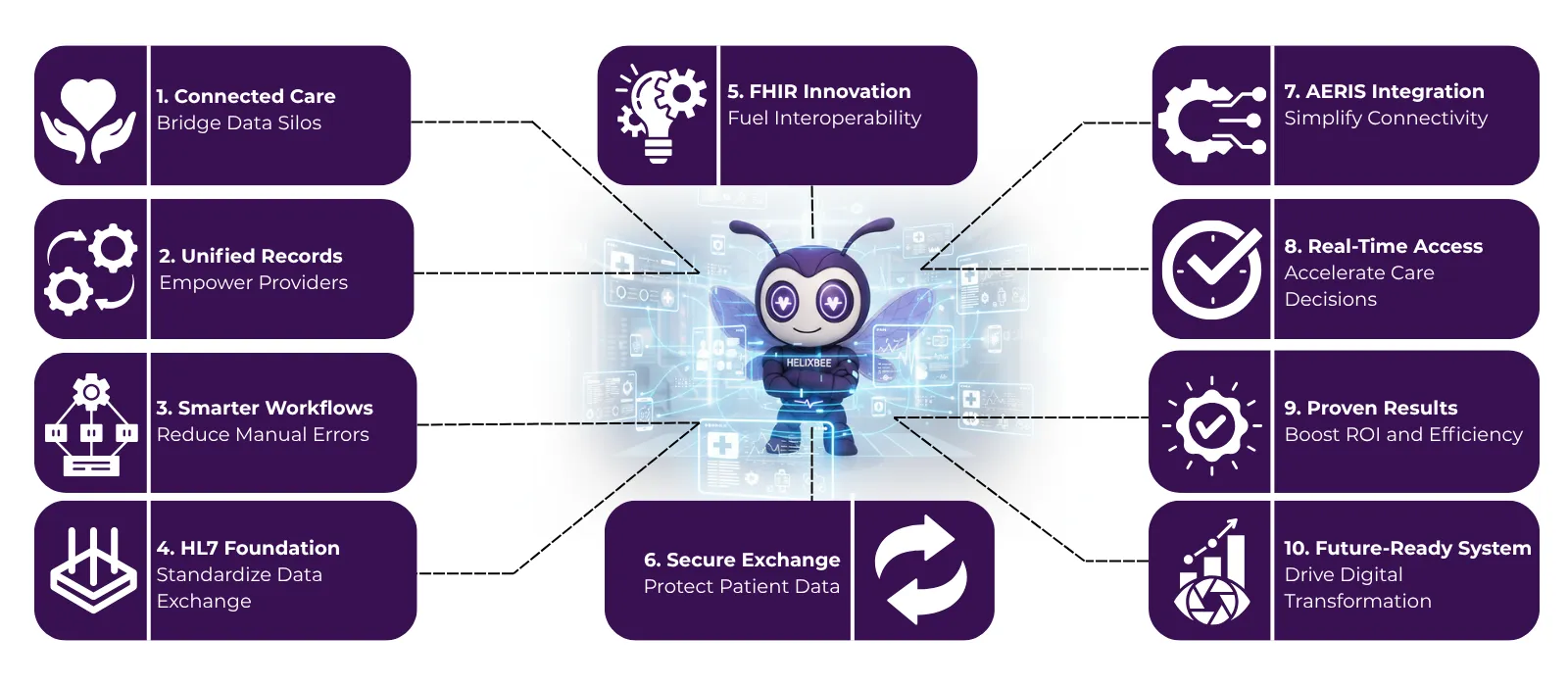
Imagine a world where your healthcare organization thrives with seamless, secure, and real-time data exchange. That’s the power of AERIS by Helixbeat, a game-changing platform designed to transform how you connect, collaborate, and care. Built for healthcare providers, clinics, hospitals, and cross-industry partners like pharmacies and insurers, AERIS harnesses the power of HL7 and FHIR standards to break down data silos, streamline operations, and put patient care first.

Ready to cut delays by 50%, double your ROI, and empower your team with instant access to critical data? Let’s dive into why AERIS is the solution you’ve been waiting for.

Why AERIS is Your Key to Healthcare Innovation

At Helixbeat, we know your challenges: fragmented systems, delayed data, and rising costs. AERIS is here to change that, offering a personalized, scalable, and secure platform that fits your unique needs. Whether you’re a small clinic or a sprawling hospital network, AERIS delivers measurable results that elevate patient outcomes and boost your bottom line.

1. 20+ Years of Expertise

Our team brings decades of healthcare IT experience to ensure AERIS works for you.

2. 50+ IT Professionals

A dedicated crew powers AERIS, delivering unmatched support and innovation.

3. 1,000+ Customers

Join a thriving community of healthcare leaders already transforming with AERIS.

4. 10,000+ Projects Completed:

Proven success across countless integrations and workflows.

5. 95% Returning Customers

Our clients trust AERIS to deliver, time and time again.
Providers adopting AERIS report faster diagnoses, lower costs, and improved outcomes, positioning it as the go-to tool for future-proof HIE.

The AERIS Advantage: Numbers That Speak for Themselves

MetricWithout AERISWith AERISYour Benefit 
Data Exchange Delays Frequent bottlenecksReduced by 50% Faster care in emergencies
Return on Investment  Slow, costly overhauls100% faster ROIGrow without breaking the bank 
Operational Costs  High redundancies Cut by 30%Save thousands annually
Error Rates Up to 20% manual errorsSlashed by 90%Precision for better patient outcomes

Your Benefits, Amplified

1. 50% Fewer Delays

Real-time data means critical information is always at your fingertips, turning hours into seconds.

2. 100% Faster ROI

Plug-and-play integration maximizes your investment without expensive system replacements.

3. 30% Cost Savings, 90% Fewer Errors

Automation eliminates waste, saving resources and ensuring accuracy.

How AERIS Works: Your 3-Step Path to Success

1. Connect Seamlessly: Integrate AERIS effortlessly into your existing systems, from legacy EHRs to modern platforms.
2. Share Securely: Activate real-time data exchange with HIPAA-compliant encryption. Watch your teams and partners collaborate effortlessly.
3. Optimize and Grow: Because AERIS evolves with your organization, it’s set up to help you succeed for the long haul.

Final Thoughts

As healthcare continues to digitize, electronic health record integration will play a central role in shaping the future. Similarly, emerging technologies like artificial intelligence are poised to enhance integration efforts. Additionally, the growing adoption of FHIR will drive the development of innovative electronic health record services, such as patient-controlled health records and real-time analytics.
The push for value-based care, where providers are rewarded for outcomes rather than services, will further emphasize the need for integrated systems. Therefore, embracing electronic health record integration is the key to building a connected, data-driven healthcare ecosystem.
Ready to streamline your healthcare data exchange? Find out how AERIS can unlock the potential of your electronic health record systems.

Frequently Ask Questions

1. Why is EHR integration so important for hospitals and clinics?
Without integration, data stays locked in silos, making it difficult for doctors to access complete patient histories. Integration helps unify this data, improving diagnosis accuracy, care coordination, and operational efficiency.
HL7 provides long-standing rules for how healthcare data is structured and shared, while FHIR uses modern web technologies like APIs to make this process faster, more scalable, and developer-friendly.
AERIS automates data validation and exchange, reducing manual entry errors by up to 90% and cutting data transfer delays by nearly half, which improves response times in critical cases.
The process starts with assessing existing systems, identifying integration goals, and selecting a reliable solution like AERIS that supports HL7 and FHIR standards for smooth connectivity and long-term scalability.