


Electronic Health Record Systems: Components, Benefits, and Future Trends
Electronic Health Record (EHR) systems have really changed healthcare by digitizing patient information and making medical processes much smoother. These systems represent a shift from traditional paper-based records to comprehensive digital platforms that store, manage, and share patient data across providers.
What Are Electronic Health Record Systems?
Electronic Health Record systems, or EHRs, are basically digital files of a patient’s medical history that doctors and hospitals keep updated over time. Unlike paper charts, these systems include a broad range of data like diagnoses, medications, treatment plans, immunization dates, allergies, radiology images, and laboratory test results. Because EHR systems enable real-time access and updates, authorized users—like doctors and nurses—can easily coordinate care across different healthcare professionals.
At their core, Electronic Health Record systems differ from Electronic Medical Records (EMRs), which are typically limited to a single practice or organization. EHRs emphasize interoperability, enabling data sharing across different healthcare settings. Standards like HL7 and FHIR support this exchange. Key features include clinical decision support tools that alert providers to potential issues, such as drug interactions, and patient portals that give individuals access to their own health information.
Key Components of Electronic Health Record Systems
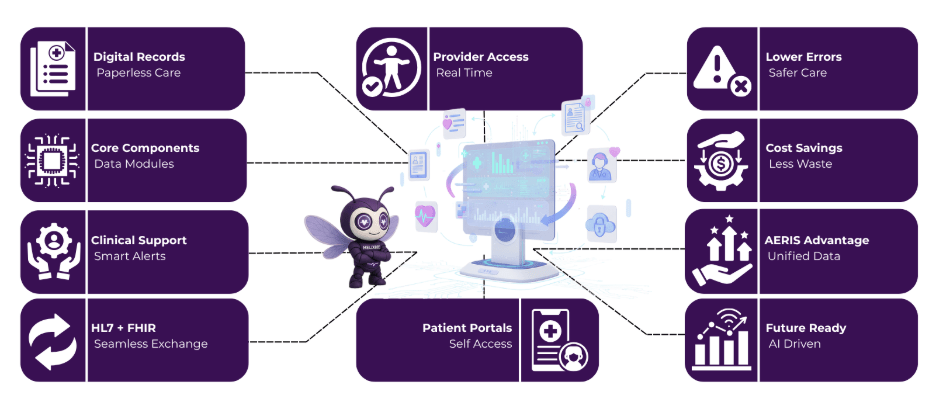
Electronic Health Record systems comprise several essential elements that work together to manage patient data effectively. The software platform forms the backbone, featuring user interfaces for data entry and retrieval. Databases, often relational or cloud-based, store vast amounts of information securely.
Interoperability standards such as FHIR and HL7 allow data exchange between systems. Clinical decision support modules provide alerts and reminders, while computerized provider order entry (CPOE) enables electronic prescribing. Security features, including encryption and audit trails, protect sensitive data in compliance with regulations like HIPAA.
Hardware components include servers, workstations, and mobile devices for access. Integration with external systems, such as laboratory information systems or picture archiving and communication systems (PACS), enhances functionality. Patient-facing components like portals empower individuals to view and contribute to their records.
Benefits of Electronic Health Record Systems
Implementing Electronic Health Record systems yields numerous advantages across clinical, organizational, and societal levels. Clinically, these systems reduce medical errors by up to 86% through CPOE and decision support tools that check for drug interactions and allergies. They improve adherence to guidelines and increase the use of preventive care measures.
Organizationally, Electronic Health Record systems boost revenue by enhancing charge capture and reducing billing errors. They cut costs by minimizing redundant tests and administrative tasks, with studies showing reductions in diagnostic testing by 14-27%. Improved efficiency leads to higher provider satisfaction and lower malpractice claims.
Societally, Electronic Health Record systems support public health surveillance and research. Aggregated data helps monitor disease outbreaks and generate real-world evidence for treatments. They promote population health by facilitating better coordination and reducing overall healthcare expenditures.
Additional benefits include real-time data access, which enhances patient safety and care quality. For example, hospitals with EHRs report lower mortality rates and fewer complications.
The Role of HL7 and FHIR in Electronic Health Record Systems
Interoperability stands as a cornerstone of modern Electronic Health Record systems, and two standards—HL7 and FHIR—drive much of this capability. Health Level Seven (HL7) emerged in 1987 as a framework to standardize the exchange of clinical and administrative data between software applications used by healthcare providers. Its Version 2 messaging protocol became widely adopted in the 1990s and 2000s, enabling Electronic Health Record systems to transmit laboratory results, admission details, and billing information across disparate platforms. HL7 Version 3 introduced a more rigorous reference information model, though its complexity slowed uptake compared to Version 2.
Fast Healthcare Interoperability Resources (FHIR), pronounced “fire,” represents the next generation of HL7 standards. FHIR adopts a modular, web-based approach using RESTful APIs, JSON, and XML formats familiar to modern developers. This design allows Electronic Health Record systems to exchange discrete data elements—called resources—such as Patient, Observation, or MedicationRequest in real time.
HL7 and FHIR together reduce the fragmentation that once isolated Electronic Health Record systems. A 2023 study in the Journal of the American Medical Informatics Association found that facilities using FHIR-based exchanges cut data retrieval times by 68% compared to legacy HL7 Version 2 methods.
These standards enable nationwide networks like the Trusted Exchange Framework and Common Agreement (TEFCA), launched in 2023, which connects over 70% of U.S. hospitals through qualified health information networks.
AERIS: Streamlining Electronic Health Record Systems Through FHIR
AERIS, by Helixbeat, acts as a translator for your EHR, using standards like HL7 and FHIR to tie all your data into one neat, unified system. This approach simplifies electronic health record integration by automating data mapping and validation.
Ready to cut delays by 50%, double your ROI, and empower your team with instant access to critical data? Let’s dive into why AERIS is the solution you’ve been waiting for.
Why AERIS is Your Key to Healthcare Innovation
At Helixbeat, we know your challenges: fragmented systems, delayed data, and rising costs. AERIS is here to change that, offering a personalized, scalable, and secure platform that fits your unique needs. Whether you’re a small clinic or a sprawling hospital network, AERIS delivers measurable results that elevate patient outcomes and boost your bottom line.
- 20+ Years of Expertise: Our team brings decades of healthcare IT experience to ensure AERIS works for you.
- 50+ IT Professionals: A dedicated crew powers AERIS, delivering unmatched support and innovation.
- 1,000+ Customers: Join a thriving community of healthcare leaders already transforming with AERIS.
- 10,000+ Projects Completed: Proven success across countless integrations and workflows.
- 95% Returning Customers: Our clients trust AERIS to deliver, time and time again.
Providers adopting AERIS report faster diagnoses, lower costs, and improved outcomes, positioning it as the go-to tool for future-proof HIE.
The AERIS Advantage: Numbers That Speak for Themselves
Metric | Without AERIS | With AERIS | Your Benefit |
Data Exchange Delays | Frequent bottlenecks | Reduced by 50%
| Faster care in emergencies |
Return on Investment | Slow, costly overhauls | 100% faster ROI | Grow without breaking the bank |
Operational Costs | High redundancies | Cut by 30% | Save thousands annually |
Error Rates | Up to 20% manual errors | Slashed by 90% | Precision for better patient outcomes |
Your Benefits, Amplified
- 50% Fewer Delays: Real-time data means critical information is always at your fingertips, turning hours into seconds.
- 100% Faster ROI: Plug-and-play integration maximizes your investment without expensive system replacements.
- 30% Cost Savings, 90% Fewer Errors: Automation eliminates waste, saving resources and ensuring accuracy.
How AERIS Works: Your 3-Step Path to Success
- Connect Seamlessly: Integrate AERIS effortlessly into your existing systems, from legacy EHRs to modern platforms.
- Share Securely: Activate real-time data exchange with HIPAA-compliant encryption. Watch your teams and partners collaborate effortlessly.
- Optimize and Grow: Because AERIS evolves with your organization, it’s set up to help you succeed for the long haul.
Future Trends in Electronic Health Record Systems
As of 2025, Electronic Health Record systems continue to advance with emerging technologies. AI integration, including NLP for documentation and predictive analytics, streamlines tasks and identifies risks early. Cloud-based systems offer remote accessibility and real-time collaboration.
Telehealth and wearable device integration incorporate continuous data from devices like smartwatches, supporting remote monitoring. Precision medicine benefits from genomic data linkage, enabling personalized treatments. Frameworks like TEFCA promote nationwide interoperability.
Future implications include expanded use in learning health systems, where data drives continuous improvement. AI will mitigate biases and incorporate social determinants of health for equitable care. By 2040, predictions suggest fully mobile, voice-enabled systems with global access and embedded NLP for multilingual support.
What Users Say About AERIS
Dr. Sarah L.
Hospital Administrator
John T.
Telemedicine Provider
Emily P.
Healthcare Executive
Common Questions About Healthcare Data Exchange with AERIS
1. What is FHIR, and why is it important for EHR systems?
FHIR (Fast Healthcare Interoperability Resources) is a standard that enables real-time, modular data exchange between healthcare systems.
2. How does AERIS help integrate EHR systems?
AERIS uses FHIR and HL7 standards to automate data mapping and validation, unifying fragmented EHR systems into a single platform.
3. Can AERIS work with both legacy and modern EHR platforms?
Yes, AERIS connects seamlessly with existing systems, whether they are older or newly implemented.
4. What operational improvements can AERIS bring?
AERIS reduces data delays, lowers error rates, cuts operational costs, and accelerates ROI for healthcare organizations.
5. Is patient data secure when using AERIS?
Absolutely. AERIS uses HIPAA-compliant encryption and secure protocols to protect sensitive information.
Final Thoughts
Electronic Health Record systems have come a long way since their inception, offering substantial improvements in healthcare delivery while facing ongoing challenges. As technology progresses, these systems will continue to evolve, supporting more efficient, patient-centered care.
Ready to take your EHR systems to the next level? Discover how AERIS by Helixbeat can streamline interoperability and enhance FHIR-based integration for your organization.