


FHIR Data Management Strategy
Get Started with a Free Demo
New Keyword Page
New Keyword Page
"*" indicates required fields
Healthcare organizations today face an unprecedented challenge: converting fragmented clinical data into actionable insights that improve care quality, operational efficiency, and population health. However, FHIR data management (Fast Healthcare Interoperability Resources) offers a pathway to interoperable, extensible, and future‑ready clinical data ecosystems.
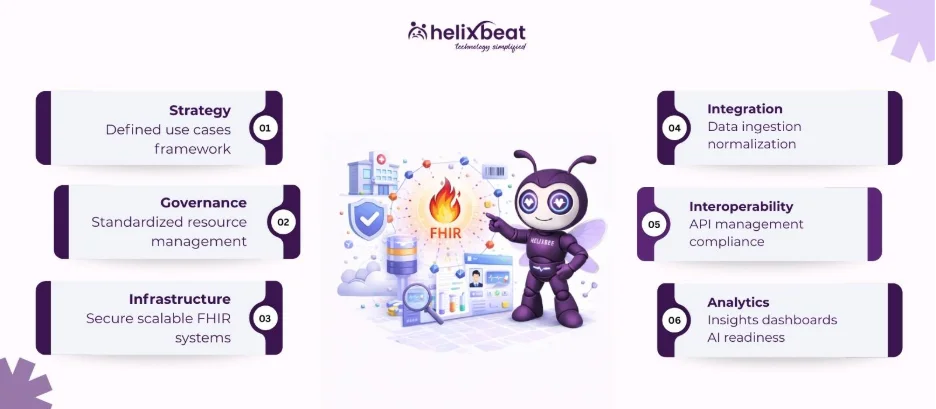
Here, we present a complete step‑by‑step framework for healthcare organizations planning to adopt or scale their FHIR data management strategy. It unpacks the core components, practical steps, and best practices needed to build an operational foundation that supports care delivery, analytics, and innovation.
What Is FHIR and Why It Matters for Data Management
FHIR (Fast Healthcare Interoperability Resources) is a standard developed by Health Level Seven International (HL7) to facilitate data exchange among disparate healthcare systems.
From a data management standpoint, FHIR is not merely a method to transmit data — it represents a structured model for storing, organizing, and querying clinical information in ways that support interoperability, analytics, and scalable integration.
The key principles of FHIR include:
- Modularity: Data is represented as discrete resources (e.g., Patient, Observation, Encounter).
- Web‑friendly Architecture: FHIR uses standards such as REST APIs, OAuth2, and JSON.
- Extensibility: Optional extensions allow custom attributes while preserving core interoperability.
- Interoperability: Shared definitions promote consistent interpretation across systems.
Effective FHIR data management is about more than API calls. It requires a cohesive approach to how data is structured, governed, secured, and used across organizational boundaries.
Understanding the Components of FHIR Data Management
Let’s break down the core components of a robust FHIR data management strategy:
1. Data Architecture
Defines how FHIR resources are stored, indexed, and retrieved across systems, including the choice of databases, integration engines, and data warehouses.
2. Data Governance
Establishes standards for data definitions, lineage, stewardship, access, and clinical context.
Therefore, planning resource models carefully ensures that systems communicate with a shared understanding of structure and meaning. A mature strategy uses standard profiles where possible, limits uncontrolled extensions, and governs custom fields with clear documentation.
3. Security and Privacy
Includes identity and access management, authentication protocols (such as SMART on FHIR), audit trails, and privacy controls.
4. Interoperability Layer
Manages API interactions, resource versioning, and mapping between different systems or coding standards.
5. Data Quality and Monitoring
Applies checks for completeness, consistency, accuracy, and timeliness of clinical data, including anomaly detection.
6. Analytics and Reporting
Transforms FHIR data for decision support and operational insights through clinical dashboards and AI models.
These components act together as a foundation. A failure in any one of them can degrade the value of FHIR data management initiatives.
Now let’s dive into the steps.
Step 1: Define Your FHIR Data Strategy and Use Cases
A strategic approach begins with clearly defined objectives. The starting point for any FHIR data management initiative is a set of measurable goals.
Identify Business and Clinical Use Cases
Common use cases for FHIR data include:
- Real‑time clinical data exchange between EHRs.
- Patient‑facing applications (e.g., mobile health apps).
- Clinical decision support systems.
- Analytics and population health initiatives.
- Research data aggregation and cohort analysis.
Each use case informs necessary resource types (e.g., Observation, Condition, MedicationRequest) and prioritizes which parts of the data ecosystem must be addressed first.
Assess Current State
Conduct a data maturity assessment:
- What data sources are available?
- Which systems already support FHIR or need adapters?
- What is the current data quality?
- Are there existing integrations or data warehouses?
This assessment helps scope your project phases and resource allocation.
Define Success Metrics
Choose metrics that align with organizational goals, such as:
- Reduction in clinical data errors.
- Time to sync patient data across systems.
- Increase in reuse of standardized data across applications.
- Analytics throughput or query performance.
Metrics convert abstract goals into tangible outcomes.
Step 2: Establish Data Governance and Standards
Data governance is a foundational pillar for any data management strategy. Without clear standards, inconsistent implementation of FHIR resources can lead to conflicting interpretations or interoperability failures.
Create a Governance Committee
Include stakeholders across:
- Clinical leadership
- Data architects
- Informatics teams
- Compliance and privacy officers
- IT operations
This committee defines shared standards, naming conventions, and resource usage guidelines.
Define Resource Profiles and Extensions
FHIR allows optional extensions to capture data not covered by core resources. Standardization of these extensions improves consistency across systems.
For example:
- Defining how social determinants of health are represented.
- Agreeing on preferred coding systems (e.g., SNOMED CT for clinical terms, LOINC for lab values).
Establish Data Stewardship
Assign data stewards responsible for:
- Validating incoming data.
- Mapping coded values.
- Handling updates and deprecations.
A stewarded approach reduces ambiguity in how resources are interpreted and used.
Step 3: Build a Secure and Scalable FHIR Infrastructure
FHIR systems operate in environments that support modern data traffic and compliance requirements. Therefore, building the right infrastructure involves selecting platforms and technologies that can handle healthcare workloads while satisfying regulatory constraints.
Select a Storage Model
There are several ways to store FHIR resources:
FHIR Servers (Application + Storage Layer): Servers like FUSION manage both storage and API access, optimized for FHIR queries and compliance.
Document Stores: Good for flexibility and schema-less storage.
Relational Databases: Suitable when resources are broken into indexed tables.
FHIR-Optimized Stores: Databases explicitly designed for FHIR query performance.
The choice depends on query needs, data volume, and integration requirements. However, using a FHIR server as your primary storage option can simplify development because it abstracts the storage details while exposing standardized APIs for interoperability.
API Gateway and Management
A layer that handles:
- Authentication (using OAuth 2.0, SMART on FHIR).
- Authorization policies.
- Rate limiting and throttling.
- Logging and auditing.
API management prevents unauthorized access and supports regulatory audits.
Security Controls
Important elements include:
- Encryption at rest and in transit.
- Token‑based authentication.
- Role‑based access control (RBAC).
- Real‑time audit trails.
FHIR environments must comply with healthcare regulations (e.g., HIPAA) where applicable.
Elastic Scalability
Infrastructure should scale horizontally to manage:
- High API traffic from multiple consumers (EHRs, apps, analytics).
- Large volumes of historical data used for analytics.
Cloud platforms offer flexible scalability.
Step 4: Data Ingestion, Transformation, and Normalization
Transforming raw clinical data into standardized FHIR resources is central to good FHIR data management.
Ingestion Pipelines
Data sources might include:
- Electronic Health Records (EHRs)
- Diagnostic devices
- Patient apps
- External health information exchanges
Each source can require unique adapters or connectors.
Transformation Logic
Convert source data into FHIR resources:
- Map source fields to FHIR structure.
- Convert coding systems (e.g., ICD‑10 to SNOMED CT).
- Normalize timestamps and clinical context.
Mapping should be documented and reusable across pipelines.
Normalization and Enrichment
Normalization aligns data to common standards, such as:
- Standard value sets for lab results.
- Unified representations of medications.
Enrichment can include:
- Linking related resources (e.g., linking an Observation to a specific Encounter).
- Generating computed fields (e.g., BMI from height and weight).
This step contributes to clinical relevance and analytic readiness.
Step 5: Enable Interoperability and API Management
Interoperability lies at the heart of FHIR. A robust FHIR data management strategy must facilitate data exchange across internal and external systems with predictable behavior.
Conformance to FHIR Specifications
Use defined FHIR profiles and capability statements to:
- Communicate supported resource versions.
- Specify operations available (read, search, update).
- Declare profiled resource constraints.
Clients and servers negotiate interactions through these statements.
API Throttling and Versioning
APIs must adapt to evolving business needs without breaking existing consumers:
- Apply versioning strategies for breaking changes.
- Use metadata to indicate resource deprecation timelines.
- Implement throttling to manage peak loads.
Standardized Communication Patterns
Common patterns include:
- RESTful resource access (GET, POST, PUT, DELETE).
- Subscriptions for event‑driven updates.
- Batch operations for bulk data transfer.
The selection of patterns depends on use case requirements.
Step 6: Monitoring, Quality Control, and Versioning
Operational monitoring and quality control keep FHIR ecosystems trustworthy and performant.
Quality Dashboards
Track key indicators such as:
- Missing or inconsistent fields.
- Resource validation errors.
- Unexpected value sets.
Dashboards help technical and clinical stakeholders address data issues swiftly.
Automated Alerts
Set alerts to notify teams when:
- API performance drops.
- Data pipelines fail.
- Security anomalies occur.
Automation reduces response time to issues.
Version Management
FHIR is versioned (e.g., R4, R5). Your ecosystem should:
- Track versions of resources stored.
- Manage schema changes between versions.
- Provide backward compatibility strategies if needed.
Version control preserves historical accuracy for clinical and analytic records.
Step 7: Analytics, Reporting, and Clinical Insights
Well‑managed FHIR data becomes a foundation for insights that support clinical decisions, performance measurement, and research.
Transform FHIR Resources for Analytics
FHIR resources are modular and event‑centric. Analytics needs often require tabular structures for:
- Trend analysis (clinical measures over time).
- Cohort identification (e.g., patients with specific conditions).
- Predictive modeling.
Tools can transform FHIR data into analytics‑friendly formats.
Clinical Dashboards
Dashboards can visualize:
- Population health metrics.
- Patient outcomes by intervention.
- Resource utilization across departments.
Data visualization makes FHIR data tangible for clinicians and leaders.
Research and AI Applications
Standardized FHIR data facilitates:
- Clinical research cohorts.
- Natural language processing on structured clinical notes.
- Machine learning models trained on normalized clinical features.
Analytics accelerates value creation from operational data.
Step 8: Training, Change Management, and Adoption
Technology changes without human adoption are futile. Effective FHIR data management programs include:
Stakeholder Training
Offer role‑based education for:
- Developers integrating APIs.
- Data stewards managing resource standards.
- Clinicians interpreting output dashboards.
Training builds a shared understanding of what constitutes high‑quality FHIR data.
Communication Plans
Update teams on:
- New resource profiles released.
- Changes in API behavior.
- Data governance policy updates.
Frequent communication reduces friction.
Feedback Loops
Capture input from:
- End users of data and applications.
- Developers integrating with API endpoints.
- Compliance teams reviewing policies.
Feedback enables iterative improvement.
Unlock Seamless Healthcare Interoperability with FUSION
Built by Helixbeat, FHIR server FUSION leverages RESTful APIs for plug-and-play integration, enabling seamless connectivity with legacy systems, modern EHRs, and emerging tools like wearable devices and telehealth platforms. This isn’t just compliance, it’s acceleration.
FUSION goes deeper by embedding critical medical coding systems like SNOMED CT, LOINC, and ICD-10 directly into its architecture. This built-in intelligence maintains data consistency and accuracy, transforming raw information into actionable insights ready for clinical decisions, regulatory reporting, and advanced analytics. No more wrestling with mismatched formats or manual mappings: FUSION handles the heavy lifting!
Organizations using FUSION report up to 70% faster data sharing, slashing referral delays by 60% and reducing redundant tests by 25%. That’s not hype; it’s a measurable impact, with providers saving $1,000–$2,000 per patient annually through streamlined claims and operations.
How FUSION Ignites Data-Driven Innovation
The true magic of healthcare FHIR lies in its potential to fuel innovation, and FUSION amplifies this like no other. As a reliable engine for standardized data flows, it powers downstream applications that were once out of reach.
Take chronic disease management, for example. By integrating real-time data from wearables and EHRs, FUSION enables continuous monitoring and proactive interventions, potentially cutting hospital readmissions and optimizing therapies. Or, imagine a telehealth consultation that’s instantly better because the doctor has the patient’s full history right there. FUSION makes that happen, giving virtual care a huge boost in quality and making patients much happier.
Certified Excellence
FUSION is officially certified by the Drummond Group for FHIR-based interoperability, validating its conformance with healthcare data exchange standards HL7, FHIR, and SMART on FHIR. This certification demonstrates that FUSION meets industry-recognized benchmarks for secure, standardized data exchange — giving you the confidence to integrate seamlessly across systems.
What This Means for You
In a complex healthcare ecosystem, FUSION simplifies connectivity and safeguards data integrity. With enterprise-grade uptime (99.99%) and secure authentication powered by OAuth2 and encrypted endpoints, it supports trusted, real-time collaboration between hospitals, labs, and payers.
Whether you’re mapping USCDI elements for regulatory reporting or automating data flows for public-health initiatives, FUSION keeps you compliant with current interoperability frameworks and ready for future mandates.
Frequently Ask Questions
1. Why is health information exchange important in healthcare?
It improves care coordination, reduces duplicate tests, minimizes errors, and helps providers make timely, data-driven decisions across different healthcare settings.
2. What are the main models of health information exchange?
3. Which standards guide health information exchange?
Standards like FHIR and HL7 define consistent data formats, making it easier for EHRs, HIEs, and other healthcare platforms to exchange information.
4. What are the benefits of using health information exchange?
HIE improves care coordination, reduces healthcare costs, supports population health management, enhances research, and increases operational efficiency.
5. How does AERIS enhance healthcare information exchange?
AERIS leverages FHIR standards, connects legacy systems, automates workflows, reduces manual errors, and provides real-time access to patient records and lab results.
1. What is the core purpose of FHIR in healthcare?
FHIR provides a standard method to represent and exchange healthcare data in a structured, web‑friendly format.
2. How does FHIR improve data interoperability?
By standardizing the structure of clinical data and using API‑based communication, FHIR reduces ambiguity between systems.
3. Can FHIR data be used for analytics?
Yes. After transformation and normalization, FHIR data can be used to build dashboards, predictive models, and research cohorts.
4. How does governance impact FHIR success?
Governance defines consistent standards and practices, which help with data quality and shared interpretation.