


Advanced FHIR Implementation Patterns: Design Strategies & Real‑World Solutions
Get Started with a Free Demo
New Keyword Page
New Keyword Page
"*" indicates required fields
FHIR in healthcare has rapidly become the foundation of modern interoperability. Healthcare organizations worldwide are adopting the Fast Healthcare Interoperability Resources (FHIR) standard to connect their disparate systems. Its adoption is driven by a universal need to move clinical data efficiently while still meeting stringent security and privacy requirements.
Yet many implementations stop at basic integration. To unlock the full potential of FHIR, advanced design strategies and implementation patterns are essential for building scalable, reliable, and extensible healthcare data infrastructure. Here, we explore those strategies and highlight patterns that can help organizations succeed with FHIR.
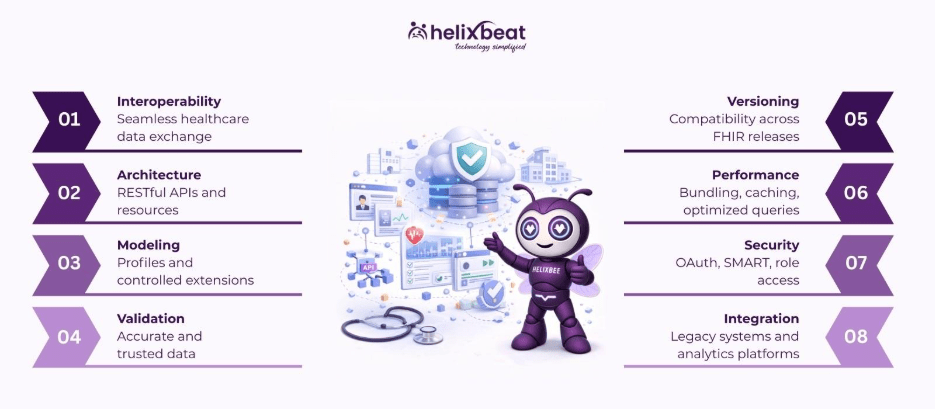
What Makes Advanced FHIR Implementation Essential in Healthcare
FHIR in healthcare embodies a modern standard that uses RESTful APIs, resource‑based architecture, and modular design to replace older integration frameworks. Unlike legacy standards like HL7 v2, which often required custom interfaces and extensive middleware, FHIR APIs communicate via universal web technologies such as HTTP, JSON, and XML.
This leads to several concrete advantages:
- Simplified integration between systems such as Electronic Health Records (EHRs), payer networks, research applications, and patient apps.
- Real‑time data access, empowering clinicians with up‑to‑date patient information.
- Support for innovation, enabling analytics, AI, and mobile app integration.
However, real-world health systems don’t just need basic interoperability. They need robust patterns for performance, security, governance, versioning, and scalability.
1. RESTful API Design and Resource Modeling
Advanced FHIR implementations center on robust API design. FHIR defines a standardized RESTful approach, which must be embraced correctly to achieve reliable interoperability.
1.1 RESTful Principles Align with Scalability
FHIR APIs should follow REST conventions — including using methods like GET, PUT, POST, and DELETE appropriately for managing FHIR resources. Following RESTful norms improves predictability and simplifies integration with external systems.
1.2 Resource Modeling with Profiles and Extensions
A fundamental aspect of FHIR in healthcare is the use of profiles and extensions to adapt standard resources for local use cases. Profiles constrain base resources to define mandatory fields, coded values, and terminologies necessary for consistent exchange. Extensions help integrate elements that the base model does not support without breaking compatibility.
Therefore, planning resource models carefully ensures that systems communicate with a shared understanding of structure and meaning. A mature strategy uses standard profiles where possible, limits uncontrolled extensions, and governs custom fields with clear documentation.
2. Resource Validation Strategies
FHIR data must be both syntactically and semantically valid for systems to trust and consume it. Implementation patterns include layered validation:
- Structural validation: Checks that resource formats comply with FHIR JSON or XML schemas.
- Profile validation: Ensures resources conform to a specific organizational profile.
- Business rule validation: Applies domain logic to detect and reject data that might be technically valid but clinically inconsistent.
- Reference integrity: Verifies that linked resources, such as references to a patient or encounter, are present and correct.
A robust validation strategy protects downstream systems from ingesting broken or incomplete data.
3. Versioning and Compatibility Patterns
FHIR evolves, with releases like R4 and R5 introducing new features and improvements. Because not all systems upgrade simultaneously, a practical implementation must handle version compatibility carefully.
3.1 API Versioning
When deploying a FHIR server, separating endpoints by version (for example, /fhir/r4/… versus /fhir/r5/…) helps clients interact predictably without being broken by upstream changes. Semantic versioning, support for deprecated features, and explicit compatibility plans help manage transitions.
3.2 Backward Compatibility Guidelines
Although the standard provides guidelines for backward compatibility — such as ignoring unrecognized codes or elements — real deployments typically demand conservative upgrade strategies to avoid breaking clinical workflows.
4. Error Handling and OperationOutcome Responses
In a production healthcare environment, simple error codes are not enough. FHIR defines the OperationOutcome resource type to convey detailed error information, including severity, specific fields that failed validation, and textual descriptions. This pattern:
- Helps clients diagnose issues without guessing.
- Provides structured, machine‑readable error feedback.
- Distinguishes business rules failures from system failures.
Using OperationOutcome consistently promotes resilience and diagnostic clarity — especially in environments where automated systems process high volumes of clinical events.
5. Performance Optimization and Bundling
FHIR servers often experience heavy loads, particularly in large health systems or federated networks. Strategies for performance include:
5.1 Resource Bundles and Field Selection
Batch operations (e.g., using FHIR transaction or batch bundles) reduce round‑trip overhead. Selecting only required fields via the _elements parameter cuts unnecessary data transfer. Both approaches reduce network load and speed client workflows.
5.2 Caching Frequently‑Accessed Resources
A caching layer for commonly requested resources such as patient demographic data, can reduce server stress and improve responsiveness, especially for mobile or analytic clients.
6. Security Architecture and Access Control Patterns
Security is a non‑negotiable for any FHIR implementation in healthcare. Open systems must protect sensitive patient information while allowing legitimate access.
6.1 OAuth and SMART on FHIR
Most advanced deployments leverage OAuth 2.0 for token‑based authorization. SMART on FHIR extends this with scopes tailored for clinical data access, enabling third‑party apps to connect with patient consent.
6.2 Role‑Based Access Control
Assigning permissions based on roles ensures that clinical and administrative roles see only what they are authorized to see. This protects private health information without inhibiting clinical workflows.
6.3 Audit Trails and Monitoring
Recording who accessed what and when strengthens compliance with regulatory frameworks like HIPAA. Regular security reviews and penetration tests help reduce vulnerabilities.
7. Integration with Legacy Systems and Transformation Pipelines
Most healthcare enterprises operate legacy systems that use older standards like HL7 v2 or proprietary data formats. To bring these into a FHIR‑centric architecture requires careful planning.
7.1 Transformation Services
Transformation pipelines map legacy data structures into FHIR resources. These can include lookup tables for terminologies, object model translators, and rule‑based logic to convert messages into FHIR Observations, Encounters, and other clinical resources.
7.2 Facade Model vs Full Repository
There are two common integration patterns:
- Facade model: FHIR acts as a read‑through layer that fetches data directly from legacy sources without replication.
- Repository model: Legacy data is transformed and stored in the FHIR server, acting as a centralized cache for rapid queries and analytics.
Choosing between these depends on organization size, existing systems, and analytic needs.
8. Subscriptions and Event‑Driven Workflows
FHIR supports Subscriptions which allow clients to register interest in events (such as new observations). When the server detects a matching update, it notifies subscribers, enabling workflows like alerting or downstream processing. These patterns support real‑time interoperability and eliminate the need for continuous polling.
This design enhances responsiveness in clinical settings, for example, by triggering alerts when lab values enter critical ranges.
9. Analytics and Data Lake Integration
In advanced environments, FHIR data is not only exchanged but also used for analytics, predictive modeling, and quality measurement. Therefore, integrating FHIR with data lakes or analytic platforms allows organizations to store both structured and unstructured clinical data for research, population health management, and machine learning initiatives.
A well‑aligned FHIR server can feed normalized, high‑quality data into analytic pipelines.
How FUSION Supports Advanced Implementation Patterns
Not all FHIR servers are created equal. A server that supports robust API patterns, sophisticated security, validation tooling, and performance optimization will accelerate your adoption and help you derive strategic value from FHIR in healthcare. That’s where FUSION comes in.
Built by Helixbeat, FHIR server FUSION leverages RESTful APIs for plug-and-play integration, enabling seamless connectivity with legacy systems, modern EHRs, and emerging tools like wearable devices and telehealth platforms.
FUSION goes deeper by embedding critical medical coding systems like SNOMED CT, LOINC, and ICD-10 directly into its architecture. This built-in intelligence maintains data consistency and accuracy, transforming raw information into actionable insights ready for clinical decisions, regulatory reporting, and advanced analytics. No more wrestling with mismatched formats or manual mappings: FUSION handles the heavy lifting!
Organizations using FUSION report up to 70% faster data sharing, slashing referral delays by 60% and reducing redundant tests by 25%. That’s not hype; it’s a measurable impact, with providers saving $1,000–$2,000 per patient annually through streamlined claims and operations.
Certified Excellence
FUSION is officially certified by the Drummond Group for FHIR-based interoperability, validating its conformance with healthcare data exchange standards HL7, FHIR, and SMART on FHIR. This certification demonstrates that FUSION meets industry-recognized benchmarks for secure, standardized data exchange — giving you the confidence to integrate seamlessly across systems.
Basic integration is just the beginning. To truly benefit from FHIR, organizations must adopt advanced implementation patterns, focusing on scalability, governance, security, real‑time workflows, and analytics.
By embracing design strategies, healthcare leaders can build systems that connect today’s clinical workflows with tomorrow’s innovations.
Frequently Ask Questions
1. Why is health information exchange important in healthcare?
It improves care coordination, reduces duplicate tests, minimizes errors, and helps providers make timely, data-driven decisions across different healthcare settings.
2. What are the main models of health information exchange?
3. Which standards guide health information exchange?
Standards like FHIR and HL7 define consistent data formats, making it easier for EHRs, HIEs, and other healthcare platforms to exchange information.
4. What are the benefits of using health information exchange?
HIE improves care coordination, reduces healthcare costs, supports population health management, enhances research, and increases operational efficiency.
5. How does AERIS enhance healthcare information exchange?
AERIS leverages FHIR standards, connects legacy systems, automates workflows, reduces manual errors, and provides real-time access to patient records and lab results.
1. What is FHIR in healthcare?
FHIR in healthcare (Fast Healthcare Interoperability Resources) is a standard for exchanging healthcare data electronically. It enables seamless integration between EHRs, mobile apps, and clinical systems.
2. Why are advanced FHIR implementation patterns important?
Advanced FHIR patterns address real-world challenges like data validation, versioning, scaling, and analytics integration, which basic FHIR adoption alone cannot solve.
3. How do FHIR profiles and extensions improve interoperability?
Profiles define specific requirements for resources, while extensions add custom fields without breaking compatibility. Together, they maintain consistency across diverse healthcare systems.
4. What are common challenges when implementing FHIR in healthcare?
Challenges include handling legacy data, version migration, large-scale deployments, security and consent management, and real-time event-driven workflows.
5. How can FHIR support analytics and AI in healthcare?
FHIR enables standardized, structured data access, feeding analytic pipelines and AI models for population health, predictive analytics, and clinical decision support.