


Understanding FHIR Payer-to-Payer: A Complete Guide to Interoperable Health Data Exchange
Get Started with a Free Demo
New Lead: FUSION
FUSION Landing Page Form, connected with the Mailchimp.
"*" indicates required fields
The healthcare industry has long struggled with data silos, where disparate systems fail to communicate effectively with each other. The growing complexity of healthcare data, combined with regulatory mandates and the push for better patient care, has led to the need for seamless interoperability. This is where FHIR Payer-to-Payer data exchange comes in, enabling secure, real-time sharing of healthcare information between payers, insurers, and healthcare providers.
By leveraging FHIR (Fast Healthcare Interoperability Resources), healthcare organizations can streamline workflows, reduce administrative overhead, and improve care coordination across the entire healthcare ecosystem. Here, we will discuss the FHIR Payer-to-Payer data exchange process and how healthcare organizations can leverage this technology to enhance patient outcomes and operational efficiency.
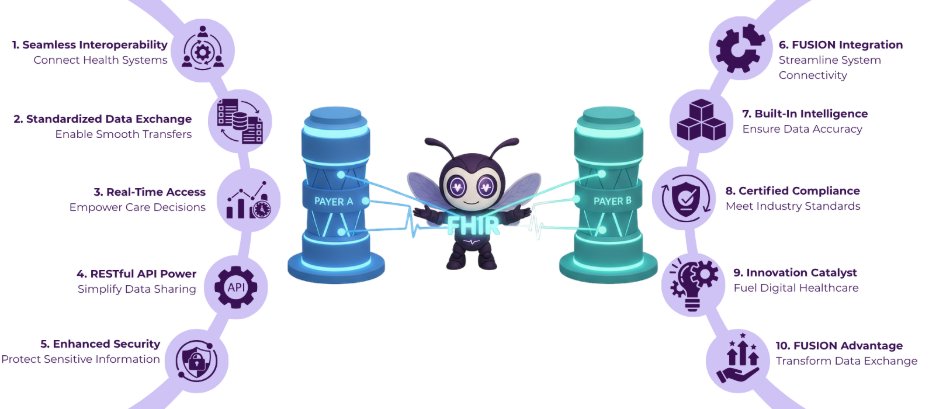
What Is FHIR Payer-to-Payer Data Exchange?
FHIR payer-to-payer refers to the standardized electronic exchange of clinical and administrative data between health insurance payers using the Fast Healthcare Interoperability Resources (FHIR) standard. Mandated by the Centers for Medicare & Medicaid Services (CMS) Interoperability and Patient Access Final Rule (CMS-9115-F), this process requires payers to share member-authorized data when a member changes plans.
Starting January 1, 2027, Medicare Advantage organizations, Medicaid managed care plans, CHIP managed care entities, and Qualified Health Plan (QHP) issuers on the Federally-facilitated Exchanges must implement a compliant FHIR-based Payer-to-Payer API. This API will facilitate the exchange of patient data between payers when a member transitions to a new plan, provided the member has opted in.
The Role of RESTful APIs in FHIR Payer-to-Payer
One of the most important aspects of FHIR Payer-to-Payer interoperability is the use of RESTful APIs. REST (Representational State Transfer) is an architectural style for designing networked applications. RESTful APIs are a set of protocols that allow different systems to communicate over the internet by using HTTP methods such as GET, POST, PUT, and DELETE.
Some key ways RESTful APIs contribute to FHIR Payer-to-Payer interoperability include:
1. Simplified Data Exchange
RESTful APIs make it easier for healthcare organizations to integrate different systems and share data. Using simple HTTP requests, data can be retrieved, updated, or deleted from a FHIR server, so payers can access patient data stored in other payer systems or EHRs. The simplicity enables healthcare organizations, even those with limited technical teams, to adopt FHIR interoperability.
2. Real-Time Communication
Unlike traditional batch-processing systems, which can experience delays and require manual intervention, RESTful APIs enable real-time data exchange. This is critical in healthcare, where timely access to patient information can significantly impact care decisions. For example, during a transition from one payer to another, the new payer can immediately access the patient’s medical history and claims data from the previous payer using FHIR RESTful APIs.
3. Scalability
FHIR servers built using RESTful APIs are highly scalable, meaning they can handle large volumes of data without significant performance degradation. This is especially important for payer organizations that need to exchange data across a large number of members, healthcare providers, and third-party systems.
4. Enhanced Security
FHIR servers using OAuth 2.0 and SMART on FHIR protocols for security can secure data exchanges between payers. These security mechanisms ensure that only authorized entities can access or update sensitive health data, complying with regulations like HIPAA. With RESTful APIs, healthcare organizations can implement these security protocols efficiently, making it easier to maintain compliance while sharing data.
How FUSION Contributes to the Process
FHIR servers, like FUSION, built on RESTful APIs, are the backbone of FHIR Payer-to-Payer interoperability. It enables seamless data exchange between payers and providers by utilizing modern web technologies and secure data-sharing protocols.
Here’s how FUSION contributes to FHIR Payer-to-Payer:
Key features of FUSION include:
- Key features of FUSION include
- FHIR-native architecture
- Plug-and-play
- APIs for rapid deployment
- Real-time data sharing across multiple endpoints
- Strong security controls that meet compliance standards
- Support for both structured and unstructured data
As a smart bridge, FUSION integrates with your existing systems; you don’t have to replace anything. This makes it perfect for organizations moving toward modern FHIR integration platforms. As a result, hospitals can quickly and easily exchange records with external labs or enable new app-based clinical tools, making overall interoperability effortless.
FHIR Healthcare Solutions for Hospitals and Clinics
FHIR healthcare solutions for hospitals and clinics optimize resource utilization through integrated platforms. FUSION exemplifies this by acting as a central hub for FHIR-compliant data management. Besides, FUSION is a huge help to multidisciplinary teams because it supports real-time sharing, meaning clinicians always have the most up-to-date patient information.
Overall, FUSION helps create a connected environment where data drives better decisions and outcomes.
How FUSION Contributes to the Process
FHIR servers, like FUSION, built on RESTful APIs, are the backbone of FHIR Payer-to-Payer interoperability. It enables seamless data exchange between payers and providers by utilizing modern web technologies and secure data-sharing protocols.
Here’s how FUSION contributes to FHIR Payer-to-Payer:
1. Fast Data Exchange
FHIR RESTful APIs enable fast, efficient data exchange. By using simple HTTP methods (GET, POST, PUT, DELETE), healthcare organizations can request or update data as needed. This reduces delays and ensures that payers have access to the most current patient information in real time.
2. Simplified Integration
FUSION offers easy integration with existing healthcare systems, including EHRs, payer platforms, and telemedicine applications. This allows payers to exchange data seamlessly without needing to overhaul their entire infrastructure.
3. Secure Communication
With OAuth 2.0 and SMART on FHIR, FUSION protects sensitive health data during transmission. These security mechanisms help prevent unauthorized access and ensure that patient information is kept safe while being exchanged between payers.
The AERIS Advantage: Numbers That Speak for Themselves
| Metric | Without AERIS | With AERIS | Your Benefit |
| Data Exchange Delays | Frequent bottlenecks | Reduced by 50% | Faster care in emergencies |
| Return on Investment | Slow, costly overhauls | 100% faster ROI | Grow without breaking the bank |
| Operational Costs | High redundancies | Cut by 30% | Save thousands annually |
| Error Rates | Up to 20% manual errors | Slashed by 90% | Precision for better patient outcomes |
Your Benefits, Amplified
1. 50% Fewer Delays
2. 100% Faster ROI
3. 30% Cost Savings, 90% Fewer Errors
Unlock Seamless Healthcare Interoperability with FUSION
By aligning with FHIR standards, FUSION doesn’t just facilitate compliance; it drives transformation.
FUSION goes deeper by embedding critical medical coding systems like SNOMED CT, LOINC, and ICD-10 directly into its architecture. This built-in intelligence maintains data consistency and accuracy, transforming raw information into actionable insights ready for clinical decisions, regulatory reporting, and advanced analytics. No more wrestling with mismatched formats or manual mappings: FUSION handles the heavy lifting!
Organizations using FUSION report up to 70% faster data sharing, slashing referral delays by 60% and reducing redundant tests by 25%. That’s not hype; it’s a measurable impact, with providers saving $1,000–$2,000 per patient annually through streamlined claims and operations.
How FUSION Ignites Data-Driven Innovation
The true magic of healthcare FHIR lies in its potential to fuel innovation, and FUSION amplifies this like no other. As a reliable engine for standardized data flows, it powers downstream applications that were once out of reach.
Take chronic disease management, for example. By integrating real-time data from wearables and EHRs, FUSION enables continuous monitoring and proactive interventions, potentially cutting hospital readmissions and optimizing therapies. Or, imagine a telehealth consultation that’s instantly better because the doctor has the patient’s full history right there. FUSION makes that happen, giving virtual care a huge boost in quality and making patients much happier.
Certified Excellence
FUSION is officially certified by the Drummond Group for FHIR-based interoperability, validating its conformance with healthcare data exchange standards HL7, FHIR, and SMART on FHIR. This certification demonstrates that FUSION meets industry-recognized benchmarks for secure, standardized data exchange — giving you the confidence to integrate seamlessly across systems.
What This Means for You
In a complex healthcare ecosystem, FUSION simplifies connectivity and safeguards data integrity. With enterprise-grade uptime (99.99%) and secure authentication powered by OAuth2 and encrypted endpoints, it supports trusted, real-time collaboration between hospitals, labs, and payers.
Whether you’re mapping USCDI elements for regulatory reporting or automating data flows for public-health initiatives, FUSION keeps you compliant with current interoperability frameworks and ready for future mandates.
Final Thoughts
FHIR Payer-to-Payer interoperability is a game-changer for the healthcare industry, providing a standardized, secure, and efficient way for payers to share patient data. By leveraging FHIR RESTful APIs, healthcare organizations can streamline workflows, improve patient care, and comply with regulatory requirements.
If you’re ready to bring FHIR Payer-to-Payer interoperability into your healthcare ecosystem, it’s time to leverage the power of FUSION. Schedule a demo today!
Frequently Ask Questions
1. Why is FHIR Payer-to-Payer important for healthcare organizations?
It helps reduce data silos and promotes seamless data sharing between payers, leading to faster claim processing, better care coordination, and improved patient outcomes.
2. How does FHIR Payer-to-Payer improve patient care?
By providing real-time access to a patient’s complete medical history, payers and healthcare providers can make more informed decisions, reduce duplicate tests, and enhance treatment continuity when patients switch insurers.
3. What role do RESTful APIs play in FHIR Payer-to-Payer integration?
RESTful APIs make it possible for FHIR servers to exchange data over the internet using standard HTTP methods. This simplifies communication between different healthcare systems, allowing payers to access and update patient data instantly.
4. How do FHIR RESTful APIs make healthcare data exchange faster?
FHIR RESTful APIs use simple HTTP methods like GET, POST, PUT, and DELETE to retrieve and update data instantly. This enables real-time access to accurate patient information, reducing administrative delays.