


×

Transforming Health Information Exchange with AERIS

Get Started with a Free Demo

New Keyword Page

New Keyword Page

"*" indicates required fields

Today, sharing health information is a foundational step toward better patient care and more efficient operations. Therefore, organizations use health information exchange to move patient data electronically, following nationally recognized standards. This enables doctors and other providers to access and share patient information securely.

This process is a big help: it supports coordinated care, cuts down on duplicated efforts, and improves decision-making across all types of healthcare settings. Since healthcare systems are often fragmented, the need to easily share health data is clear, especially when patients see multiple doctors, specialists, or need emergency services.

Here, we’ll explore the fundamentals of health information exchange—what it is, its benefits, its challenges, and how an innovative solution like AERIS is transforming this space.
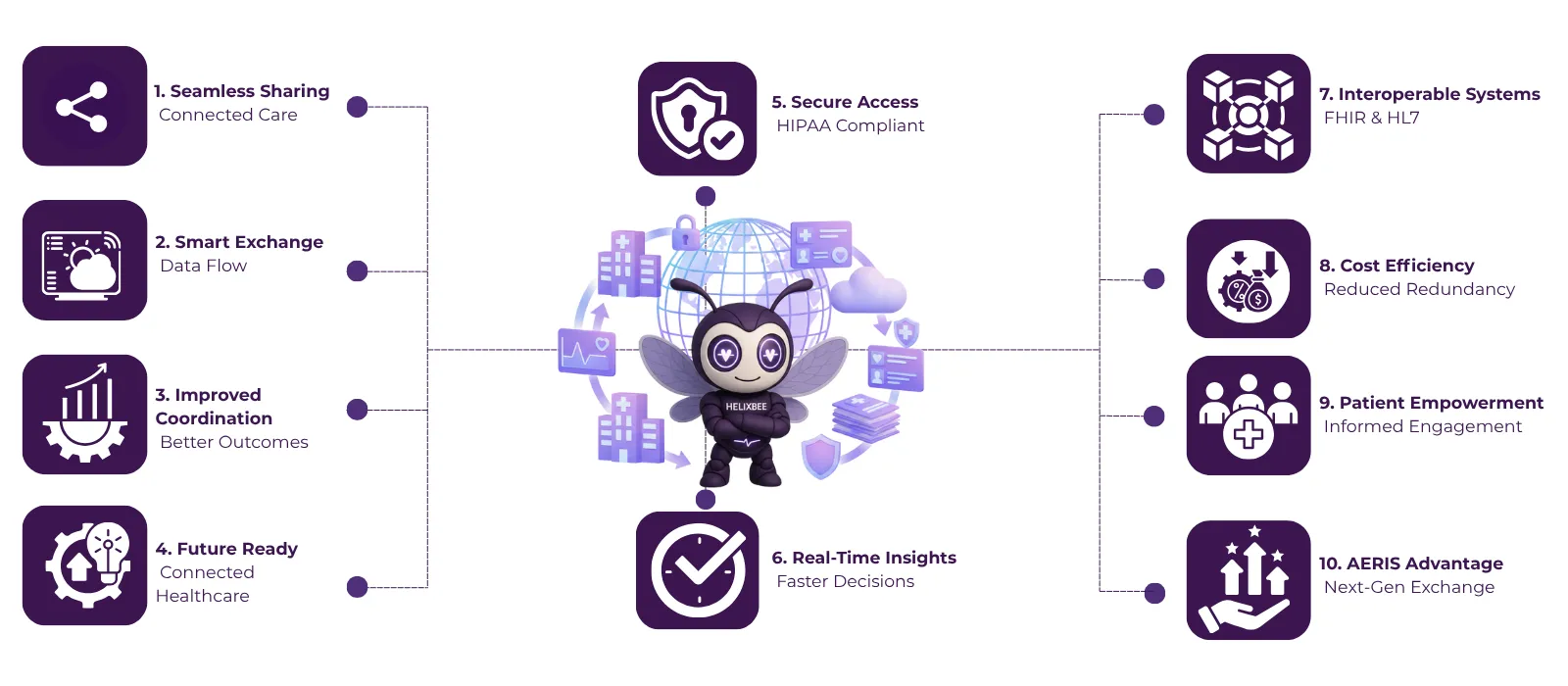
image 2 1

What is Health Information Exchange?

Health information exchange (HIE) involves the secure and appropriate sharing of patient medical information electronically among healthcare professionals, patients, and organizations. At its core, HIE facilitates access to vital health data, regardless of where the patient receives care—whether in a primary clinic, hospital emergency room, or specialist office. This exchange occurs through networks that connect electronic health records (EHRs), laboratories, pharmacies, and other entities, adhering to privacy regulations like HIPAA.
There are several models of health information exchange, including direct exchange for point-to-point secure messaging, query-based exchange where providers request specific data, and directed exchange for pushing notifications or summaries. These forms adapt to different needs, from routine care coordination to public health reporting. For example, in query-based systems, a physician can pull a patient’s full history from multiple sources to confirm accurate diagnoses.
Taking this further, healthcare information exchange focuses on connecting broader networks, sometimes covering entire regions or countries, and relies on government initiatives to standardize the data. Likewise, a health management information system complements HIE by collecting and analyzing data for administrative purposes, like tracking disease outbreaks or resource utilization. Working together, they form a comprehensive framework where health information exchange and interoperability make data flow smoothly and reduce data silos.

Benefits of Health Information Exchange

Implementing health information exchange brings many benefits. A key advantage is better care coordination, because doctors and nurses get full access to a patient’s history. This means they can make smarter treatment decisions and cut down on medication errors. For example, during an emergency, quickly seeing a patient’s allergies or past diagnoses can prevent serious complications.
Cost savings represent another key advantage. By eliminating duplicate tests and procedures through shared data, healthcare organizations lower expenses while improving resource allocation. Studies show that effective HIE can decrease hospital readmissions and streamline administrative tasks, which contributes to overall financial health.
Patient empowerment also increases with the use of health information exchange. Individuals can participate more actively in their care by accessing their records via patient portals. For public health, HIE can quickly pull data together for surveillance, making it easier to spot and respond to outbreaks.
Health information exchange brings these benefits to a much larger scale, making it easier for providers to collaborate and improve outcomes, especially when managing chronic diseases. Ultimately, sharing and linking health data pushes the entire system toward value-based care, using data-driven strategies to prioritize quality over the sheer quantity of services.

Health Information Exchange and Interoperability

Health information exchange and interoperability go hand-in-hand; you need interoperability to unlock the full potential of sharing health data. Standards like FHIR and HL7 are important because they standardize data formats, making it easy for EHRs, HIEs, and other platforms to talk to each other.
In practice, health information exchange relies on interoperable systems to query, retrieve, and integrate data across providers. For instance, the U.S. Core Data for Interoperability (USCDI) specifies essential data elements, such as clinical notes and lab results, to support nationwide sharing. This framework addresses information blocking, where entities restrict access to data, thereby promoting transparent exchanges.
The benefits of strong health information exchange and interoperability include improved population health management and advancements in research, as aggregated data informs policy and drives innovation. While challenges arise from heterogeneous systems, solutions like API-based integrations mitigate them.

How AERIS Revolutionizes Healthcare Information Exchange

Imagine a world where your healthcare organization thrives with seamless, secure, and real-time data exchange. That’s the power of AERIS by Helixbeat, a game-changing platform designed to transform how you connect, collaborate, and care. Built for healthcare providers, clinics, hospitals, and cross-industry partners like pharmacies and insurers, AERIS harnesses the power of HL7 and FHIR standards to break down data silos, streamline operations, and put patient care first.
Ready to cut delays by 50%, double your ROI, and empower your team with instant access to critical data? Let’s dive into why AERIS is the solution you’ve been waiting for.

Why AERIS is Your Key to Healthcare Innovation

At Helixbeat, we know your challenges: fragmented systems, delayed data, and rising costs. AERIS is here to change that, offering a personalized, scalable, and secure platform that fits your unique needs. Whether you’re a small clinic or a sprawling hospital network, AERIS delivers measurable results that elevate patient outcomes and boost your bottom line.

1. 20+ Years of Expertise

Our team brings decades of healthcare IT experience to ensure AERIS works for you. 

2. 50+ IT Professionals

A dedicated crew powers AERIS, delivering unmatched support and innovation. 

3. 1,000+ Customers

Join a thriving community of healthcare leaders already transforming with AERIS. 

4. 10,000+ Projects Completed

Proven success across countless integrations and workflows. 

5. 95% Returning Customers

Our clients trust AERIS to deliver, time and time again. 

Providers adopting AERIS report faster diagnoses, lower costs, and improved outcomes, positioning it as the go-to tool for future-proof HIE.

The AERIS Advantage: Numbers That Speak for Themselves

MetricWithout AERISWith AERISYour Benefit
Data Exchange Delays Frequent bottlenecks Reduced by 50% Faster care in emergencies 
Return on Investment  Slow, costly overhauls 100% faster ROI Grow without breaking the bank 
Operational Costs  High redundancies Cut by 30% Save thousands annually 
Error Rates  Up to 20% manual errors  Slashed by 90% Precision for better patient outcomes 

Your Benefits, Amplified

1. 50% Fewer Delays

Real-time data means critical information is always at your fingertips, turning hours into seconds.

2. 100% Faster ROI

Plug-and-play integration maximizes your investment without expensive system replacements.

3. 30% Cost Savings, 90% Fewer Errors

Automation eliminates waste, saving resources and ensuring accuracy.

How AERIS Works: Your 3-Step Path to Success

1. Connect Seamlessly: Integrate AERIS effortlessly into your existing systems, from legacy EHRs to modern platforms.
2. Share Securely: Activate real-time data exchange with HIPAA-compliant encryption. Watch your teams and partners collaborate effortlessly.
3. Optimize and Grow: Because AERIS evolves with your organization, it’s set up to help you succeed for the long haul.

Final Thoughts

Looking ahead, health information exchange will continue evolving with advancements in AI, telehealth, and global standards. Initiatives like TEFCA will expand connectivity, while solutions like AERIS pave the way for inclusive, interoperable ecosystems. 
In conclusion, embracing health information exchange unlocks a more connected, efficient healthcare future. With tools like AERIS leading the charge, organizations can overcome barriers and deliver superior care. Contact Helixbeat today to find out more about AERIS!

Frequently Ask Questions

1. Why is health information exchange important in healthcare?

It improves care coordination, reduces duplicate tests, minimizes errors, and helps providers make timely, data-driven decisions across different healthcare settings.

The primary models include direct exchange (secure point-to-point messaging), query-based exchange (requesting specific patient data), and directed exchange (pushing summaries or notifications).

Standards like FHIR and HL7 define consistent data formats, making it easier for EHRs, HIEs, and other healthcare platforms to exchange information.

HIE improves care coordination, reduces healthcare costs, supports population health management, enhances research, and increases operational efficiency.

AERIS leverages FHIR standards, connects legacy systems, automates workflows, reduces manual errors, and provides real-time access to patient records and lab results.

1. Why is health information exchange important in healthcare?
It improves care coordination, reduces duplicate tests, minimizes errors, and helps providers make timely, data-driven decisions across different healthcare settings.

The primary models include direct exchange (secure point-to-point messaging), query-based exchange (requesting specific patient data), and directed exchange (pushing summaries or notifications).

Standards like FHIR and HL7 define consistent data formats, making it easier for EHRs, HIEs, and other healthcare platforms to exchange information.
HIE improves care coordination, reduces healthcare costs, supports population health management, enhances research, and increases operational efficiency.
AERIS leverages FHIR standards, connects legacy systems, automates workflows, reduces manual errors, and provides real-time access to patient records and lab results.