


AERIS:Revolutionizing Health Information Systems for Smarter, Faster Healthcare
Get Started with a Free Demo
New Lead: AERIS
AERIS Landing Page Form, connected with the Mailchimp.
"*" indicates required fields
Healthcare is evolving rapidly, and at its core, you need a robust health information system. It’s the engine that keeps things running smoothly and helps patients get better care. This integrated framework handles the collection, storage, management, and transmission of health data, so providers can make informed decisions swiftly. As hospitals and clinics grapple with increasing data volumes, adopting a health information system becomes necessary for streamlining workflows and enhancing care delivery.
Here, we’ll explore everything about health information systems and explain why AERIS is the best health information system software for hospitals.
Here, we’ll explore the fundamentals of health information exchange—what it is, its benefits, its challenges, and how an innovative solution like AERIS is transforming this space.
What is a Health Information System?
A health information system encompasses a socio-technical subsystem within healthcare settings that processes data, information, and knowledge to support patient care, administration, and management. It involves the systematic gathering of health-related data from various sources, such as patient records, diagnostic tests, and administrative logs. This data is then compiled, analyzed, and disseminated to stakeholders, including doctors, nurses, administrators, and policymakers.
Unlike traditional paper-based methods, a modern health information system leverages digital tools to facilitate seamless access and real-time updates. For example, it supports electronic health records (EHRs), which provide a digital version of a patient’s medical history maintained over time. These systems adhere to standards like HIPAA to protect sensitive patient information while enabling interoperability across different platforms.
Health information systems evolved as healthcare went digital, mainly because hospitals needed a better way to handle all those rising patient numbers and their data. Today, they integrate advanced technologies like cloud computing and artificial intelligence to handle complex datasets, making them indispensable in both small clinics and large hospital networks.
Key Components of a Health Information System
A well-designed health information system comprises several interconnected components. Primary elements include data generation, where information is captured from sources like patient intake forms and lab results; compilation, which organizes raw data into usable formats; analysis, involving tools for interpreting trends; and synthesis, where insights inform strategic decisions.
Electronic health records are usually the starting point. Beyond those, key components are billing and coding platforms, modules for managing inventory, and laboratory information systems. When you look at an entire hospital system, it covers everything from patient administration and operating room scheduling to dietary management, covering every aspect of hospital operations.
Similarly, security features, like encryption and access controls, protect data integrity, while backup mechanisms safeguard against losses. Additionally, interoperability standards facilitate data exchange between systems, a key aspect for coordinated care. For hospitals, integrating Internet of Things (IoT) devices into the health information system enables real-time monitoring of medical equipment and patient vitals, which further enhances responsiveness.
These components not only reduce paperwork but also minimize errors, like duplicate tests, leading to cost savings and improved efficiency.
Benefits of Implementing a Health Information System
When you start using a health information system, you gain several benefits. One major benefit is easy access to patient data, which empowers providers to deliver timely interventions. This accessibility reduces delays in treatment and supports precision medicine through data-driven insights.
These systems give administrators a much clearer picture of what’s working—things like how fast patients move through the system and how resources are used. This information helps everyone constantly get better. The biggest win is for patient care: with all records in one place, doctors get a complete view of a person’s health, which cuts down on mix-ups and mistakes. Plus, the systems automatically flag things like drug interactions or allergies, making care much safer.
On the business side, they save money by streamlining tasks like billing and reducing paperwork. For bigger hospitals, they can even pull together data to study health trends across an entire community. Ultimately, they make healthcare fairer for everyone, especially in remote areas, by easily connecting people through telehealth.
Selecting the Best Health Information System Software for Hospitals
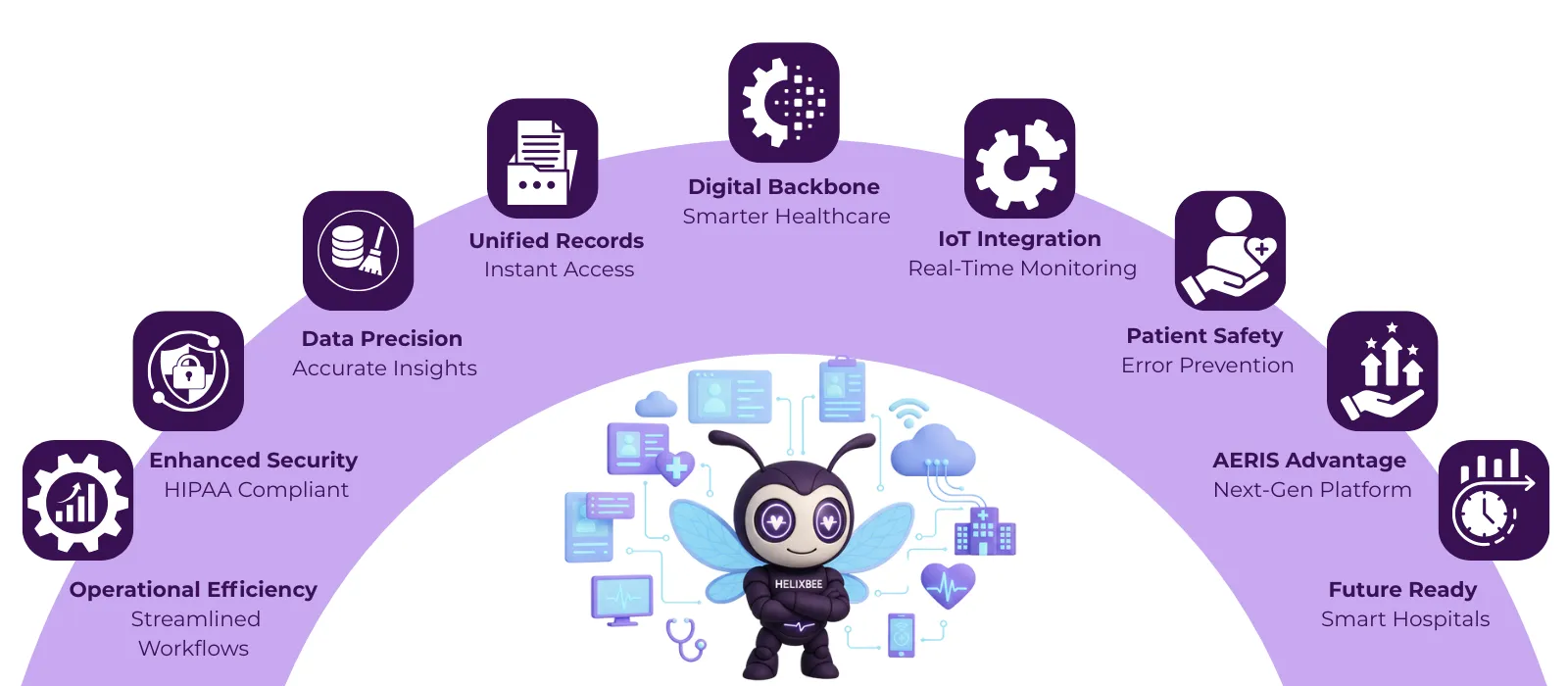
When choosing the best health information system software for hospitals, priorities include interoperability, real-time data exchange, and robust security. AERIS, a cloud-based real-time data exchange and interoperability platform by Helixbeat, excels in financial reporting, data management, and healthcare interoperability.
Built on trusted HL7 and FHIR standards, AERIS bridges communication gaps between fragmented systems, enabling healthcare professionals to access real-time data when it matters most. With this unified approach, hospitals can simplify workflows, reduce redundancies, and deliver coordinated patient care that’s faster, smarter, and more reliable.
Why Healthcare Providers Choose AERIS
At Helixbeat, we developed AERIS to solve the everyday challenges of modern healthcare—data overload, interoperability issues, and administrative bottlenecks. Whether it’s a local clinic or a large hospital network, AERIS adapts effortlessly to each environment.
1. Seamless Integration
Works with existing EHRs and legacy systems without disrupting ongoing operations.
2. Real-Time Collaboration
Connects doctors, labs, pharmacies, and insurers for instant data exchange and decision-making.
3. Data Accuracy
Automated workflows and validation tools minimize manual errors, improving the quality of clinical insights.
4. Scalability
Grows with your organization as patient volumes and data complexity increase.
5. Security & Compliance
Built with HIPAA-grade encryption and audit controls to keep sensitive information protected at all times.
Providers adopting AERIS report faster diagnoses, lower costs, and improved outcomes, positioning it as the go-to tool for future-proof HIE.
The AERIS Impact in Numbers
| Metric | Before AERIS | After AERIS | Outcome |
| Data Exchange Speed | Frequent delays | 50% faster exchange | Quicker care delivery |
| ROI | Slow recovery | Doubled ROI rate | Greater financial performance |
| Operational Costs | High redundancies | Reduced by 30% | Efficient resource use |
| Manual Errors | Up to 20% | Decreased by 90% | Accurate patient records |
Your Benefits, Amplified
1. 50% Fewer Delays
Real-time data means critical information is always at your fingertips, turning hours into seconds.
2. 100% Faster ROI
Plug-and-play integration maximizes your investment without expensive system replacements.
3. 30% Cost Savings, 90% Fewer Errors
Automation eliminates waste, saving resources and ensuring accuracy.
How AERIS Works: Your 3-Step Path to Success
1. Connect Seamlessly: Integrate AERIS effortlessly into your existing systems, from legacy EHRs to modern platforms.
2. Share Securely: Activate real-time data exchange with HIPAA-compliant encryption. Watch your teams and partners collaborate effortlessly.
3. Optimize and Grow: Because AERIS evolves with your organization, it’s set up to help you succeed for the long haul.
Final Thoughts
Modern healthcare is a complex machine, and the right health information system is the engine that keeps it running smoothly. These systems are important for making informed decisions, enhancing efficiency, and ensuring patient safety.
For hospitals and clinics, AERIS changes the game. It’s built to be the best: connecting effortlessly with other systems (unmatched interoperability), integrating the latest smart devices (IoT integration), and making billing painless. Check out AERIS today to see the difference it makes!
Frequently Ask Questions
1. What is a Health Information System (HIS)?
A Health Information System is a digital framework that collects, manages, and shares patient and hospital data to support better healthcare delivery and decision-making.
2. What are the main components of a Health Information System?
Key components include data generation, compilation, analysis, and synthesis. Modules often cover EHR, billing, inventory, lab systems, and patient management tools.
3. How do Health Information Systems improve patient care?
By providing instant access to accurate patient data, HIS helps doctors make faster and better decisions, reduces duplicate tests, and flags potential risks like drug allergies.
4. How do Health Information Systems maintain data privacy and security?
They use encryption, access control, and regular backups to protect sensitive patient information and comply with healthcare regulations such as HIPAA.
5. Why is AERIS considered the best Health Information System software for hospitals?
AERIS offers cloud-based real-time data exchange, supports the FHIR standard, enables no-code customization, and provides seamless integration with other healthcare systems.
6. What technologies are used in modern Health Information Systems?
Modern HIS platforms integrate cloud computing, artificial intelligence, and IoT devices for real-time monitoring, smart analytics, and remote accessibility.