


Healthcare Data Integration
Get Started with a Free Demo
New Keyword Page
New Keyword Page
"*" indicates required fields
Healthcare Data Integration: Benefits, Challenges, and Best Practices
Efficient healthcare data integration has become a mainstay of modern medical delivery. As healthcare systems adopt digital tools like electronic health records (EHRs), telemedicine, wearable sensors, and AI analytics, the need to unify patient data across platforms grows stronger every day. With rising volumes of clinical, operational, and administrative information, organizations require robust strategies to aggregate, share, and utilize data. Yet achieving seamless healthcare data integration remains complex due to interoperability challenges, incompatible formats, legacy systems, and security concerns. In this landscape, FUSION—a certified FHIR server—is transforming how providers implement data exchange, setting new standards for interoperability and quality care.
Experience Seamless Healthcare Data Integration
Unlock real-time, secure, and compliant data exchange with FUSION.
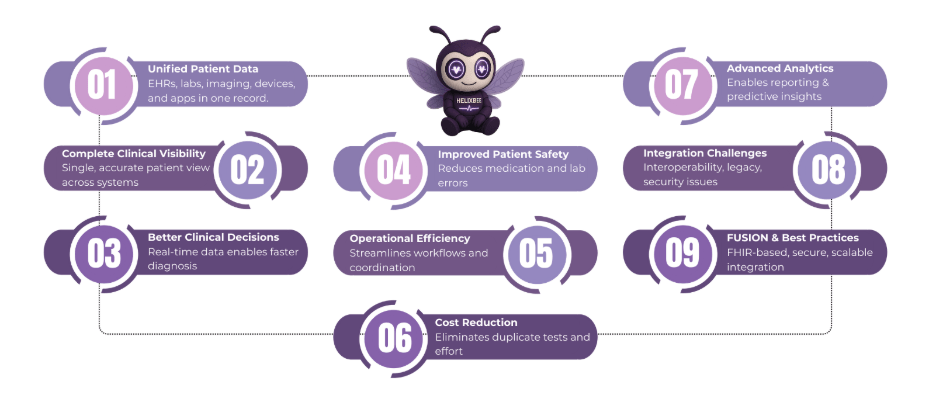
What Is Healthcare Data Integration?
Healthcare data integration refers to the process of consolidating patient and clinical information from disparate sources into a unified, standardized system that is accessible, usable, and secure. Rather than storing data in separate silos—such as lab systems, EHRs, pharmacy records, imaging centers, and wearable devices—an effective integration strategy enables:
- Consistent and complete patient profiles
- Real‑time access to clinical histories
- Cross‑system analytics and reporting
- Coordinated workflows for clinicians and care teams
At its core, healthcare data integration ensures that information flows seamlessly across systems, departments, and organizations, improving decisions and operational efficiency.
To achieve true interoperability, technologies like HL7 integration, clinical data integration, and HL7 integration services for healthcare interoperability are leveraged to translate, standardize, and route data between systems. These methods help ensure that disparate platforms—such as legacy EHRs and modern FHIR‑based applications—can “speak” the same language.
Benefits of Healthcare Data Integration
The advantages of robust healthcare data integration extend from clinical outcomes to operational performance:
Improved Clinical Decision‑Making
When providers have access to unified patient records, they can make faster and more accurate decisions. A consolidated view of patient data reduces uncertainty and helps clinicians avoid unnecessary tests or treatments, improving outcomes and patient satisfaction.
Enhanced Patient Safety
Integrated clinical data means fewer errors due to incomplete or missing information. For example, allergy lists, medication histories, and lab trends can be immediately available at the point of care, helping prevent adverse events.
Streamlined Clinical Workflow
With effective integration, healthcare professionals spend less time searching multiple systems and more time delivering care. Automated alerts and unified dashboards help clinicians prioritize care, track treatment plans, and reduce administrative overhead.
Cost Savings and Efficiency
Healthcare data integration minimizes duplication of services—such as redundant imaging or lab tests—and reduces billing errors. The result is lower operational costs and better resource utilization.
Population Health and Analytics
Aggregated data fuels analytics platforms that identify trends, manage chronic disease populations, and support value‑based care initiatives. Integrated systems help stakeholders understand patterns that drive better prevention strategies.
Enhanced Patient Engagement
When patients can view their records in one place—across visits, providers, and systems—they engage more actively in their care. Secure patient portals and shared records help patients stay informed and compliant with treatment plans.
Challenges of Healthcare Data Integration
Despite its clear benefits, implementing healthcare data integration can be daunting:
Interoperability Gaps
Many legacy systems were not designed to communicate beyond their own environments. While HL7 integration has helped bridge some gaps, translating between older standards and modern systems still poses challenges.
Inconsistent Data Standards
Different providers often use varied terminologies or data formats. Without a common framework like FHIR, clinical data can be fragmented or misinterpreted, compromising usability.
Data Quality and Normalization
Collected data may be incomplete, inconsistent, or stored with errors. Achieving meaningful insights requires cleansing, normalizing, and standardizing inputs so that comparison and analysis are reliable.
Security and Privacy Concerns
Healthcare records contain highly sensitive information. Integrating data across systems increases the attack surface if security controls—such as encryption and access governance—are inadequate.
Workflow Disruption
Introducing new integration platforms can temporarily disrupt existing processes. It requires training, technical support, and change management to ensure clinician adoption.
Cost and Resource Constraints
Comprehensive integration initiatives require investment in infrastructure, tools, and skilled personnel. This can strain budgets, particularly for smaller healthcare organizations.
Regulatory and Compliance Burdens
Regulations such as HIPAA and CMS interoperability mandates require robust compliance mechanisms. Ensuring that integrated systems meet evolving legal standards adds complexity to implementation.
How FUSION Helps in Healthcare Data Integration
FUSION is a powerful, scalable FHIR server built to tackle these exact challenges and enable seamless healthcare data integration across health systems. Designed for real‑time interoperability and robust security, FUSION harmonizes data from EHRs, labs, mobile applications, telehealth platforms, wearable devices, and more.
FHIR‑Native Integration Platform
At the core of FUSION’s capability is its adherence to Fast Healthcare Interoperability Resources (FHIR), a modern standard developed by HL7. By using FHIR as the foundation, FUSION ensures consistent, structured, and semantically rich data exchange.
FHIR enables clinical data integration by translating disparate inputs into standardized resources—like Patient, Observation, MedicationRequest, and Encounter—so that data from virtually any source can be shared and consumed efficiently.
Comprehensive HL7 Support
While FHIR represents the future of interoperability, many systems continue to use older formats. FUSION includes full support for HL7 integration services for healthcare interoperability, allowing organizations to bring HL7 v2 and CDA into a unified ecosystem alongside FHIR resources.
By facilitating both backward compatibility and forward‑looking standards, FUSION ensures that no data is left behind.
Scalable Cloud Deployment
FUSION supports cloud‑based deployments with near‑constant availability. This allows scalable, secure healthcare data exchange across facilities, regions, and partnerships—supporting large hospital networks, integrated delivery systems, and community providers.
Secure and Compliant by Design
Security is foundational to FUSION, enabling organizations pursuing compliant healthcare data integration without sacrificing privacy or performance. Role‑based access controls, encryption at rest and in motion, and audit logging help meet regulatory requirements efficiently.
Real‑Time Analytics and Workflows
By centralizing and structuring data, FUSION accelerates clinical workflows, supports real‑time decision‑making, and enables powerful operational reporting. Rather than isolated analytics, clinicians and administrators can access insights derived from integrated datasets.
Transform Your Clinical Workflows Today
Integrate EHRs, labs, and devices effortlessly with FUSION’s FHIR server.
Best Practices for Healthcare Data Integration
To maximize the success of healthcare data integration, organizations should adopt a strategic approach that includes the following best practices:
EstablishCommon Standards
Adopt universal formats such as FHIR for interoperability while ensuring support for legacy standards. Using common data models prevents misinterpretation and improves cross‑system compatibility.
Prioritize Security and Compliance
Ensure that encryption, identity management, and access governance are in place. Compliance with HIPAA and related regulations should be built into the integration strategy from day one.
Focus on Data Quality
Invest in data cleansing, normalization, and governance tools. High‑quality data leads to accurate analytics, better clinical insights, and improved decision‑making.
Modular Implementation
Rather than a single, monolithic rollout, integrate systems incrementally. Begin with core clinical workflows and expand to labs, imaging, and third‑party applications to minimize disruption.
Foster Stakeholder Collaboration
Healthcare data integration touches many groups—clinicians, IT, security teams, and decision makers. Engage stakeholders early and often to ensure alignment on goals and workflows.
Monitor and Optimize Continuously
Ongoing evaluation of integration performance, user adoption, and security posture ensures long‑term success. Use analytics to identify bottlenecks and areas for improvement.
Invest in Training and Support
Provide clinicians and administrators with training and change management resources. Familiarity with integrated systems increases adoption, reduces errors, and improves satisfaction.
Why FUSION Is Best Among All
FUSION delivers exceptional value as a comprehensive solution for healthcare data integration—not just because it unifies data, but because it is built to meet real‑world needs through certified, secure, and interoperable design.
Why FUSION Certifications Matter for Healthcare Data Integration
- HIPAA Certified: Ensures secure handling of patient information, which is critical for compliant healthcare data integration at every stage.
- SOC 2 Type 2 Certified: Provides assurance that FUSION maintains strong controls around data security, availability, and confidentiality—essential for trusted integration workflows.
- Drummond Health IT Compliance: Validates interoperability and adherence to global standards such as FHIR and HL7, enabling seamless clinical data integration across systems.
- Cloud Security Standards: Operating on a HIPAA‑compliant cloud infrastructure ensures safe storage and transmission of sensitive health data, even at scale.
- Trust & Reliability: These certifications demonstrate FUSION’s commitment to secure, efficient, and scalable healthcare data integration across large hospital networks, clinics, and multisite practices.
By earning recognized industry certifications, FUSION stands out as a trusted platform that meets legal, clinical, and technological requirements for modern data exchange.
Final Words
Achieving effective healthcare data integration is no longer a competitive advantage—it’s a fundamental requirement for quality care delivery, operational excellence, and patient engagement. By consolidating data from multiple sources, implementing standards like HL7 and FHIR, and prioritizing security and compliance, organizations can unlock the full potential of clinical information.
FUSION provides a certified, secure, scalable solution that enables real‑time interoperability and transforms fragmented data into actionable insights. Whether you are a large integrated delivery network, a community health system, or an emerging telehealth provider, FUSION meets the demands of modern care delivery.
Unlock the future of healthcare with dependable, seamless healthcare data integration—built on standards, verified by certifications, and trusted by clinicians. Let your organization thrive with integrated insights that improve outcomes and enhance patient trust
Frequently Ask Questions
1. What is healthcare data integration?
It’s the process of unifying patient data from multiple sources into a single system. FUSION enables secure healthcare data integration for accurate and complete records.
2. How does FUSION support HL7 integration?
FUSION converts HL7 v2, CDA, and other formats into FHIR resources, enabling smooth HL7 integration services for healthcare interoperability.
3. What are the benefits of clinical data integration
FUSION enhances patient safety, reduces redundant tests, and improves workflow through efficient clinical data integration.
4. Can FUSION work with legacy healthcare systems?
Yes, FUSION supports HL7 Integration for Healthcare Systems, ensuring backward compatibility and seamless data exchange.
5. How secure is healthcare data integration with FUSION?
FUSION is HIPAA-certified and SOC 2 Type 2 compliant, providing safe and reliable healthcare data integration across systems.