


USCDI v3 & TEFCA Explained: What Healthcare Organizations Must Prepare for in 2026–2027
Get Started with a Free Demo
New Keyword Page
New Keyword Page
"*" indicates required fields
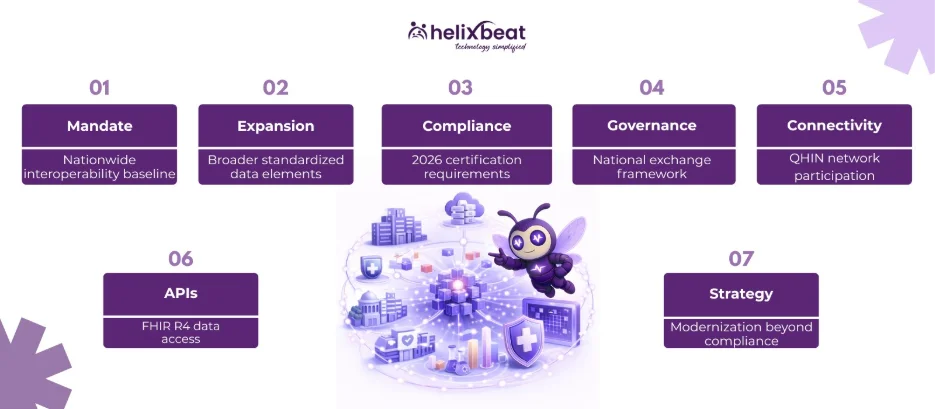
Healthcare data interoperability in the US has moved from a technical ideal to a strategic imperative. Two major initiatives are reshaping how health information flows across systems, networks, providers, payers, and patients:
- United States Core Data for Interoperability (USCDI) Version 3 (v3)
- Trusted Exchange Framework and Common Agreement (TEFCA)
Both are central to compliance and operational modernization in 2026–2027. In this guide, we explain what they are, why they matter, and what key actions healthcare organizations should take now.
What Is USCDI and Why USCDI v3 Matters
Defining USCDI
The Office of the National Coordinator for Health Information Technology (ONC) defines the United States Core Data for Interoperability (USCDI) as a standardized set of health data classes and data elements used for exchanging electronic health information. Its purpose is to enable consistent, nationwide healthcare data sharing for clinical care, research, public health, and patient access. USCDI acts as a baseline vocabulary, making a core set of information, like medications and vital signs, available in a format every system understands
What Changed in USCDI v3
USCDI v3 was adopted as the baseline standard within the ONC Health IT Certification Program under the Health Data, Technology, and Interoperability: Certification Program Updates (HTI-1) Final Rule. As of January 1, 2026, certified health IT must support USCDI v3 data elements.
Key points about USCDI v3:
- It expanded the required dataset to include more comprehensive patient information, such as health insurance information, health status/assessments, and enhanced demographic elements.
- The expansion reflects a broader set of use cases important for both clinical care and administrative exchange.
- Certified health IT developers and other health technology providers must implement full support for these elements by the compliance deadline.
Mandatory Compliance Timeline
Although USCDI standards are updated regularly, the HTI-1 Final Rule solidified that USCDI v3 will be the only required version under the certification program beginning in 2026. This means:
- All health IT products seeking or maintaining ONC certification must support USCDI v3 data classes and elements through both application programming interfaces (APIs) and document-based exchange mechanisms.
- Systems not meeting this baseline cannot be certified under the federal program, affecting eligibility for federal incentive programs and participation in certain data exchange networks.
Understanding TEFCA: National-Scale Interoperability
The Trusted Exchange Framework and Common Agreement (TEFCA) was developed by the U.S. Department of Health and Human Services and implemented by the Recognized Coordinating Entity, The Sequoia Project.
TEFCA establishes:
- A common legal agreement
- A national governance model
- Standardized policies for exchange
- Technical requirements for nationwide connectivity
Its goal is to create a “network of networks,” reducing the need for organizations to build multiple custom data-sharing connections.
Qualified Health Information Networks (QHINs)
Under TEFCA, designated organizations known as Qualified Health Information Networks (QHINs) connect participants to the broader nationwide exchange.
As a result, healthcare organizations can connect to:
- A QHIN directly
- A participant within a QHIN
Once connected, participants can exchange data across the broader TEFCA ecosystem.
As TEFCA participation expands, healthcare data interoperability shifts from regional exchange models to a national-level framework.
TEFCA in Action: Data Exchange Growth
In early 2026, health data exchange under TEFCA reached a milestone with nearly 500 million health records exchanged through networks operating under its framework. HHS projections indicate large-scale cost savings across the U.S. healthcare system as participation grows.
This level of exchange indicates real activity rather than theoretical planning, making TEFCA a foundational component of national healthcare data interoperability infrastructure.
How USCDI v3 and TEFCA Work Together
Shared Standards, Shared Goals
USCDI v3 and TEFCA are distinct but deeply complementary:
- USCDI v3 provides the content baseline — what data fields must be available.
- TEFCA provides the governance and connectivity model — how data is exchanged across the nation.
TEFCA explicitly requires the ability to exchange USCDI standard data elements. As a result, when information moves across QHINs, it’s not just being transferred; it has a consistent structure that can be interpreted across systems.
The Critical Role of FHIR APIs in 2026–2027
No discussion of healthcare data interoperability in the U.S. is complete without addressing FHIR APIs. Under federal rules:
- Certified health IT must support standardized APIs.
- These APIs must allow access to USCDI data elements.
- APIs must use FHIR Release 4 (R4) as specified under ONC regulations.
FHIR APIs enable:
- Patient access applications
- Payer-to-payer data exchange
- Provider data retrieval
- Population health data aggregation
FHIR supports RESTful architecture, JSON/XML formats, and modular resource structures, making it more adaptable than older messaging standards.
How FHIR Aligns with USCDI v3
USCDI defines what data must be exchangeable.
FHIR defines how it is exchanged via APIs.
Beginning January 1, 2026:
- Certified health IT must expose USCDI v3 data through FHIR APIs.
- Systems must support read access for standardized datasets.
- API documentation must be publicly available.
This alignment between USCDI and FHIR is central to advancing healthcare data interoperability nationwide.
What Healthcare Organizations Must Prepare for
1. Technology Modernization
Organizations must confirm that:
- EHR systems are certified to USCDI v3.
- FHIR R4 APIs are implemented and operational.
- Data mapping aligns with USCDI data classes.
- Internal systems support both inbound and outbound exchange.
Legacy systems that rely solely on older HL7 v2 messaging may require modernization.
2. Participation Strategy for TEFCA
Healthcare organizations should evaluate:
- Whether to join a QHIN directly.
- Whether to participate via a network already connected to TEFCA.
- Internal governance policies for national data exchange.
Participation involves contractual obligations under the Common Agreement.
3. Identity Matching and Data Governance
Nationwide healthcare data interoperability requires:
- Accurate patient matching
- Master Patient Index strategies
- Clear data governance policies
- Strong cybersecurity controls
Without proper identity matching processes, cross-network exchange can produce duplicate or fragmented records.
4. Information Blocking Compliance
The Information Blocking Rule prohibits practices that interfere with lawful data exchange.
Therefore, organizations must:
- Respond to electronic health information requests.
- Provide access through standardized APIs.
- Document legitimate exceptions where applicable.
Failure to comply may result in penalties or reputational consequences.
Strategic Benefits Beyond Compliance
While regulatory alignment is mandatory, organizations that fully leverage healthcare data interoperability can gain:
- Improved care coordination
- Reduced duplicate testing
- Enhanced value-based care analytics
- Better patient engagement tools
- Stronger payer-provider collaboration
Interoperability is becoming foundational to reimbursement models tied to quality and outcomes.
How AERIS Revolutionizes Interoperability with FHIR APIs
Imagine a world where your healthcare organization thrives with seamless, secure, and real-time data exchange. That’s the power of AERIS by Helixbeat, a game-changing platform designed to transform how you connect, collaborate, and care. Built for healthcare providers, clinics, hospitals, and cross-industry partners like pharmacies and insurers, AERIS harnesses FHIR APIs to break down data silos, streamline operations, and put patient care first.
Ready to cut delays by 50%, double your ROI, and empower your team with instant access to critical data? Let’s dive into why AERIS is the solution you’ve been waiting for.
Why AERIS is Your Key to Healthcare Innovation
At Helixbeat, we know your challenges: fragmented systems, delayed data, and rising costs. AERIS is here to change that, offering a personalized, scalable, and secure platform that fits your unique needs. Whether you’re a small clinic or a sprawling hospital network, AERIS delivers measurable results that elevate patient outcomes and boost your bottom line.
- 20+ Years of Expertise: Our team brings decades of healthcare IT experience to ensure AERIS works for you.
- 50+ IT Professionals: A dedicated crew powers AERIS, delivering unmatched support and innovation.
- 1,000+ Customers: Join a thriving community of healthcare leaders already transforming with AERIS.
- 10,000+ Projects Completed: Proven success across countless integrations and workflows.
- 95% Returning Customers: Our clients trust AERIS to deliver, time and time again.
Providers adopting AERIS report faster diagnoses, lower costs, and improved outcomes, positioning it as the go-to tool for future-proof HIE.
Your Benefits, Amplified
- 50% Fewer Delays: Real-time data means critical information is always at your fingertips, turning hours into seconds.
- 100% Faster ROI: Plug-and-play integration maximizes your investment without expensive system replacements.
- 30% Cost Savings, 90% Fewer Errors: Automation eliminates waste, saving resources and ensuring accuracy.
Final Thoughts
USCDI v3 and TEFCA represent the most significant structural advancement in U.S. healthcare data interoperability in over a decade.
Between 2026 and 2027, healthcare organizations must align technology infrastructure, governance policies, API capabilities, and exchange strategies with federal requirements.
AERIS leverages FHIR APIs to enable secure, real-time data exchange across healthcare systems. As a powerful interoperability solution, AERIS helps organizations seamlessly connect EHRs, applications, and clinical platforms — transforming fragmented data into actionable insights.
Connect with Helixbeat today to modernize your interoperability strategy and power truly connected healthcare.
Frequently Ask Questions
1. Why is health information exchange important in healthcare?
It improves care coordination, reduces duplicate tests, minimizes errors, and helps providers make timely, data-driven decisions across different healthcare settings.
2. What are the main models of health information exchange?
3. Which standards guide health information exchange?
Standards like FHIR and HL7 define consistent data formats, making it easier for EHRs, HIEs, and other healthcare platforms to exchange information.
4. What are the benefits of using health information exchange?
HIE improves care coordination, reduces healthcare costs, supports population health management, enhances research, and increases operational efficiency.
5. How does AERIS enhance healthcare information exchange?
AERIS leverages FHIR standards, connects legacy systems, automates workflows, reduces manual errors, and provides real-time access to patient records and lab results.
1. What is healthcare data interoperability?
Healthcare data interoperability refers to the ability of health IT systems to exchange, interpret, and use electronic health information across organizations.
2. Does TEFCA replace regional HIEs?
No. TEFCA connects networks but does not eliminate regional health information exchanges.
3. What version of FHIR is required?
FHIR Release 4 (R4) is required under the ONC certification criteria tied to the HTI-1 rule.
4. Are APIs mandatory for certified health IT?
Yes. Certified systems must provide standardized API access to USCDI data.
5. What happens if a vendor does not comply?
Health IT products may lose certification status under the ONC program.