


An Essential Guide to Healthcare Database Systems
Get Started with a Free Demo
New Keyword Page
New Keyword Page
"*" indicates required fields
Healthcare database systems are a big part of modern medicine, as they handle everything from patient information to medical records and day-to-day operations. By bringing data from different sources into one spot, these systems give healthcare providers a complete picture.
Here, we’ll explore the fundamentals of healthcare database systems, including their types, key components, benefits, and emerging trends.
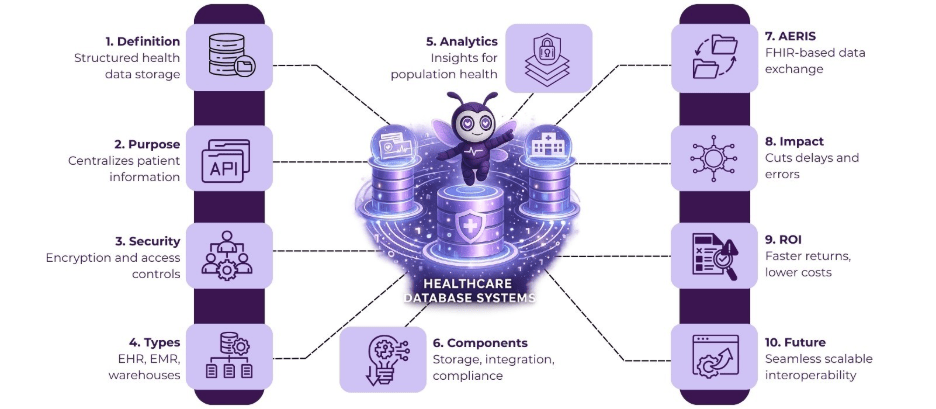
What Are Healthcare Database Systems?
Healthcare database systems refer to structured repositories that store, manage, and retrieve health-related data. They comprise a range of technologies, from simple patient record databases to complex networks handling big data analytics. These systems collect information such as patient demographics, treatment histories, lab results, and billing details.
Unlike general databases, healthcare database systems prioritize security and interoperability. They often incorporate standards like HL7 or FHIR to facilitate data exchange between providers. This facilitates seamless integration across electronic health records (EHRs) and other platforms. For example, a hospital might use a healthcare database system to track patient admissions, while a public health agency analyzes aggregated data for disease surveillance.
The evolution of healthcare database systems stems from the shift to digital records. Paper-based systems once dominated, but digital alternatives now dominate due to their scalability and accessibility. These systems vary in scale: small clinics might use basic relational databases, while large organizations employ data warehouses for comprehensive analytics.
Key features include data encryption, audit trails, and real-time querying capabilities. By centralizing information, healthcare database systems reduce errors and enhance coordination among care teams.
Types of Healthcare Database Systems
Healthcare database systems come in various forms. Electronic Health Records (EHRs) and Electronic Medical Records (EMRs) form the foundation. EMRs focus on data within a single practice, while EHRs expand this to a broader view, sharing data across providers for holistic patient care.
Another type includes health data warehouses, which aggregate information from multiple sources like claims, labs, and wearables. These enable advanced analytics for population health management. Similarly, disease registries, such as cancer or trauma databases, collect specialized data for research and tracking outcomes.
Specialized databases for research, like those from NCBI, support secondary data reuse for studies. Each type addresses unique aspects, from operational efficiency to predictive modeling.
Key Components of Healthcare Database Systems
Effective healthcare database systems rely on several core components. Data storage forms the base, using relational models or NoSQL for flexibility with large volumes. Integration tools, like APIs, connect disparate systems for a 360-degree data view.
Security measures, including encryption and access controls, protect sensitive information. Likewise, analytics engines process data for insights using AI. Additionally, user interfaces provide intuitive access, with dashboards for quick overviews.
Scalability components, such as cloud infrastructure, handle growing data loads without performance loss. Besides, compliance features, like audit logs and data anonymization, align with the HIPAA standards.
These elements work together to make healthcare database systems robust and user-friendly.
How AERIS Strengthens Healthcare Database Systems with FHIR
Imagine a world where your healthcare organization thrives with seamless, secure, and real-time data exchange. That’s the power of AERIS by Helixbeat, a game-changing platform designed to transform how you connect, collaborate, and care. Built for healthcare providers, clinics, hospitals, and cross-industry partners like pharmacies and insurers, AERIS harnesses the power of HL7 and FHIR standards to break down data silos, streamline operations, and put patient care first.
Ready to cut delays by 50%, double your ROI, and empower your team with instant access to critical data? Let’s dive into why AERIS is the solution you’ve been waiting for.
Why AERIS is Your Key to Healthcare Innovation
At Helixbeat, we know your challenges: fragmented systems, delayed data, and rising costs. AERIS is here to change that, offering a personalized, scalable, and secure platform that fits your unique needs. Whether you’re a small clinic or a sprawling hospital network, AERIS delivers measurable results that elevate patient outcomes and boost your bottom line.
- 20+ Years of Expertise: Our team brings decades of healthcare IT experience to ensure AERIS works for you.
- 50+ IT Professionals: A dedicated crew powers AERIS, delivering unmatched support and innovation.
- 1,000+ Customers: Join a thriving community of healthcare leaders already transforming with AERIS.
- 10,000+ Projects Completed: Proven success across countless integrations and workflows.
- 95% Returning Customers: Our clients trust AERIS to deliver, time and time again.
Providers adopting AERIS report faster diagnoses, lower costs, and improved outcomes, positioning it as the go-to tool for HIS.
The AERIS Advantage: Numbers That Speak for Themselves
Metric | Without AERIS | With AERIS | Your Benefit |
Data Exchange Delays | Frequent bottlenecks | Reduced by 50% | Faster care in emergencies |
Return on Investment | Slow, costly overhauls | 100% faster ROI | Grow without breaking the bank |
Operational Costs | High redundancies | Cut by 30% | Save thousands annually |
Error Rates | Up to 20% manual errors | Slashed by 90% | Precision for better patient outcomes |
Your Benefits, Amplified
- 50% Fewer Delays: Real-time data means critical information is always at your fingertips, turning hours into seconds.
- 100% Faster ROI: Plug-and-play integration maximizes your investment without expensive system replacements.
- 30% Cost Savings, 90% Fewer Errors: Automation eliminates waste, saving resources and ensuring accuracy.
How AERIS Works: Your 3-Step Path to Success
- Connect Seamlessly: Integrate AERIS effortlessly into your existing systems, from legacy EHRs to modern platforms.
- Share Securely: Activate real-time data exchange with HIPAA-compliant encryption. Watch your teams and partners collaborate effortlessly.
- Optimize and Grow: Because AERIS evolves with your organization, it’s set up to help you succeed for the long haul.
Final Thoughts
Healthcare database systems play a vital role in modern medicine, providing the tools needed to manage patient data, streamline operations, and improve care quality. From EHRs and EMRs to health data warehouses, these systems centralize information, reduce errors, and support informed decision-making. While challenges like system fragmentation and data delays exist, solutions like AERIS are transforming the landscape.
Take the next step with Helixbeat today and improve patient outcomes through seamless, secure, and scalable solutions.
Frequently Ask Questions
1. Why is health information exchange important in healthcare?
It improves care coordination, reduces duplicate tests, minimizes errors, and helps providers make timely, data-driven decisions across different healthcare settings.
2. What are the main models of health information exchange?
3. Which standards guide health information exchange?
Standards like FHIR and HL7 define consistent data formats, making it easier for EHRs, HIEs, and other healthcare platforms to exchange information.
4. What are the benefits of using health information exchange?
HIE improves care coordination, reduces healthcare costs, supports population health management, enhances research, and increases operational efficiency.
5. How does AERIS enhance healthcare information exchange?
AERIS leverages FHIR standards, connects legacy systems, automates workflows, reduces manual errors, and provides real-time access to patient records and lab results.
1. Why is data security important in healthcare databases?
Healthcare databases hold sensitive information, and security measures like encryption and access controls protect against unauthorized access and breaches.
2. What role do health data warehouses play?
They aggregate information from multiple sources, enabling advanced analytics for population health management and operational insights.
3. How does AERIS improve healthcare database systems?
AERIS integrates HL7 and FHIR standards to provide real-time, secure data exchange, which reduces delays and operational costs.
4. Can small clinics benefit from AERIS?
Yes, AERIS is scalable and works for both small clinics and large hospital networks, improving data sharing and workflow efficiency.