


Healthcare Integration Engine
Get Started with a Free Demo
New Keyword Page
New Keyword Page
"*" indicates required fields
Advanced Healthcare Integration Engine for Unified Data Exchange
You know that frustrating moment when your specialist asks for test results your primary care doctor ordered last month, and somehow those records are stuck in limbo? Yeah, that’s the data interoperability nightmare we’re fixing. Let’s talk about how a healthcare integration engine can transform that chaos into seamless collaboration.
What Is a Healthcare Integration Engine?
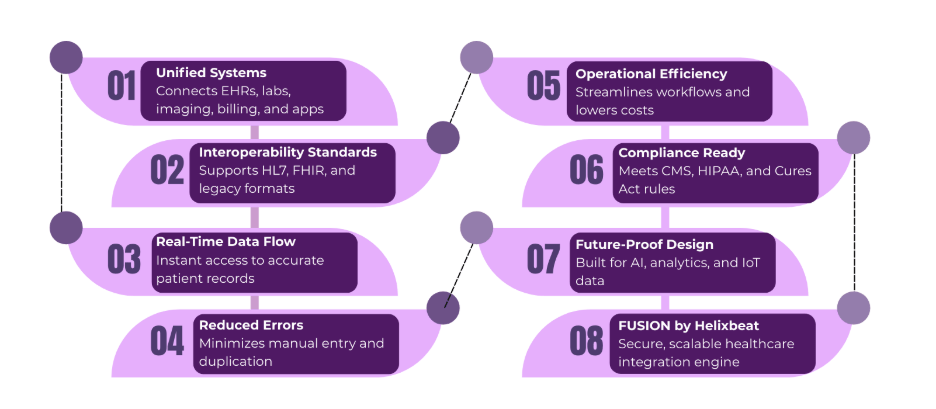
Think of a healthcare integration engine as the universal translator for your hospital’s tech ecosystem. Just like how your smartphone connects your messages, photos, and apps in one place, a healthcare integration engine connects your EHRs, lab systems, imaging platforms, and billing software so they actually talk to each other.
Here’s the reality: over 80% of healthcare providers are wrestling with systems that don’t play nice together. A healthcare integration engine solves this by standardizing how patient data moves between platforms—whether that’s HL7 v2 messages, FHIR resources, or proprietary formats. It’s the backbone that ensures a patient’s medication list in the pharmacy system matches what their cardiologist sees in real-time.
The Problem With Healthcare Data Today
Let’s get real about what’s broken. Research shows that healthcare organizations waste approximately $30 billion annually on administrative inefficiencies tied to poor data integration. When your lab results can’t automatically flow into your EHR, someone’s manually entering that data—and making mistakes about 15-20% of the time.
That’s where a robust healthcare interface engine steps in. Unlike basic point-to-point connections that create spaghetti architecture, a modern healthcare integration engine creates a centralized hub where data transformation happens intelligently. FUSION by Helixbeat exemplifies this approach, cutting redundant processes by 30% while ensuring CMS compliance.
How Healthcare Integration Engines Actually Work
Picture this workflow: A patient gets bloodwork done at 9 AM. The lab instrument generates results in its native format. Your healthcare integration engine intercepts that message, validates the data quality, transforms it into FHIR-compliant resources, and routes it to three destinations simultaneously—the ordering physician’s EHR, the patient portal, and the billing system for claims processing.
All of this happens in seconds, not hours or days. That’s the power of a well-configured healthcare interface engine. It’s monitoring, routing, transforming, and logging every transaction to create an audit trail that keeps you compliant with regulations.
Key Components of Modern Healthcare Integration Engines
Message Processing: Your healthcare integration engine handles thousands of messages daily—ADT notifications when patients are admitted, lab orders (ORU messages), prescription fills, imaging requests. Each message type requires specific handling rules.
Data Transformation: Different systems speak different dialects. A healthcare interface engine converts HL7 v2.5 to v2.3, maps proprietary codes to SNOMED CT or LOINC, and ensures that “patient temperature” in one system becomes the correct field in another.
Real-Time Monitoring: When messages fail (and they will), your healthcare integration engine alerts the IT team immediately. FUSION’s monitoring capabilities reduce downtime by catching errors before they cascade into system-wide issues.
The Business Case: Why Your Hospital Needs This Now
Let’s talk numbers that matter to your CFO. Hospitals using a comprehensive healthcare integration engine report:
- 25% reduction in duplicate diagnostic tests (saving $200-$400 per patient annually)
- 30% faster insurance claim approvals improving cash flow by 20%
- 50% decrease in data entry duplication freeing up clinical staff for actual patient care
- 90% reduction in data formatting errors lowering liability risks
But here’s the kicker: CMS mandates for interoperability mean penalties up to $1.5 million annually for non-compliance. A FHIR-enabled healthcare integration engine like FUSION isn’t optional anymore—it’s your compliance insurance policy.
FUSION: Healthcare Integration Engine Built for the Future
What makes FUSION different from legacy healthcare interface engines? It’s built on FHIR from the ground up, not retrofitted. That means native support for RESTful APIs, JSON resources, and the modern web standards that your patient-facing apps need.
Internal System Integration
FUSION connects those fragmented EHR systems creating data silos across your hospital network. When your emergency department, surgical unit, and outpatient clinics all run different platforms, your healthcare integration engine becomes the single source of truth. The result? Critical patient records become accessible hospital-wide, reducing redundant data entry by 50%.
Lab Result Standardization
Here’s a common scenario: Your hospital partners with three different lab companies, each sending results in slightly different formats. FUSION’s healthcare interface engine capabilities automatically convert all lab data into FHIR-compatible formats, cutting duplicate test orders by 25%. That’s real money saved—and better patient outcomes when physicians have complete information.
Streamlined Referrals and Specialist Coordination
Ever sent a patient to a specialist only to have them call back asking for records? A proper healthcare integration engine eliminates that friction. When you initiate a referral through your EHR, FUSION packages the complete patient history—diagnoses, medications, recent labs, imaging reports—and delivers it in whatever format the receiving specialist’s system requires. Referral processing delays drop by 30%.
Compliance Made Simple
Let’s address the elephant in the room: regulatory compliance. The 21st Century Cures Act and CMS interoperability rules aren’t suggestions—they’re mandates with teeth. Your healthcare integration engine like FUSION addresses this with:
- SOC 2 Type II compliance
- HIPAA-aligned security controls
- Encryption at rest and in transit
- Role-based access management
- Complete audit logs
This makes FUSION a trusted healthcare integration engine for enterprise healthcare environments.
Integration With External Partners
Modern healthcare is a team sport. Your healthcare interface engine needs to seamlessly exchange data with external labs, pharmacies, imaging centers, and referring physicians. FUSION supports this through standards-based connectors that reduce communication costs by 60%.
Imagine a pharmacy automatically receiving prescription information the moment your physician clicks “send”—no faxes, no phone calls, no delays. That’s what a properly implemented healthcare integration engine delivers daily.
Preparing for AI and IoT Innovation
Here’s where it gets exciting. The same healthcare integration engine standardizing your current data flows becomes the foundation for next-generation technologies. When patient data is already in FHIR format, training AI models for predictive analytics becomes dramatically simpler.
Wearable devices, remote patient monitoring, IoT-enabled medical devices—they all generate data streams that need integration. FUSION’s architecture anticipates these needs, ensuring you’re not replacing your healthcare integration engine in three years when you want to deploy AI-powered clinical decision support.
Making the Switch: What Implementation Looks Like
Migrating to a new healthcare interface engine sounds daunting, but the process is more straightforward than you’d think. Helixbeat’s implementation approach involves:
- Infrastructure Assessment: Mapping your current integrations and data flows
- Phased Migration: Moving non-critical interfaces first to minimize risk
- Parallel Testing: Running old and new systems simultaneously until confidence is built
- Staff Training: Ensuring your IT team can monitor and maintain the healthcare integration engine
- Optimization: Fine-tuning performance and adding new integrations post-launch
Most organizations achieve full implementation within 3-6 months, with critical integrations live much sooner.
Real-World Impact: From Theory to Practice
Let’s get specific about outcomes. A mid-sized hospital network implementing FUSION as their primary healthcare integration engine saw:
- Error-free data exchange across 15 previously incompatible systems
- Real-time lab results flowing to physicians within 2 minutes of completion
- Unified patient medication lists eliminating dangerous drug interaction risks
- Automated insurance eligibility checks reducing claim denials by 40%
The clinical staff stopped spending hours chasing down records. IT stopped firefighting integration failures. And patients received faster, safer care because their complete medical picture was always available.
The Cost of Doing Nothing
Sticking with your current patchwork of point-to-point interfaces and manual data entry? Let’s calculate that cost:
- Staff time: 4 hours daily manually reconciling data across systems = $60,000 annually per department
- Delayed care: Even a 15-minute delay in receiving critical lab results can impact outcomes
- Compliance risk: One HIPAA breach or CMS penalty dwarfs the investment in a proper healthcare integration engine
- Lost opportunities: Without standardized data, AI projects and population health initiatives remain stuck in PowerPoint
Why Healthcare Organizations Choose FUSION
FUSION isn’t just another healthcare integration engine—it’s a comprehensive interoperability platform designed specifically for the challenges modern healthcare faces. Unlike competitors focused solely on message routing, FUSION provides:
- Native FHIR Support: Not an afterthought, but the core architecture
- Scalability: From small clinics to enterprise health systems
- Security: End-to-end encryption and access controls meeting HIPAA requirements
- Monitoring: Real-time dashboards showing exactly what’s happening with your data
- Support: Expert guidance from teams who understand both healthcare and technology
Future-Proofing Your Infrastructure
The healthcare technology landscape evolves constantly. New regulations emerge. Standards get updated. Patient expectations shift toward more digital engagement. Your healthcare interface engine needs to adapt without requiring complete replacement.
FUSION’s modular architecture means adding support for new standards or connecting new systems doesn’t require starting over. When FHIR R5 becomes the norm or new interoperability requirements emerge, your healthcare integration engine updates to meet them.
Getting Started With FUSION
Ready to move beyond data silos and toward truly unified healthcare? The first step is understanding your current state—where data flows smoothly and where it gets stuck. Helixbeat offers comprehensive assessments that map your existing integrations and identify quick wins alongside long-term transformation opportunities.
Whether you’re a single facility looking to connect a few systems or a health system requiring enterprise-scale interoperability, FUSION scales to meet your needs. The healthcare integration engine you implement today becomes the foundation for innovation tomorrow.
Frequently Ask Questions
What is the difference between a healthcare integration engine and a healthcare interface engine?
While these terms are often used interchangeably, a healthcare interface engine traditionally focuses on message routing and transformation between systems, while a healthcare integration engine encompasses broader capabilities including API management, FHIR support, analytics, and workflow orchestration. Modern solutions like FUSION combine both functions into a comprehensive platform.
How long does it take to implement a new healthcare integration engine?
Implementation timelines vary based on the complexity of your environment, but most organizations see critical integrations live within 4-8 weeks. Complete migration from legacy systems typically takes 3-6 months. FUSION’s phased approach allows you to realize benefits quickly while minimizing disruption to clinical operations.
Can a healthcare integration engine work with my legacy systems?
Absolutely. FUSION supports HL7 v2.x, v3, CDA documents, X12 EDI, and proprietary formats alongside modern FHIR APIs. The healthcare integration engine acts as a bridge, allowing legacy systems to coexist with modern applications while you gradually modernize your infrastructure.
What kind of ROI can we expect from implementing FUSION?
Organizations typically see ROI within 12-18 months through reduced manual labor, fewer duplicate tests, faster claim processing, and avoided compliance penalties. Specific ROI varies by organization size and current state, but most realize 20-40% operational cost savings in integration-related processes. Schedule a consultation for a customized ROI analysis.
Is FUSION compliant with current healthcare regulations?
Yes. FUSION is designed to meet CMS interoperability mandates, 21st Century Cures Act requirements, HIPAA security standards, and supports the patient access, provider directory, and payer-to-payer APIs required by regulation. The healthcare integration engine includes built-in audit logging and access controls to simplify compliance documentation.