


Importance of Online Food Ordering Systems for Restaurants in 2026
Get Started with a Free Demo
New Keyword Page
New Keyword Page
"*" indicates required fields
Did you know that more than 60% of diners now prefer to order food online instead of calling or visiting in person?
If you’re still relying on handwritten orders or phone calls, chances are you’re facing missed orders, long wait times, and unhappy customers. It’s stressful for your staff and frustrating for your guests.
That’s where an online food ordering system for restaurants can make a real difference. Think giving your customers the ability to browse your online menu, place orders in seconds, and pay easily – all while your kitchen runs efficiently.
With a smart restaurant menu ordering system, you not only reduce mistakes and save time, but you also make your guests’ experience smoother, faster, and more enjoyable. It’s not just technology; it’s a way to grow your business and keep your customers coming back.
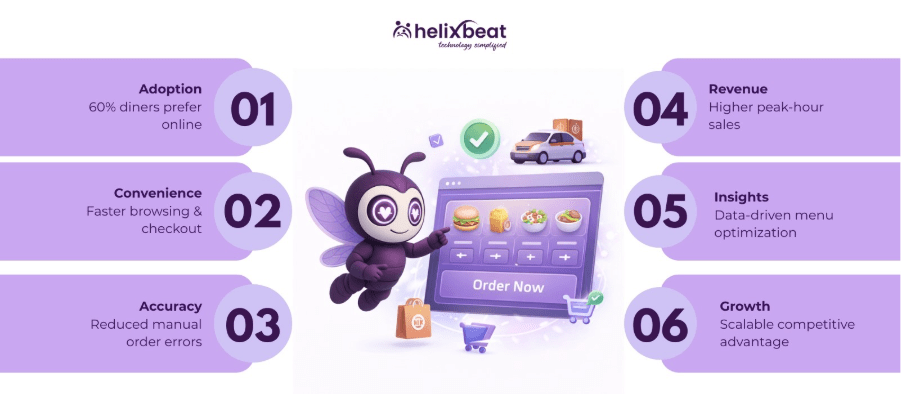
Short Note on Online Food Ordering System
An online food ordering system for restaurants is a digital platform that lets customers place orders through a website or mobile app instead of calling or visiting in person. It displays your online menu for restaurants, allows customers to customize dishes, choose delivery or pickup, and make secure payments – all in a few clicks.
This system simplifies the ordering process for both customers and your staff, reducing errors and saving valuable time.
Beyond convenience, an online order system for restaurants also provides restaurants with powerful tools to manage orders efficiently, track popular dishes, and analyze customer preferences.
With features like a restaurant menu ordering system, you can update your menu in real time, run promotions, and ensure a smooth dining experience. In short, it’s not just a tool, it’s a way to grow your business and keep customers coming back.
How to Order Restaurant Food Online?
Ordering food online has never been easier. Here’s how you can get your favorite meals in just a few clicks:
- Visit the Restaurant’s Website or App
Open the restaurant’s official website or mobile app to start your order. Look for theonline menu for restaurants section to see all available dishes. - Browse and Select Your Dishes
Go through the menu, check descriptions, and select yourfavorite items. You can customize your order, choose portions, and add special instructions if needed. - Add Items to Cart
Onceyou’ve chosen your dishes, add them to the cart. Double-check your selections and quantities to ensure everything is correct before proceeding. - Choose Delivery or Pickup & Payment
Decide whether you want your food delivered or will pick it up. Then select a convenient payment method: card, wallet, or cash on delivery. - Confirm and Track Your Order
Confirm your order, andyou’ll usually get real-time updates on preparation and delivery. With a restaurant menu ordering system, tracking your meal becomes easy and stress-free.
Benefits of Online Food Ordering Systems for Restaurants in 2026
Nowadays, in restaurants, adopting an online food ordering system for restaurants is no longer just a convenience; it’s a necessity for staying competitive and growing revenue.
Here are the top benefits you can expect in 2026:
1. Increases Revenue by Handling More Orders Efficiently
An online system allows you to take multiple orders simultaneously without overloading staff.
For example, a busy café in Bangalore saw a 30% increase in daily orders after implementing an online ordering system because customers could order anytime, even during peak hours.
2. Reduces Errors and Improves Accuracy
Manual orders are prone to mistakes: wrong items, missed instructions, or incorrect quantities. With a restaurant menu ordering system, customers enter preferences directly, reducing errors significantly.
A pizza chain in Mumbai reported that order mistakes dropped by 40%, improving customer satisfaction.
3. Enhances Customer Experience and Convenience
Customers value convenience. By offering a user-friendly online menu for restaurants, they can browse dishes, customize meals, and place orders anytime.
A local bakery in Delhi noticed that repeat orders doubled because loyal customers found it easier to reorder online.
4. Provides Valuable Insights and Analytics
Online systems capture data on orders, peak hours, and popular dishes. Restaurants can use this to optimize inventory, menu offerings, and promotions.
A mid-sized restaurant in Hyderabad used their online order system for restaurants analytics to identify top-selling dishes, reducing food wastage.
5. Streamlines Marketing and Loyalty Programs
Many online ordering systems integrate with loyalty programs and promotions. Restaurants can send discounts, special offers, or notifications directly to customers.
For example, a South Indian chain offered a 10% discount to app users on weekdays, increasing weekday sales by 25% while keeping customers engaged.
Implementing an online food ordering system for restaurants doesn’t just streamline operations; it increases revenue, reduces errors, and keeps your customers coming back for more.
Difference between Manual and Online Food Ordering System
Switching from manual orders to an online food ordering system for restaurants can transform how your business operates, making it faster, more accurate, and customer-friendly.
|
Feature |
Manual Ordering |
Online Food Ordering System |
|
Order Placement |
Customers call or visit the restaurant to place orders. |
Orders are placed directly via website or app using a restaurant menu ordering system. |
|
Accuracy |
Prone to errors such as wrong dishes, quantities, or instructions. |
Highly accurate since customers input their preferences directly, reducing mistakes by up to 40%. |
|
Speed |
Slow during peak hours; staff can be overwhelmed. |
Fast and efficient, handling multiple orders simultaneously without delays. |
|
Customer Experience |
Limited convenience; customers wait on calls or in-person. |
Convenient and flexible; customers can browse online menu for restaurants, customize, and order anytime. |
|
Data and Analytics |
No record of customer preferences or order trends. |
Provides insights on popular dishes, peak hours, and repeat customers to improve operations and marketing. |
|
Marketing & Loyalty |
Hard to run promotions or reward regular customers. |
Easily integrates with loyalty programs, discounts, and notifications, boosting customer retention. |
|
Scalability |
Difficult to manage as business grows; errors increase. |
Scalable; handles growth efficiently while maintaining quality and customer satisfaction. |
By adopting an online order system for restaurants, you not only streamline operations but also enhance customer satisfaction, boost revenue, and stay ahead in a competitive market.
How to Choose the Best Online Food Ordering System
Choosing the right online food ordering system for restaurants can make all the difference in efficiency, customer satisfaction, and revenue growth. Here’s how to make the best choice:
1. Look for a User-Friendly Interface
Your system should be easy for both customers and staff to use. A restaurant menu ordering system that’s simple and intuitive encourages customers to place orders quickly and reduces training time for staff. For example, a café in Pune switched to an app with a clean interface and saw orders increase by 25% within a month.
2. Ensure Integration with POS and Kitchen Management
The system should sync seamlessly with your point-of-sale (POS) and kitchen operations. This prevents delays and errors, making the order process smoother. A Delhi-based bakery integrated their online order system for restaurants with their POS and reduced preparation mistakes by 40%.
3. Check Payment and Security Options
Choose a system that supports multiple payment methods, including wallets, cards, and cash on delivery, with secure transactions. Customers are more likely to order when they trust that their payments are safe and convenient.
4. Look for Analytics and Marketing Features
The best systems offer insights on popular dishes, peak hours, and repeat customers. They may also support loyalty programs and promotions. For instance, a South Indian restaurant used system analytics to launch targeted discounts, increasing weekday orders by 20%.
Selecting the right online food ordering system for restaurants is about balancing convenience, efficiency, and growth potential.
The right system not only simplifies operations but also enhances the overall customer experience, giving your restaurant a competitive edge.
Why Helixbeat is the Best Food Ordering System for Restaurants
Running a restaurant is challenging – juggling orders, managing menus, and keeping customers happy can feel overwhelming.
That’s why Helixbeat was built as a complete online food ordering system for restaurants. It simplifies every step of the process, from taking orders to tracking deliveries, so you can focus on what matters most – delivering great food and experiences.
Here’s why Helixbeat stands out:
- User-Friendly Interface: Customers and staff can navigate menus and place orders quickly without confusion.
- Seamless Integration: Connects with your POS and kitchen management for error-free operations.
- Smart Analytics: Track popular dishes, peak hours, and customer preferences to boost sales.
- Marketing & Loyalty Tools: Run promotions, discounts, and reward loyal customers effortlessly.
With Helixbeat, your restaurant menu ordering system becomes smarter, faster, and more profitable, helping you grow your business while delighting every customer.
Frequently Ask Questions
1. Why is health information exchange important in healthcare?
It improves care coordination, reduces duplicate tests, minimizes errors, and helps providers make timely, data-driven decisions across different healthcare settings.
2. What are the main models of health information exchange?
3. Which standards guide health information exchange?
Standards like FHIR and HL7 define consistent data formats, making it easier for EHRs, HIEs, and other healthcare platforms to exchange information.
4. What are the benefits of using health information exchange?
HIE improves care coordination, reduces healthcare costs, supports population health management, enhances research, and increases operational efficiency.
5. How does AERIS enhance healthcare information exchange?
AERIS leverages FHIR standards, connects legacy systems, automates workflows, reduces manual errors, and provides real-time access to patient records and lab results.
1. What does a QA services company do differently from in-house teams?
A qa services company offers specialized testing expertise, access to advanced tools, and structured software testing & quality assurance processes that most in-house teams may lack. They provide objective analysis, scalable testing, and industry-specific solutions for higher-quality software.
2. How can hiring the best software testing services save money?
Outsourcing to the best software testing services reduces costs associated with hiring and training an internal QA team. It also minimizes post-release bug fixes and downtime, ensuring faster, more cost-effective product launches.
3. Can QA software testing services improve user experience?
Yes. Professional qa software testing services perform functional, performance, and usability testing to ensure your software works smoothly on different devices and platforms, delivering a consistent and reliable user experience.
4. How do software quality assurance companies help with regulatory compliance?
Top software quality assurance companies provide compliance testing for standards like GDPR, HIPAA, ISO, or PCI DSS. They ensure your software securely handles data, meets legal requirements, and passes audits without issues.