


Insurance Data Warehouse
Get Started with a Free Demo
New Keyword Page
New Keyword Page
"*" indicates required fields
Managing massive amounts of insurance and healthcare data is no small feat. Every claim, policy update, and patient record contributes to a growing mountain of information, and without a centralized system, organizations struggle to derive meaningful insights. This is where an insurance data warehouse becomes a gamechanger, as it brings together fragmented data and turns it into a unified, analysis-ready resource. By consolidating data from multiple sources, Helixbeat DaaS helps insurers streamline operations, enhance reporting accuracy, and gain actionable insights quickly.
From improving claims processing to providing advanced analytics for risk assessment, our solution transforms complex data into strategic intelligence. Whether your organization is focused on health insurance, life insurance, or multi-line policies, Helixbeat DaaS ensures that your data is organized, secure, and ready for analysis.
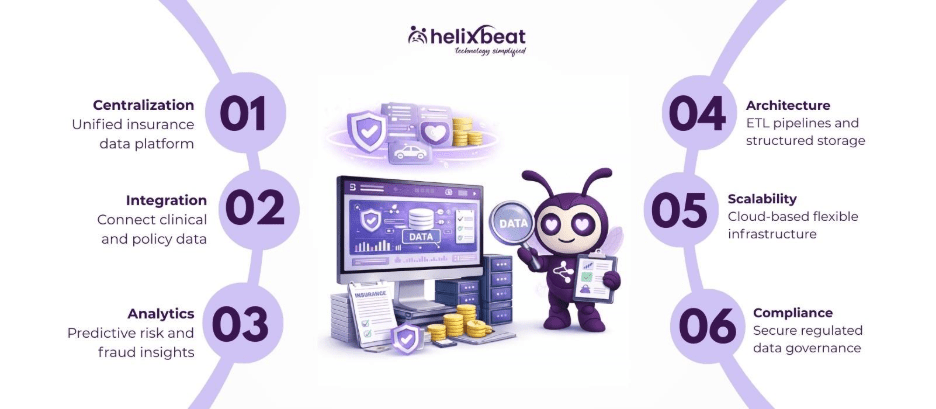
Understanding Insurance Data Warehouse
Managing complex insurance operations requires a centralized system to handle vast amounts of data efficiently. An insurance data warehouse provides this foundation, enabling organizations to unify their data and derive meaningful insights.
Definition and Purpose
An insurance data warehouse is a centralized repository that stores structured data from multiple insurance systems, including claims, policies, and customer databases. Its primary purpose is to provide a single source of truth for reporting, analytics, and strategic decision-making.
Difference Between Database and Data Warehouse
While traditional databases are designed for day-to-day transactional processing, an insurance data warehouse is optimized for querying, reporting, and analytics. This allows insurers to access historical trends, evaluate performance metrics, and gain actionable intelligence in real time.
How It Supports Decision-Making
By consolidating information in an insurance data warehouse, insurers can make informed decisions on claims management, risk assessment, and customer service improvements. It reduces manual reporting, enhances operational efficiency, and accelerates compliance with regulatory requirements.
Healthcare Data Warehousing for Insurers
Healthcare data warehousing is critical for integrating clinical and administrative information, allowing insurers to connect patient care data with policy management. This unified approach transforms data into actionable insights for better decision-making.
Integrating Medical Data Warehouse
Integrating Medical Data Warehouse
Benefits for Health Insurance Providers
By leveraging a health insurance data warehouse model, insurers can identify high-risk populations, optimize policy pricing, and reduce fraud. Combining clinical and administrative data in the warehouse enhances predictive analytics, supports member engagement, and improves overall operational performance.
Impact of Healthcare Data Warehousing
Organizations that implement healthcare data warehousing solutions experience faster claims processing, better risk modeling, and improved insights from historical patient and policy data trends. This helps insurers make timely, data-driven decisions.
Key Components of an Insurance Data Warehouse
An insurance data warehouse relies on multiple integrated components to consolidate, process, and deliver data efficiently. Understanding these elements is essential for designing a robust data management framework.
Data Sources
Insurers collect data from policy management systems, claims databases, billing platforms, customer service tools, and healthcare records. Helixbeat DaaS consolidates these varied sources into a single structured repository for analysis.
ETL (Extract, Transform, Load) Process
Data from multiple systems is extracted, cleaned, and transformed into a standardized format for storage. This ETL process maintains accuracy and consistency, supporting reliable reporting and analytics across the insurance data warehouse
Data Storage and Modeling
Insurance data is stored in relational or cloud-based warehouses with dimensional models that enable fast querying. Fact tables track claims, while dimension tables track policies, customers, and providers, providing a comprehensive view of operations.
Reporting and Analytics Layer
A strong reporting layer allows insurers to visualize KPIs, track claims turnaround, detect fraud, and assess policy profitability. Predictive analytics and regulatory compliance reports further enhance strategic decision-making.
Insurance Data Warehouse Model Comparison
Choosing the right insurance data warehouse model is crucial for scalability, security, and integration with healthcare data. Understanding the differences between on-premises and cloud options helps insurers make informed decisions.
On-Premises vs. Cloud Models
Insurance data warehouses can be hosted on-premises or in the cloud. Helixbeat DaaS provides a cloud-first architecture, offering scalability, advanced security, and reduced infrastructure costs, while simplifying maintenance and integration with healthcare data warehousing solutions.
Comparison of Warehouse Models
Feature | On-Premises Warehouse | Cloud-Based (Helixbeat DaaS) |
Deployment Time | Weeks to Months | Days to Weeks |
Scalability | Limited by hardware | Virtually unlimited |
Maintenance | In-house IT | Managed by Helixbeat DaaS |
Security | Controlled internally | Enterprise-grade cloud security |
Cost | High upfront | Flexible subscription |
Accessibility | On-prem only | Anytime, anywhere access |
Choosing the Right Model
A cloud-based insurance data warehouse model, like Helixbeat DaaS, enables real-time updates, seamless integration with medical data warehouses, and cost efficiency. This allows insurers to focus on analytics and insights rather than infrastructure management.
Benefits of Helixbeat DaaS Insurance Data Warehouse
Harnessing a centralized insurance data warehouse brings measurable advantages for insurers, allowing them to consolidate operations and gain actionable insights. The right platform turns complex data into strategic intelligence.
Centralized Data for Analytics
By combining claims, policy, and customer information, insurers can analyze trends efficiently and make informed business decisions. Interactive dashboards provide quick insights, helping management monitor performance in real time.
Regulatory Compliance Made Easy
Insurance and healthcare data is subject to strict regulations. Helixbeat DaaS supports compliance with HIPAA, GDPR, and other regulatory standards through automated reporting, secure storage, and consistent data governance.
Fraud Detection and Risk Management
A health insurance data warehouse model enables predictive analytics that identify fraudulent claims and optimize risk assessment. This helps minimize financial losses and improve operational reliability.
Healthcare Data Warehouse Vendors and Implementation
Choosing the right healthcare data warehousing solution is critical for integrating medical and insurance data. Selecting the right vendor ensures security, scalability, and seamless analytics capabilities.
Selecting the Right Vendor
When implementing an insurance data warehouse, evaluate a vendor’s ability to integrate a medical data warehouse, maintain robust security, and provide scalable solutions. Helixbeat DaaS delivers all these capabilities with a cloud-first approach.
Implementation Steps
- Assess current data systems and business requirements
- Design the insurance data warehouse model schema
- Execute ETL pipelines for data integration
- Deploy dashboards and reporting tools for analytics
- Conduct user training and provide continuous support
Post-Implementation Benefits
After deployment, insurers benefit from faster reporting, improved data quality, actionable insights, and enhanced customer service. This approach strengthens decision-making across both insurance and healthcare operations.
Why Helixbeat DaaS Stands Out
A modern insurance data warehouse solution must be scalable, secure, and fully integrated with healthcare data. Helixbeat DaaS addresses these needs while enabling real-time analytics and operational efficiency.
Cloud-First and Scalable
Our cloud-native insurance data warehouse model grows with your business, eliminating hardware constraints and providing flexible subscription options. This ensures scalability and cost efficiency.
Integration With Healthcare Systems
Helixbeat DaaS seamlessly integrates with EHRs, claims processing platforms, and policy management tools, making healthcare data warehousing and insurance analytics fully unified and actionable.
Secure and Compliant
The platform enforces role-based access, encryption, and compliance auditing to protect sensitive insurance and medical data. Organizations can maintain trust and regulatory compliance effortlessly.
Data-Driven Insights
Insurers leveraging Helixbeat DaaS experience higher data accuracy and faster claim resolution, benefiting from predictive analytics and a consolidated view of both insurance and healthcare data.
Ready to Transform Your Insurance Data?
Turning your insurance and healthcare data into actionable intelligence is now easier with Helixbeat DaaS. A centralized platform empowers insurers to optimize operations and accelerate decision-making.
- Centralized insurance data warehouse improves reporting and analytics
- Cloud-based model ensures scalability and flexibility
- Supports regulatory compliance effortlessly
- Enables predictive analytics and fraud detection
- Seamless integration with healthcare and insurance systems
- Accelerates decision-making and operational efficiency
Frequently Ask Questions
1. Why is health information exchange important in healthcare?
It improves care coordination, reduces duplicate tests, minimizes errors, and helps providers make timely, data-driven decisions across different healthcare settings.
2. What are the main models of health information exchange?
3. Which standards guide health information exchange?
Standards like FHIR and HL7 define consistent data formats, making it easier for EHRs, HIEs, and other healthcare platforms to exchange information.
4. What are the benefits of using health information exchange?
HIE improves care coordination, reduces healthcare costs, supports population health management, enhances research, and increases operational efficiency.
5. How does AERIS enhance healthcare information exchange?
AERIS leverages FHIR standards, connects legacy systems, automates workflows, reduces manual errors, and provides real-time access to patient records and lab results.
1. What is an insurance data warehouse?
An insurance data warehouse is a centralized repository that consolidates insurance and healthcare data from multiple sources for analytics and reporting.
2. How does Helixbeat DaaS help insurance companies?
Helixbeat DaaS provides a cloud-based, scalable, and secure insurance data warehouse solution that integrates healthcare and policy data for actionable insights.
3. What are the benefits of a healthcare data warehouse?
Healthcare data warehousing improves claims processing, fraud detection, policy pricing, and regulatory compliance while providing actionable analytics.
4. On-premises or cloud-based warehouse – which is better?
Cloud-based solutions like Helixbeat DaaS offer scalability, lower costs, faster deployment, and better accessibility compared to traditional on-premises systems.
5. How long does it take to implement an insurance data warehouse?
Implementation typically ranges from a few weeks to a few months depending on the organization’s size, data complexity, and integration needs.