


Interoperability in Healthcare
Interoperability in healthcare is the ability of different information devices, applications, and systems to access, exchange, integrate, and cooperatively use data in a coordinated manner. This capability allows electronic health records (EHRs) from one provider to communicate seamlessly with systems at another facility. The Office of the National Coordinator for Health Information Technology (ONC) defines it as the secure access, integration, and use of electronic health data to optimize health outcomes for individuals and populations.
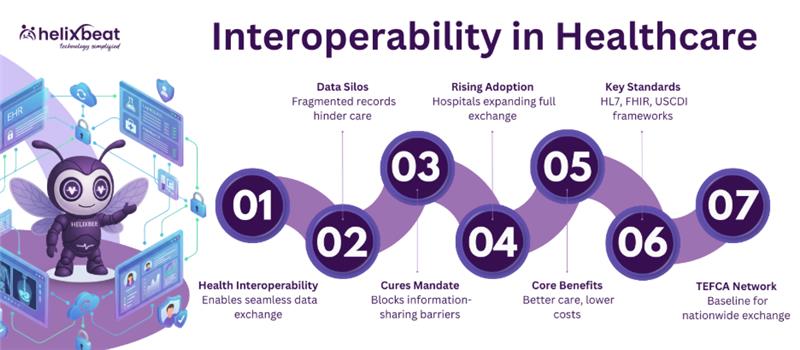
At its core, interoperability in healthcare eliminates data silos that fragment patient information across providers, payers, and labs. The interoperability of electronic health records plays a central role, as EHRs hold comprehensive patient data like medications, allergies, and lab results. HL7 FHIR-based solutions like AERIS enable this exchange by using modern APIs and web technologies.
The 21st Century Cures Act, signed in 2016, mandates advancements in this area. It prohibits information blocking—practices that interfere with the access, exchange, or use of electronic health information (EHI)—and requires certified health IT to support standardized APIs. By December 2025, progress includes increasing adoption of FHIR and implementation of the Trusted Exchange Framework and Common Agreement (TEFCA), which provides a baseline for nationwide health data exchange.
Interoperability in healthcare addresses long-standing issues. Recent data show that around 70% of U.S. non‑federal acute care hospitals were engaged in full interoperable exchange of patient health information (send, receive, find, integrate) in 2023 — up from 46% in 2018.
Benefits of Interoperability in Healthcare
Interoperability in healthcare yields measurable gains across care delivery, costs, and population health.
Patients gain seamless access to complete medical records through apps, reducing the need for repeat tests. A RAND study projected potential savings of $81 billion annually from networked EHRs with coded data exchange. Likewise, providers benefit from full patient histories, which helps reduce errors.
Population health also improves through aggregated data used for surveillance and public health response. Besides, payers streamline workflows with accurate prior authorizations using FHIR APIs, cutting administrative delays. Even research accelerates as de-identified datasets become accessible.
Standards Driving Interoperability in Healthcare
Standards form the backbone of interoperability in healthcare.
HL7 Standards: Version 2.x handles messaging; v3 adds context. FHIR, released in 2014, uses RESTful APIs and JSON/XML for granular resources like Patient or Observation. ONC mandates FHIR US Core Implementation Guide v6.1.0 for certification.
USCDI: Version 1 (2020) included 50+ elements; v3 (2024) exceeds 80, adding sex parameter for clinical use. Vendors adopt v4 in 2025 to cover provenance and facility information.
TEFCA: Launched in 2023, it designates QHINs for secure exchange. By 2025, FHIR is required for participants, with USCDI v1 as minimum for post-2024 data.
Other Frameworks: IHE profiles bundle standards for use cases like cross-community access. C-CDA Companion Guide clarifies clinical notes.
The interoperability of electronic health records is shaped in part by the ONC’s HTI‑1 rule (2024), which updates certification criteria and mandates standardized APIs (such as FHIR) — a move that aims to promote interoperable data exchange and reduce some regulatory burden via a simpler, “edition-less” certification model.
AERIS: Advancing Interoperability with FHIR
AERIS, built on HL7 FHIR, connects disparate systems, legacy platforms, and modern applications into a single, unified data environment.
Ready to cut delays by 50%, double your ROI, and empower your team with instant access to critical data? Let’s dive into why AERIS is the solution you’ve been waiting for.
Why AERIS is Your Key to Healthcare Innovation?
At Helixbeat, we know your challenges: fragmented systems, delayed data, and rising costs. AERIS is here to change that, offering a personalized, scalable, and secure platform that fits your unique needs. Whether you’re a small clinic or a sprawling hospital network, AERIS delivers measurable results that elevate patient outcomes and boost your bottom line.
- 20+ Years of Expertise: Our team brings decades of healthcare IT experience to ensure AERIS works for you.
- 50+ IT Professionals: A dedicated crew powers AERIS, delivering unmatched support and innovation.
- 1,000+ Customers: Join a thriving community of healthcare leaders already transforming with AERIS.
- 10,000+ Projects Completed: Proven success across countless integrations and workflows.
- 95% Returning Customers: Our clients trust AERIS to deliver, time and time again.
Providers adopting AERIS report faster diagnoses, lower costs, and improved outcomes.
Why AERIS is Your Key to Healthcare Innovation?
At Helixbeat, we know your challenges: fragmented systems, delayed data, and rising costs. AERIS is here to change that, offering a personalized, scalable, and secure platform that fits your unique needs. Whether you’re a small clinic or a sprawling hospital network, AERIS delivers measurable results that elevate patient outcomes and boost your bottom line.
- 20+ Years of Expertise: Our team brings decades of healthcare IT experience to ensure AERIS works for you.
- 50+ IT Professionals: A dedicated crew powers AERIS, delivering unmatched support and innovation.
- 1,000+ Customers: Join a thriving community of healthcare leaders already transforming with AERIS.
- 10,000+ Projects Completed: Proven success across countless integrations and workflows.
- 95% Returning Customers: Our clients trust AERIS to deliver, time and time again.
Providers adopting AERIS report faster diagnoses, lower costs, and improved outcomes, positioning it as the go-to tool for future-proof HIE.
The AERIS Advantage: Numbers That Speak for Themselves
Metric | Without AERIS | With AERIS | Your Benefit |
Data Exchange Delays | Frequent bottlenecks | Reduced by 50%
| Faster care in emergencies |
Return on Investment | Slow, costly overhauls | 100% faster ROI | Grow without breaking the bank |
Operational Costs | High redundancies | Cut by 30% | Save thousands annually |
Error Rates | Up to 20% manual errors | Slashed by 90% | Precision for better patient outcomes |
Your Benefits, Amplified
- 50% Fewer Delays: Real-time data means critical information is always at your fingertips, turning hours into seconds.
- 100% Faster ROI: Plug-and-play integration maximizes your investment without expensive system replacements.
- 30% Cost Savings, 90% Fewer Errors: Automation eliminates waste, saving resources and ensuring accuracy.
How AERIS Works: Your 3-Step Path to Success
- Connect Seamlessly: Integrate AERIS effortlessly into your existing systems, from legacy EHRs to modern platforms.
- Share Securely: Activate real-time data exchange with HIPAA-compliant encryption. Watch your teams and partners collaborate effortlessly.
- Optimize and Grow: Because AERIS evolves with your organization, it’s set up to help you succeed for the long haul.
What Users Say About AERIS
Dr. Sarah L.
Hospital Administrator
John T.
Telemedicine Provider
Emily P.
Healthcare Executive
FAQs
1- What role does HL7 FHIR play in interoperability?
FHIR provides standardized APIs and modern web technologies to exchange granular healthcare data like patient records, observations, and lab results.
2. What is the ONC HTI‑1 rule (2024)?
HTI‑1 updates certification criteria for health IT, mandates standardized APIs like FHIR, and reduces some regulatory burden through an “edition-less” certification approach.
3. How does interoperability benefit patients?
Patients gain real-time access to complete medical records, reduce repeat tests, and experience fewer medication errors through reconciled medication lists.
4. How does interoperability improve population health?
Aggregated health data allows public health authorities to monitor trends, respond to outbreaks, and manage vaccination or disease surveillance programs.
5. How does AERIS enhance healthcare interoperability?
AERIS connects legacy and modern systems, supports FHIR-based real-time data exchange, reduces delays by 50%, cuts operational costs, and improves care outcomes.
Final Thoughts
Interoperability in healthcare is no longer a future concept—it is a necessity for modern medical care. By enabling seamless exchange of electronic health records, reducing data silos, and supporting standards like HL7 FHIR, USCDI, and TEFCA, interoperability improves patient outcomes, streamlines workflows, and strengthens population health management.
Platforms like AERIS demonstrate how FHIR-based solutions can unify disparate systems, accelerate care delivery, reduce errors, and optimize costs.