


Usability and Human‑Centered Design in Medical Electronic Record Systems
Get Started with a Free Demo
New Keyword Page
New Keyword Page
"*" indicates required fields
Electronic medical record (EMR) systems have become foundational in modern healthcare. While these systems promise increased efficiency, better clinical decision‑making, and improved patient outcomes, their real‑world impact depends heavily on usability and human‑centered design. Systems built through human‑centered design principles improve workflow efficiency, clinician satisfaction, safety outcomes, and ultimately, financial returns.
Here, we’ll explore how usability and human‑centered design influence the success of medical electronic record systems, why they matter for clinicians and patients, and what organizations can do to optimize both workflow and outcomes.
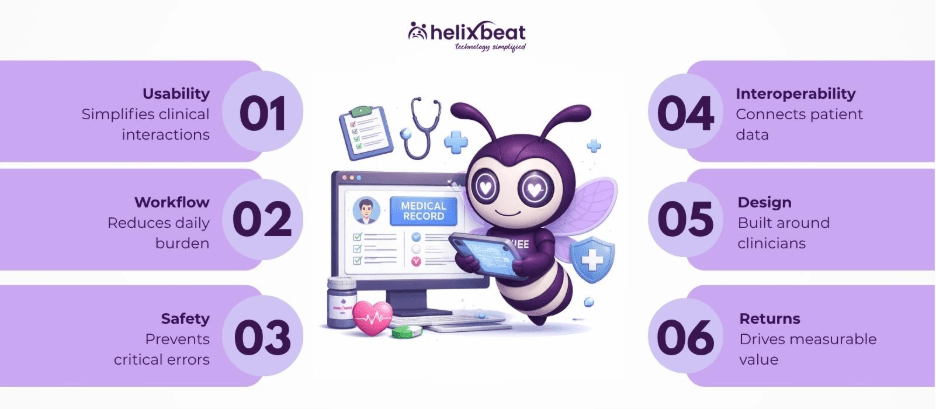
What Is Usability and Human‑Centered Design in EMRs?
Usability refers to how easily users can accomplish intended goals using a system. In this case, how clinicians interact with EMRs to retrieve and input patient data. When a system helps clinicians perform tasks accurately, quickly, and without frustration, it is considered usable.
Human‑centered design (HCD) is a development approach that starts and ends with the people who will use the system. It involves seeking input from clinicians at every stage, from identifying needs and workflows to prototyping, testing, and implementation. Research shows that usability problems are a frequent source of clinician frustration and workflow disruptions.
How Poor Usability Impacts Clinician Workflow
Clinicians spend a significant portion of their day interacting with EMRs. When usability is poor, these interactions become inefficient, slow, and error‑prone.
1. Workflow Interruptions and Documentation Burden
Numerous studies document how poorly designed EMRs disrupt clinical workflows by forcing clinicians to switch between screens, duplicate documentation, and navigate excessive menus. This contributes to:
- Increased documentation time
- Task switching between unrelated fields
- Cognitive overload
- Workflow fragmentation
2. Cognitive Load and Clinical Decision‑Making
High cognitive load, the mental effort required to process information, is a major usability concern in EMR design. When system design fails to present information clearly and logically, clinicians must spend extra mental effort sorting through data, which increases the likelihood of mistakes and decision fatigue.
3. Clinician Satisfaction and Burnout
Usability directly affects clinician satisfaction. Systems that are difficult to
navigate or require excessive clicks contribute to frustration and burnout, a major concern in modern healthcare, where burnout rates are high.
Usability and Patient Safety Outcomes
EMR usability and interoperability directly affect patient safety.
-
Medication Safety
Poor design features like confusing alert interfaces or unclear data entry fields can contribute to medication errors. EMRs with intuitive alert systems, combined with real-time interoperability, reduce the risk of overdoses and drug interactions.
-
Error Rates and Workflow Complexity
Multi-center studies indicate that interface complexity correlates with higher error rates. Systems designed for simplicity and connected through interoperability platforms reduce the likelihood of missed test results or incomplete documentation.
-
Alert Fatigue
Excessive, irrelevant EMR alerts can desensitize clinicians.
However, interoperability platforms can direct clinician attention toward the most critical warnings by filtering and prioritizing alerts based on relevance.
Human-Centered Design Principles That Improve EMR Usability
- Early Clinician Involvement: Engage physicians, nurses, and administrative staff in workflow analysis, interviews, and observational studies.
- Iterative Prototyping and Testing: Conduct usability tests on prototypes to identify friction points before deployment.
- Modular, Intuitive Interfaces: Reduce clutter and present contextually relevant data to support rapid decision-making.
- Workflow Integration: Align EMR functions with natural clinical task sequences to reduce redundancy and clicks.
- Interoperability Integration: By connecting EMRs with real-time data exchange platforms, you equip clinicians with seamless, comprehensive patient information.
How Usability and Interoperability Translate to Financial Value
- Time Savings: Systems optimized for usability and integrated with real-time interoperability platforms reduce documentation time by 15-25%.
- Reduced Error Costs: Fewer errors due to improved interface design and comprehensive real-time patient data lower the risk of litigation, malpractice claims, and adverse event costs.
- Improved Adoption Rates: Clinicians are more likely to adopt systems that are usable and provide full patient data instantly, which maximizes the ROI from EMR investments.
- Higher Patient Throughput: Efficient EMRs paired with interoperability platforms can enable clinicians to see 10-20% more patients per day while maintaining safety and quality standards.
Data Tables for Quick Reference
EMR Usability Metrics and Impact
|
Metric |
Description |
Impact |
|
Task Completion Time |
Time to complete clinical tasks |
Faster workflows, reduced clinician workload |
|
Clicks per Task |
Total clicks needed |
Fewer clicks = higher efficiency |
|
Navigation Errors |
Mis-clicks or wrong menu selections |
Reduces cognitive load |
|
User Satisfaction |
Clinician satisfaction score |
Higher adoption & ROI |
Safety Outcomes
|
Feature |
Safety Outcome |
|
Medication Alerts |
Fewer errors |
|
Data Entry Consistency |
Reduced transcription errors |
|
Streamlined Navigation |
Fewer missed results |
|
Meaningful Alerts |
Reduced alert fatigue |
How AERIS Revolutionizes Interoperability with FHIR APIs
Imagine a world where your healthcare organization thrives with seamless, secure, and real-time data exchange. That’s the power of AERIS by Helixbeat, a game-changing platform designed to transform how you connect, collaborate, and care. Built for healthcare providers, clinics, hospitals, and cross-industry partners like pharmacies and insurers, AERIS harnesses FHIR APIs to break down data silos, streamline operations, and put patient care first.
Why AERIS is Your Key to Healthcare Innovation
- 20+ Years of Expertise: Our team brings decades of healthcare IT experience to ensure AERIS works for you.
- 50+ IT Professionals: A dedicated crew powers AERIS, delivering unmatched support and innovation.
- 1,000+ Customers: Join a thriving community of healthcare leaders already transforming with AERIS.
- 10,000+ Projects Completed: Proven success across countless integrations and workflows.
- 95% Returning Customers: Our clients trust AERIS to deliver, time and time again.
Implementing Usability and Interoperability Best Practices
- Conduct workflow analyses before EMR deployment.
- Engage clinicians continuously in design and testing.
- Train clinicians on both usability and interoperability tools.
- Monitor post-implementation metrics: task completion, error rates, satisfaction, and throughput.
- Integrate AERIS to facilitate complete, seamless access to patient data.
Final Thoughts
Medical electronic record systems can transform care delivery, but only when designed for clinicians and integrated seamlessly across healthcare networks. Human-centered design improves usability, reduces cognitive load, and enhances clinician satisfaction. When paired with a real-time interoperability platform, EMRs enable instant access to patient data, streamline workflows, reduce errors, and maximize ROI.
Are you ready to simplify your healthcare data exchange?
Frequently Ask Questions
1. Why is health information exchange important in healthcare?
It improves care coordination, reduces duplicate tests, minimizes errors, and helps providers make timely, data-driven decisions across different healthcare settings.
2. What are the main models of health information exchange?
3. Which standards guide health information exchange?
Standards like FHIR and HL7 define consistent data formats, making it easier for EHRs, HIEs, and other healthcare platforms to exchange information.
4. What are the benefits of using health information exchange?
HIE improves care coordination, reduces healthcare costs, supports population health management, enhances research, and increases operational efficiency.
5. How does AERIS enhance healthcare information exchange?
AERIS leverages FHIR standards, connects legacy systems, automates workflows, reduces manual errors, and provides real-time access to patient records and lab results.
1. What are medical electronic record systems (EMRs)?
EMRs are digital versions of patient medical records that store clinical data, including diagnoses, medications, lab results, and treatment history.
2. How does a real-time interoperability platform enhance EMR ROI?
AERIS streamlines workflows, prevents redundant tests, and reduces errors to accelerate system adoption and yield measurable efficiency gains and cost savings.
3. How do EMRs improve workflow efficiency in hospitals?
Usable EMRs minimize redundant documentation, provide instant access to patient data, and enable clinicians to complete tasks faster.
4. Are there standards or best practices for designing EMRs?
Yes. Best practices include user-centered design, iterative testing with clinicians, streamlined navigation, and integration with interoperability platforms like AERIS for real-time data access.
Absolutely. Our Power BI developers are skilled at working remotely while maintaining clear communication and timely delivery.