


The Role of an MVP Development Company in Building Scalable Startup Products
Get Started with a Free Demo
New Keyword Page
New Keyword Page
"*" indicates required fields
In 2026, startups face intense competition, with many new products struggling to gain traction. Research shows that nearly 80% of apps and digital solutions fail due to poor product-market fit or rushed development. The real challenge isn’t just building a product – it’s building one that users actually need and that can scale efficiently.
This is where a startup MVP development company can make a real difference. By creating a focused Minimum Viable Product, these companies help startups validate ideas, gather user feedback, and plan for growth without wasting time or resources.
Whether it’s a SaaS platform, enterprise solution, or mobile app, partnering with an experienced MVP development company ensures your product is built on a strong foundation and ready to scale.
What is MVP Software Development?
MVP software development is the process of building a Minimum Viable Product—a simplified version of your product with just enough features to test the core idea in the market. Instead of investing months in a full-scale product, startups can launch an MVP, gather real user feedback, and iterate quickly.
For example, Airbnb started as a simple website connecting travelers with hosts, validating demand before expanding into the global platform we know today. This approach helps startups save time, reduce costs, and ensure they build products users actually want.
Different Roles of an MVP Development Company in Building Scalable Startup Products
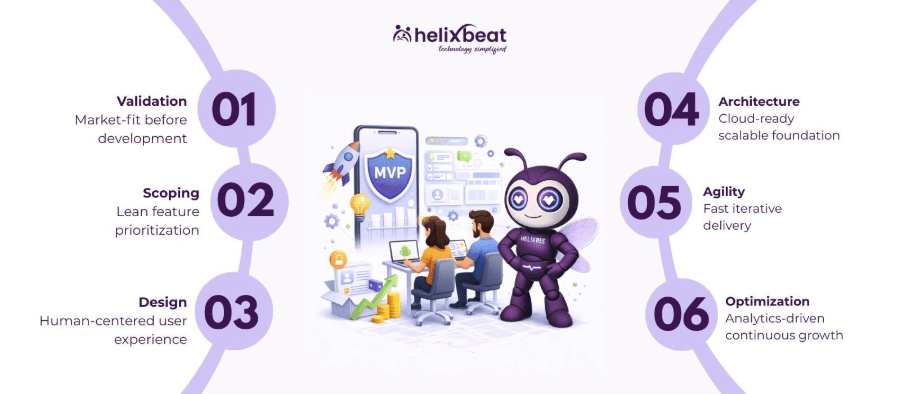
validation at every step. A professional MVP development company plays multiple roles to ensure your product succeeds from concept to launch, minimizing risk and maximizing impact.
1. Idea Validation and Market Research
A reliable MVP development company doesn’t just code; they first help you validate your concept. Using tools like competitive analysis, market segmentation, and customer personas, they identify real pain points and opportunities. This ensures that your product idea has genuine demand before investing heavily in development.
Stat: Startups that conduct thorough market research before development are 50% more likely to achieve product-market fit.
2. Defining the Product Scope with Lean Principles
MVP software development companies excel at defining the minimum feature set that delivers value. By applying Lean Startup methodologies, they help startups avoid feature bloat, focus on high-impact functionality, and accelerate time-to-market. This scoped approach also enables easier iteration based on user feedback.
Stat: Startups that follow lean MVP principles reduce wasted development costs by up to 30%.
3. UX/UI Design and Human-Centered Prototyping
Creating an intuitive interface is crucial for adoption. MVP development teams use human-centered design principles, wireframes, and interactive prototypes to ensure users can navigate and interact with the product naturally. Early prototypes also help spot usability issues before full-scale development.
Stat: Products with user-friendly MVP designs see up to 70% higher initial user engagement.
4. Scalable Architecture and Tech Stack Planning
A top MVP development company doesn’t just build for now – they plan for future scalability. Using microservices, cloud-native architecture, and API-first approaches, they ensure the MVP can handle increased traffic, integrate with other services, and evolve into a full-scale product without a complete rewrite.
Stat: Startups using scalable MVP architecture experience 40% faster growth when scaling from MVP to full product.
5. Rapid Development with Agile Practices
Speed is critical. MVP development companies leverage Agile and Scrum methodologies, creating incremental features in sprints and continuously testing them. This allows startups to launch functional MVPs quickly, gather feedback, and iterate without waiting months for a final product.
Stat: Agile-driven MVPs are 60% more likely to meet launch deadlines compared to traditional development approaches.
6. Testing, QA, and Performance Optimization
Quality matters even in an MVP. Professional teams conduct automated testing, performance benchmarking, and security audits to ensure the product works smoothly under real-world conditions. This reduces the risk of technical debt while preparing the MVP for scaling.
Stat: MVPs with structured QA processes reduce post-launch bugs by up to 45%.
7. Analytics Integration and Continuous Iteration
Finally, an MVP development company integrates analytics and tracking tools to collect user behavior data. This helps startups understand engagement, retention, and feature adoption. Based on these insights, the team iterates on the MVP, adding or refining features to increase user satisfaction and business impact.
Stat: Startups using analytics-driven MVP iteration increase feature adoption rates by 50–60% within the first 6 months.
By combining strategy, design, engineering, and analytics, an MVP development company acts as a full-spectrum partner, helping startups transform their ideas into scalable, data-driven products while reducing risk and maximizing growth potential.
MVP Development Company vs In-House Team – Which Is Better?
Aspect | MVP Development Company | In-House Team |
Expertise | Access to a wide range of specialized skills (UI/UX, backend, cloud, SaaS) | Limited by existing team skills; may require training or hiring |
Time-to-Market | Agile methodologies and proven frameworks allow faster MVP launch | Onboarding, recruitment, and internal processes slow down delivery |
Cost Efficiency | Pay for what you need; no overhead for salaries, benefits, or equipment | High long-term costs due to salaries, infrastructure, and ongoing maintenance |
Scalability | Teams experienced in cloud architecture, microservices, and SaaS scaling | May need significant restructuring to handle growth |
Flexibility & Iteration | Can pivot quickly based on user feedback and analytics | Slower response to market feedback due to rigid workflows |
Risk Management | Mitigates technical debt with testing, QA, and security audits | Higher risk of bugs, rework, and delayed launch |
What Makes Helixbeat the Best MVP Development Company?
At Helixbeat, we don’t just build MVPs—we help turn your ideas into products that can grow and succeed in the market. Whether it’s a SaaS app, mobile app, or enterprise solution, we focus on creating a product that works, gets user feedback, and scales as your business grows.
Why Choose Helixbeat:
- Complete MVP Support: We handle everything from idea validation and design to development, testing, and analytics.
- Quick and Flexible: Using Agile methods, we launch MVPs fast and adjust features based on real user feedback.
- Built to Scale: Our products use cloud-ready architecture so they can grow without needing a complete rebuild.
- Experience Across Industries: We’ve worked with startups in SaaS, healthcare, fintech, e-commerce, and more.
- Proven Results: Startups working with us launch faster, save costs, and see more users adopt their products quickly.
With Helixbeat as your MVP development company, you’re not just building a product – you’re building a strong, scalable solution ready to succeed.
Frequently Ask Questions
1. Why is health information exchange important in healthcare?
It improves care coordination, reduces duplicate tests, minimizes errors, and helps providers make timely, data-driven decisions across different healthcare settings.
2. What are the main models of health information exchange?
3. Which standards guide health information exchange?
Standards like FHIR and HL7 define consistent data formats, making it easier for EHRs, HIEs, and other healthcare platforms to exchange information.
4. What are the benefits of using health information exchange?
HIE improves care coordination, reduces healthcare costs, supports population health management, enhances research, and increases operational efficiency.
5. How does AERIS enhance healthcare information exchange?
AERIS leverages FHIR standards, connects legacy systems, automates workflows, reduces manual errors, and provides real-time access to patient records and lab results.
1. Can an MVP be upgraded into a full-scale product later?
Yes. A well-built MVP uses scalable architecture and modular design, allowing you to add features, support more users, and expand into a full product without rebuilding from scratch.
2. How much does hiring an MVP development company cost?
Costs depend on project scope, technology stack, and features. Generally, working with a dedicated MVP company is more cost-effective than building an in-house team, as you avoid overheads like salaries, infrastructure, and long development timelines.
3. Do MVP development companies handle both web and mobile apps?
Most top MVP development companies, including Helixbeat, provide cross-platform expertise. They can build web, mobile, SaaS, and enterprise MVPs using technologies like React, Flutter, Node.js, and cloud services.