


Why Every U.S. Hospital Needs a Secure Patient Pay Portal
Get Started with a Free Demo
New Lead: PayNova
PayNova Landing Page Form, connected with the Mailchimp.
"*" indicates required fields
In the fast-changing landscape of American healthcare, digital transformation isn’t just about patient records or telemedicine — it’s also about payments. U.S. hospitals are under growing pressure to manage rising operational costs, shrinking reimbursements, and complex multi-payer billing systems. In this environment, traditional payment methods—manual billing, mailed invoices, and in-person payments—are inefficient and prone to delays.
That’s why a secure patient pay portal has become a necessity for every U.S. hospital. Modern healthcare organizations need a seamless, compliant, and patient-friendly patient payments solution that automates billing, enhances transparency, and boosts revenue flow.
PayNova is designed precisely for this mission — helping healthcare providers simplify financial transactions, improve patient satisfaction, and maintain strict HIPAA compliance.
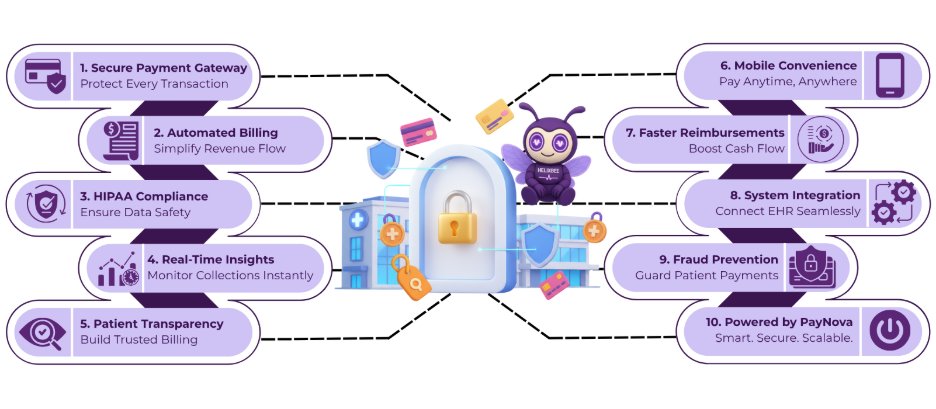
Understanding the Challenge — The Complex Reality of Healthcare Payments in the U.S.
The U.S. healthcare payment ecosystem is one of the most intricate financial systems in the world. With multiple payers — including private insurers, Medicare, Medicaid, and patients — hospitals often find themselves navigating a maze of regulations, codes, and processes.
1.1 The Multi-Payer Maze
When a patient receives care, multiple entities become part of the payment journey:
- Primary and secondary insurance carriers
- Government programs like Medicare and Medicaid
- Patients themselves, who handle deductibles, co-pays, and uncovered expenses
Each payer has different claim rules, reimbursement cycles, and eligibility requirements. Without automation, hospitals must rely on billing teams to manually verify coverage, submit claims, follow up on denials, and collect outstanding balances.
The result? Delayed payments, denied claims, and revenue leakage.
1.2 Administrative Burden and Rising Costs
According to the American Hospital Association (AHA), administrative complexity adds billions to the U.S. healthcare system every year. Hospitals spend countless hours processing claims, sending reminders, and reconciling payments.
Every delay in payment affects cash flow. Every denied claim adds administrative overhead. And every confused patient invoice damages the hospital’s reputation.
A dedicated patient pay portal can change that dynamic — by automating billing, enabling digital payments, and streamlining revenue cycles.
1.3 Patient Confusion and Payment Delays
Today’s patients are also consumers. They expect convenience, clarity, and transparency — especially when paying their medical bills. Unfortunately, traditional billing systems rarely offer that.
Patients often:
- Receive confusing paper bills weeks after treatment
- Struggle to understand what insurance covered versus what they owe
- Lack digital options to pay easily or set up payment plans
This leads to late or missed payments and increases bad debt for hospitals.
A modern patient pay portal app eliminates these friction points — allowing patients to log in, see itemized bills, and pay instantly from their smartphones or desktops.
Empower Your Patients with Easy, Secure Online Payments — Book a Demo.
Why Secure Patient Pay Portals Are Essential for U.S. Hospitals
As healthcare shifts toward digital-first models, secure and compliant payment systems are becoming core to hospital success. A patient payments solution like PayNova brings transparency, automation, and security together to meet modern expectations.
2.1 Centralized and Automated Payment Processing
Hospitals often manage payments across different platforms — insurance reimbursements, patient self-pay, third-party partners, and vendor payments. This fragmentation causes inefficiencies.
With a centralized patient pay portal, all payments flow through one secure system. This makes reconciliation faster and ensures that payments are automatically mapped to the right accounts — reducing human error and improving operational efficiency.
Key advantages include:
- Unified billing for all services (labs, pharmacy, physician, etc.)
- Automated posting of payments and claims updates
- Real-time synchronization with Electronic Health Records (EHRs)
2.2 Enhancing Cash Flow
One of the biggest benefits of adopting a patient pay portal app is improved cash flow. Digital systems enable instant payments, recurring billing, and auto-reminders — reducing the long wait times associated with paper-based billing.
With PayNova:
- Hospitals receive payments faster
- Patients get automatic notifications and due-date reminders
- Financial teams can track outstanding balances in real time
In a system where even small delays can disrupt operations, faster payments mean stronger revenue health.
2.3 Strengthening Compliance and Security
In healthcare, security isn’t optional — it’s mandatory. Hospitals handle sensitive patient and payment data governed by two major regulations:
- HIPAA (Health Insurance Portability and Accountability Act)
- PCI-DSS (Payment Card Industry Data Security Standard)
Non-compliance can lead to severe penalties and reputational damage.
PayNova’s patient payments solution ensures:
- Full HIPAA compliance for patient financial data
- PCI-DSS encryption for all card transactions
- Continuous monitoring and fraud detection for unauthorized access
This dual compliance structure makes PayNova a trusted healthcare payment gateway built specifically for the U.S. healthcare environment.
2.4 Building Patient Trust Through Transparency
Transparent billing directly affects patient satisfaction. Confusing bills and hidden charges often erode trust between patients and hospitals.
A patient pay portal app solves this by offering:
- Clear, itemized billing that breaks down all charges
- Real-time access to insurance adjustments and balances
- Digital receipts for every transaction
Patients can see exactly what they’re paying for — which leads to fewer disputes and faster payments.
2.5 Empowering Patients with Digital Convenience
From online consultations to telehealth appointments, digital care has redefined patient expectations. Payment systems must keep pace.
With PayNova, hospitals can offer:
- 24/7 access to bills and payment options
- Multiple payment methods — credit/debit cards, ACH transfers, digital wallets
- Payment plans and recurring payments for affordability
- Mobile-first interfaces for on-the-go access
This seamless experience not only boosts collections but also enhances overall patient satisfaction and loyalty.
Experience HIPAA-Compliant Payment Processing with PayNova — Try It Today!
How PayNova Transforms Patient Payments in the U.S. Healthcare Sector
PayNova is a secure, HIPAA-compliant patient payments solution built exclusively for U.S. healthcare providers. It goes beyond being a simple payment gateway — it’s an intelligent financial ecosystem that simplifies billing, improves revenue cycles, and elevates patient experience.
3.1 Integration with Existing Healthcare Systems
PayNova integrates seamlessly with your hospital’s existing infrastructure, including:
- Electronic Health Records (EHR) systems
- Practice Management Systems (PMS)
- Revenue Cycle Management tools
This ensures accurate data synchronization — from patient registration to billing and insurance reconciliation — reducing manual entry errors and saving administrative time.
3.2 Real-Time Insurance Verification and Claim Automation
PayNova connects with insurance databases to:
- Instantly verify coverage and eligibility
- Automate preauthorizations
- Submit and track claims digitally
By automating this workflow, PayNova helps reduce claim denials and accelerates reimbursement timelines, addressing two of the biggest pain points in U.S. hospital finance operations.
3.3 Advanced Security and Fraud Prevention
PayNova employs end-to-end encryption, tokenization, and multi-layered fraud detection algorithms to protect transactions and patient data.
Features include:
- Role-based access control
- Secure cloud infrastructure
- Continuous monitoring for anomalies and fraud patterns
Hospitals gain peace of mind knowing every transaction complies with HIPAA and PCI-DSS standards.
3.4 Comprehensive Financial Reporting
PayNova provides robust financial analytics and dashboards that give administrators a full picture of their revenue cycle.
You can track:
- Daily collections (patient and insurance)
- Outstanding balances
- Claim approval rates
- Payment success and failure ratios
This real-time visibility helps CFOs and administrators make data-driven decisions that optimize financial performance.
3.5 Simplified Refunds and Dispute Handling
PayNova simplifies what is often a major administrative challenge: managing refunds, disputes, and payment adjustments.
Hospitals can process partial or full refunds instantly, and all transactions are logged for audit compliance. Patients receive instant updates, reducing friction and improving trust.
3.6 Telehealth and Remote Payment Support
The rise of telehealth requires flexible, digital payment systems. PayNova’s patient pay portal app supports virtual consultations, online prescriptions, and remote monitoring services — enabling patients to pay securely from any location.
This makes PayNova an ideal payment partner for hybrid and remote healthcare models.
3.7 Multi-Entity and Group Management
For healthcare networks, PayNova supports multi-location and multi-departmental billing. This ensures that payments made by patients are automatically routed to the correct provider, clinic, or department — simplifying financial management across large hospital chains.
3.8 Boosting Revenue Cycle Efficiency
By automating billing, verifying insurance instantly, and enabling faster patient payments, PayNova shortens the revenue cycle and increases collection efficiency. Hospitals can reduce accounts receivable aging, cut down on manual errors, and maintain healthier cash flow.
3.9 Enhancing Patient Engagement and Loyalty
A smooth, transparent payment experience directly improves patient engagement. PayNova’s patient-facing dashboard empowers users to:
- Track their medical bills in one place
- Set up auto-pay options
- Receive reminders for due payments
- Access payment history anytime
Satisfied patients are more likely to return for care and refer others — turning financial clarity into a long-term trust advantage.
Conclusion: PayNova — The Future of Patient Payments in U.S. Healthcare
In a healthcare environment where efficiency, compliance, and patient experience matter more than ever, a secure patient pay portal is no longer optional — it’s essential.
PayNova empowers hospitals to modernize their payment infrastructure, reduce administrative burdens, and enhance patient satisfaction. By merging automation, compliance, and transparency, PayNova sets a new benchmark for patient payments solutions in the U.S. healthcare industry.
From accelerating reimbursements to securing every transaction, PayNova helps hospitals focus on what truly matters — better patient care.
FAQs About PayNova’s Patient Pay Portal
1. What is a patient pay portal and why does my hospital need one?
A patient pay portal is a secure online system that allows patients to view, understand, and pay their medical bills digitally. Hospitals need it to streamline billing, reduce delays, and improve patient satisfaction through transparent, easy-to-use payment options.
2. How does PayNova ensure HIPAA compliance?
PayNova is built with advanced encryption, secure data storage, and strict access controls to meet HIPAA and PCI-DSS requirements. Every transaction is monitored to ensure full data protection and regulatory compliance.
3. Can PayNova integrate with our existing hospital systems?
Yes. PayNova integrates with Electronic Health Records (EHR), Practice Management Systems (PMS), and billing software — ensuring smooth data flow without disrupting existing workflows.
4. Does PayNova support payment plans for patients?
Absolutely. Patients can choose flexible payment plans or set up automatic recurring payments through the PayNova patient pay portal app, making it easier to manage out-of-pocket costs.
5. How can PayNova improve my hospital’s cash flow?
By automating payments, reducing claim errors, and enabling instant digital transactions, PayNova accelerates reimbursements and collections — ensuring steady, predictable cash flow for healthcare providers