


QA as a Service
Get in Touch
New Lead: Testing as a Service
Testing as a Service Landing Page Form, connected with the Mailchimp.
"*" indicates required fields
A recent World Quality Report found that more than half of software teams face challenges in testing their products properly, and around 40% of bugs are found after launch. This means companies lose time, money, and sometimes customers because of poor software quality.
The main problem is that traditional QA models can’t keep up with the fast pace of modern software development. In-house testing teams often lack enough people, tools, or time. As a result, bugs slip through, releases get delayed, and product quality suffers.
This is where QA as a service (QaaS) helps. It allows businesses to outsource their quality assurance to a software testing services company that offers skilled testers, advanced tools, and flexible support whenever needed. Instead of building a full QA department, companies can use expert quality assurance consulting firms who work with the latest quality assurance management systems to find and fix issues quickly.
Why Traditional QA Models Fall Short
Traditional QA models were built for an era when software updates were released once or twice a year. But in today’s agile world, over 70% of companies release new updates weekly or biweekly, according to Capgemini’s World Quality Report. In-house QA teams often struggle to match this speed. They face limited automation coverage (only 30–35%), manual testing bottlenecks, and outdated processes that can’t support continuous integration or delivery. As a result, product quality drops, bugs slip into production, and release cycles get delayed.
Cost and flexibility are also major issues. Maintaining a full-time QA department, buying testing tools, and setting up test environments can cost 25–30% of the total software development budget. Yet, during low-demand periods, these resources often remain underused. Businesses also find it hard to quickly scale their teams for high-demand phases. That’s why more companies are adopting QA as a service — a pay-as-you-go solution that brings automation, skilled testers, and faster results, reducing overall QA costs by up to 40% while improving product reliability.
How QA as a Service Works
QA as a service (QaaS) follows a structured and scalable process that integrates seamlessly into your software development lifecycle. Here’s how it works in 7 simple steps:
1. Requirement Understanding
The QA team begins by analyzing your business goals, application architecture, and testing requirements. They identify critical user journeys, performance benchmarks, and compliance needs to create a clear testing roadmap.
2. QA Strategy & Planning
Based on the project scope, a customized QA plan is developed. This includes defining test objectives, timelines, tools, automation frameworks, and quality metrics — all aligned with your development process.
3. Environment Setup
A secure and scalable testing environment is created using cloud infrastructure. This allows the software testing services company to test across multiple devices, operating systems, and browsers simultaneously, ensuring full coverage.
4. Test Case Design & Automation
The QA team designs manual and automated test cases for functional, regression, API, and performance testing. Using the latest quality assurance management systems, they streamline execution and reporting to reduce human errors.
5. Test Execution
Test cycles are executed in alignment with your development sprints. Continuous testing ensures that every new code change is verified in real-time, preventing issues from reaching production.
6. Defect Tracking & Reporting
All identified bugs are logged, categorized, and tracked through a transparent dashboard. Detailed reports include defect trends, risk levels, and actionable insights to help developers fix issues faster.
7. Continuous Improvement & Feedback Loop
After each release, insights from test results are analyzed to enhance testing efficiency. This continuous feedback loop ensures product quality improves with every iteration, a key advantage of QA as a service over traditional QA models.
By following these steps, quality assurance consulting firms help businesses achieve faster releases, fewer defects, and better user experiences — all while maintaining flexibility and cost efficiency.
Key Benefits of QA as a Service
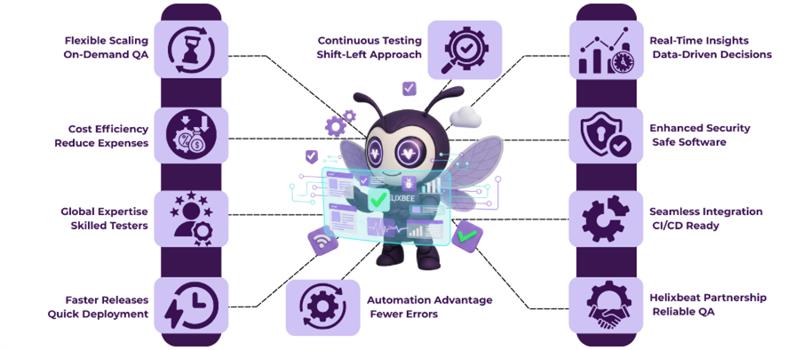
Adopting QA as a service gives businesses the flexibility and expertise they need to maintain high-quality software without the limitations of traditional QA models. Here are the top five benefits that make QaaS a smarter choice:
- Scalability on Demand: Easily scale your QA efforts up or down based on project size, release frequency, or workload without hiring or laying off staff.
- Cost Efficiency: Save up to 40% on testing costs by eliminating the need for permanent QA infrastructure, tools, and full-time testers.
- Access to Global Expertise: Work with specialized QA engineers from leading quality assurance consulting firms experienced in automation, security, and performance testing.
- Faster Time-to-Market: Continuous integration and automated testing help reduce release cycles by up to 50%, enabling quicker product launches.
- Enhanced Transparency and Reporting: Through a robust quality assurance management system, businesses get real-time insights into test progress, defect density, and product readiness.
In short, QA as a service empowers organizations to deliver reliable, bug-free software faster, while maintaining agility, reducing costs, and ensuring long-term product quality.
Comparing In-house QA vs. QA as a Service
Aspect | In-house QA | QA as a Service (QaaS) |
Setup Time | Requires hiring, training, and tool setup before testing begins. | Ready-to-start model with pre-trained testers and established tools. |
Workload Handling | Teams often struggle during peak release cycles due to fixed staffing. | Scales instantly to handle multiple projects or seasonal workloads. |
Access to Latest Practices | May rely on outdated methods if training budgets are limited. | Partners stay updated with the latest testing frameworks, automation tools, and QA trends. |
Resource Utilization | Internal teams may remain idle during downtime between projects. | Pay only for the testing services used — no idle resource costs. |
Knowledge Retention | Depends on individual team members’ experience; high turnover risks losing expertise. | Institutionalized processes ensure consistent quality and documentation across cycles. |
Tool Integration | Often requires separate licenses and maintenance. | Integrated quality assurance management systems streamline tracking, reporting, and collaboration. |
Risk Management | Limited coverage if expertise gaps exist. | Managed by experienced quality assurance consulting firms with domain-specific knowledge. |
Delivery Model | Linear and slower due to dependencies between development and QA teams. | Parallel testing aligned with agile or DevOps workflows for faster feedback. |
Role of a Software Testing Services Company in QaaS
A reliable software testing services company plays a crucial role in making QA as a service (QaaS) successful. From planning test strategies to maintaining software quality throughout the product lifecycle, these companies bring structure, expertise, and automation to every stage of testing. Here’s how they add value:
1. Building a Tailored QA Strategy
Every business has different testing needs. A quality assurance consulting firm starts by understanding the client’s goals, product type, and release cycle. They then design a customized QA roadmap that fits the organization’s workflow, ensuring that the QA as a service model integrates seamlessly with existing development and DevOps processes.
2. Setting Up a Robust Quality Assurance Management System
A key part of QA as a service is establishing a solid quality assurance management system. This system helps in tracking defects, managing test cases, and monitoring real-time progress through detailed dashboards. It ensures full visibility across teams and faster feedback for developers, reducing release risks.
3. Delivering Scalable and Automated Testing Solutions
A software testing services company uses advanced automation tools and frameworks to speed up the QA process. With automation coverage expanding across functional, API, and performance testing, businesses can achieve higher test accuracy and repeatability, a key advantage over manual QA models.
4. Providing Access to Specialized Expertise
Partnering with quality assurance outsourcing companies gives businesses access to highly skilled QA engineers and domain experts. These professionals bring years of experience in various industries, helping detect complex defects early and ensuring compliance with global quality standards.
5. Ensuring Continuous Quality Improvement
A trusted quality assurance services company focuses on continuous improvement. They collect insights from each release cycle, measure performance metrics, and refine testing processes. This data-driven approach ensures software quality keeps improving over time, making QA as a service a long-term, value-driven model for modern enterprises.
By combining automation, scalability, and expert guidance, software testing services companies help businesses deliver flawless digital products faster and more efficiently.
Why Businesses Choose Quality Assurance Outsourcing Companies
Many companies choose quality assurance outsourcing companies because they bring in advanced tools and testing expertise that in-house teams may not have. These experts use automation frameworks like Selenium and Cypress, along with cloud-based testing setups, to run faster and more accurate tests.
With QA as a service, businesses can achieve better quality metrics like keeping defect leakage below 2% and increasing test automation to over 70%, which means fewer bugs and smoother product releases.
A professional quality assurance services company also offers flexibility and deep technical know-how across different domains such as APIs, security, and performance. They use smart quality assurance management systems to track testing progress and share real-time reports on test results, error rates, and fix times.
This helps businesses release software faster, maintain consistency across versions, and deliver a better experience to users — all while keeping costs under control.
How Quality Assurance Improves Your Software Quality
A strong quality assurance framework goes beyond bug detection — it’s about embedding reliability, scalability, and performance into every stage of development. Here’s how quality assurance enhances overall software quality using advanced technical practices:
1. Early Defect Prevention through Shift-Left Testing
Modern QA teams adopt a shift-left testing approach, where testing begins early in the development cycle. By integrating testing into CI/CD pipelines, QA engineers can detect defects at the unit and integration levels using tools like JUnit, Selenium, and Cypress.
This prevents defect leakage into later stages, reducing remediation costs by up to 85%. Combined with static code analysis tools such as SonarQube, teams ensure cleaner, more maintainable code from the start.
2. Improved Reliability through Continuous Testing and Automation
Using QA as a service, testing becomes continuous and data-driven. Automated frameworks like Appium, TestNG, and Playwright simulate real-world user interactions and performance scenarios across devices and browsers. Integration with a quality assurance management system enables continuous test execution and instant feedback after every code commit.
This ensures reliability across builds, supports faster deployment cycles, and enhances mean time to detect (MTTD) and mean time to recovery (MTTR) metrics.
3. Data-Driven Insights for Performance and Security Optimization
Quality assurance today relies heavily on analytics. By leveraging AI-assisted dashboards and predictive defect analysis within quality assurance services company platforms, teams can identify recurring failure patterns and performance bottlenecks before release.
Tools like JMeter for load testing and OWASP ZAP for vulnerability scanning help assess scalability and security posture. This proactive, insight-led approach ensures your software not only works but performs optimally, securely, and consistently under varying loads.
Final Words
Today, traditional QA methods can slow down progress and increase risks. QA as a service offers a better way; it gives companies access to skilled testers, smart automation tools, and flexible testing setups that grow with their needs. Working with a reliable software testing services company helps teams find bugs early, speed up releases, and keep software performance strong from start to finish.
With the help of expert quality assurance consulting firms and modern quality assurance management systems, businesses get clear visibility, faster results, and ongoing quality improvement.
Whether it’s a small app or a large enterprise platform, choosing QA as a Service helps companies deliver better products, happier users, and more confident launches every time.
FAQs
1. How does a Quality Assurance Services Company support product scalability?
A quality assurance services company helps products scale by setting up automated testing environments that handle increasing user loads, data volumes, and feature expansions. They ensure the product remains stable and high-performing even as the system grows.
2. What is the role of Quality Assurance Consulting Firms in improving development workflows?
Quality assurance consulting firms assess your existing QA processes, identify bottlenecks, and implement strategies like continuous testing and CI/CD integration. Their goal is to streamline workflows, reduce testing time, and improve collaboration between QA and development teams.
3. Why is a Quality Assurance Management System important for modern businesses?
A quality assurance management system centralizes all testing activities from test case creation and bug tracking to analytics and reporting. It helps teams monitor quality metrics in real time, making it easier to maintain consistency, transparency, and compliance across all software releases.