


How to Use SQL on FHIR and FHIR Data Tools to Power Analytics
Get Started with a Free Demo
New Keyword Page
New Keyword Page
"*" indicates required fields
Healthcare organizations generate vast amounts of clinical and administrative data every day. From lab results and medication orders to claims and care plans, the volume and variety of data can be overwhelming. However, the real challenge is not collecting data; it’s turning that data into actionable insights.
That’s where SQL on FHIR and modern FHIR data tools come into play.
By combining the interoperability strengths of Fast Healthcare Interoperability Resources (FHIR) with the analytical power of SQL, healthcare organizations can unlock scalable, high-performance analytics across clinical datasets.
In this comprehensive guide, you’ll learn:
- What SQL on FHIR is
- How it works with FHIR resources
- The role of FHIR data tools in analytics
- Real-world use cases
- Best practices for implementation
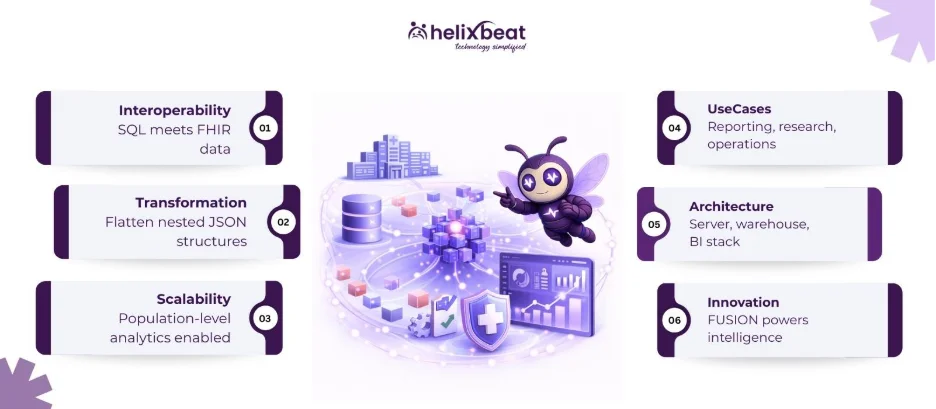
What Is SQL on FHIR?
SQL on FHIR is an approach that allows users to query FHIR data using standard SQL. It works by mapping hierarchical FHIR resources into relational views that can be queried using traditional SQL syntax.
In simple terms:
- FHIR = API-based healthcare data standard
- SQL = Structured Query Language for analytics
- SQL on FHIR = Querying FHIR datasets using SQL
This makes FHIR data accessible to data analysts, BI tools, and data scientists who already work with SQL-based systems.
Why SQL on FHIR Matters for Healthcare Analytics
FHIR APIs are excellent for retrieving individual patient records. But analytics often require:
- Aggregating data across thousands or millions of patients
- Performing joins across multiple resource types
- Running population health queries
- Feeding dashboards and reporting tools
Querying FHIR purely through REST APIs can be inefficient for these use cases.
SQL on FHIR bridges this gap by:
- Flattening nested structures
- Creating relational views
- Allowing JOIN operations
- Supporting analytical workloads
This makes FHIR data compatible with data warehouses, lakehouses, and BI platforms.
Understanding the Structure of FHIR Data
FHIR resources are hierarchical and often deeply nested. For example, an Observation resource may contain:
- Patient reference
- CodeableConcept for test type
- Multiple components
- Units
- Effective date
- Performer references
In JSON format, this structure is nested and not directly query-friendly for SQL engines.
To run analytics, this data must be transformed into tabular structures — rows and columns.
This transformation layer is central to SQL on FHIR.
How SQL on FHIR Works
The SQL on FHIR approach typically involves the following steps:
1. Ingest FHIR Data
FHIR resources are stored in:
- FHIR servers
- Data lakes
- Cloud object storage
- Data warehouses
2. Map Resources to Relational Views
FHIR resource elements are mapped into SQL-accessible views. For example:
- Patient table
- Observation table
- Encounter table
Complex nested fields are flattened into structured columns.
3. Use SQL Queries for Analytics
Once mapped, analysts can run queries such as:
- Count diabetic patients
- Calculate readmission rates
- Track lab trends
- Analyze medication adherence
All using standard SQL.
These tools include:
- FHIR servers
- ETL pipelines
- Data transformation engines
- Cloud data platforms
- BI connectors
Some tools focus on interoperability. Others focus on analytics and reporting.
When combined with SQL on FHIR, they create a scalable healthcare analytics stack.
Core Components of a SQL on FHIR Analytics Stack
FHIR Server
A FHIR server, like FUSION by Helixbeat, stores and exposes FHIR resources via REST APIs. These systems store data in FHIR-native formats.
Data Lake or Warehouse
FHIR data is often exported into:
- Cloud storage
- Data lakes
- Data warehouses
These systems support SQL-based querying at scale.
Transformation Layer
This layer:
- Flattens nested FHIR JSON
- Normalizes codes
- Handles arrays
- Maps references
It may use ETL tools or SQL-based view definitions.
BI and Analytics Tools
Once data is queryable via SQL, it can power:
- Tableau
- Power BI
- Looker
These tools can connect directly to SQL databases and generate dashboards.
Example: Querying Patient Lab Results with SQL on FHIR
Imagine you want to analyze HbA1c levels for diabetic patients.
Using SQL on FHIR:
- Observation resources are flattened into an Observation table.
- Patient references are resolved.
- LOINC codes are normalized.
- A SQL query aggregates values by patient and date.
You can now:
- Calculate average HbA1c
- Identify uncontrolled diabetes
- Track trends over time
- Segment populations
All without manually parsing nested JSON.
Real-World Use Cases of SQL on FHIR
Population Health Analytics
Health systems can:
- Identify high-risk patients
- Track chronic disease prevalence
- Monitor quality metrics
SQL on FHIR supports cohort-building queries at scale.
Value-Based Care Reporting
Organizations participating in value-based contracts need:
- Outcome tracking
- Utilization analysis
- Cost reporting
Structured SQL queries simplify performance reporting across FHIR datasets.
Clinical Quality Measures
FHIR-based data can power:
- HEDIS measures
- Readmission rates
- Preventive screening compliance
SQL queries can calculate numerators and denominators efficiently.
Research and Real-World Evidence
Researchers can:
- Extract patient cohorts
- Analyze longitudinal trends
- Study medication outcomes
SQL-based workflows are familiar to data scientists.
Operational Analytics
Hospitals can analyze:
- Bed utilization
- Encounter volumes
- Procedure rates
- Emergency department trends
FHIR data becomes operationally actionable.
Unlock Seamless Healthcare Interoperability with FUSION
Imagine a platform that not only meets modern healthcare standards like FHIR but actually pushes your operations forward. That’s FUSION: the FHIR server designed to make interoperability effortless and impactful. Whether you’re a hospital administrator streamlining workflows or a payer optimizing reimbursements, FUSION bridges the gap.
Built on FHIR, it leverages RESTful APIs for plug-and-play integration, enabling seamless connectivity with legacy systems, modern EHRs, and emerging tools like wearable devices and telehealth platforms. This isn’t just compliance, it’s acceleration.
FUSION goes deeper by embedding critical medical coding systems like SNOMED CT, LOINC, and ICD-10 directly into its architecture. This built-in intelligence maintains data consistency and accuracy, transforming raw information into actionable insights ready for clinical decisions, regulatory reporting, and advanced analytics. No more wrestling with mismatched formats or manual mappings: FUSION handles the heavy lifting!
Organizations using FUSION report up to 70% faster data sharing, slashing referral delays by 60% and reducing redundant tests by 25%. That’s not hype; it’s a measurable impact, with providers saving $1,000–$2,000 per patient annually through streamlined claims and operations.
How FUSION Ignites Data-Driven Innovation
The true magic of healthcare FHIR lies in its potential to fuel innovation, and FUSION amplifies this like no other. As a reliable engine for standardized data flows, it powers downstream applications that were once out of reach.
Take chronic disease management, for example. By integrating real-time data from wearables and EHRs, FUSION enables continuous monitoring and proactive interventions, potentially cutting hospital readmissions and optimizing therapies. Or, imagine a telehealth consultation that’s instantly better because the doctor has the patient’s full history right there. FUSION makes that happen, giving virtual care a huge boost in quality and making patients much happier.
Certified Excellence
FUSION is officially certified by the Drummond Group for FHIR-based interoperability, validating its conformance with healthcare data exchange standards HL7, FHIR, and SMART on FHIR. This certification demonstrates that FUSION meets industry-recognized benchmarks for secure, standardized data exchange — giving you the confidence to integrate seamlessly across systems.
What This Means for You
In a complex healthcare ecosystem, FUSION simplifies connectivity and safeguards data integrity. With enterprise-grade uptime (99.99%) and secure authentication powered by OAuth2 and encrypted endpoints, it supports trusted, real-time collaboration between hospitals, labs, and payers.
Whether you’re mapping USCDI elements for regulatory reporting or automating data flows for public-health initiatives, FUSION keeps you compliant with current interoperability frameworks and ready for future mandates.
Final Thoughts
SQL on FHIR represents a practical evolution in healthcare analytics. By combining standardized FHIR data models with SQL-based querying, organizations can transform raw clinical data into actionable insights that support population health, value-based care, research, and operational reporting.
If you’re planning to modernize your interoperability and analytics stack, FUSION, a powerful FHIR server, can serve as the backbone of your architecture. With robust FHIR resource management, scalable performance, and support for analytics-ready integrations, FUSION helps healthcare organizations build a strong foundation for SQL on FHIR workflows.
Get started with FUSION today and transform your FHIR data into actionable intelligence.
Frequently Ask Questions
1. Why is health information exchange important in healthcare?
It improves care coordination, reduces duplicate tests, minimizes errors, and helps providers make timely, data-driven decisions across different healthcare settings.
2. What are the main models of health information exchange?
3. Which standards guide health information exchange?
Standards like FHIR and HL7 define consistent data formats, making it easier for EHRs, HIEs, and other healthcare platforms to exchange information.
4. What are the benefits of using health information exchange?
HIE improves care coordination, reduces healthcare costs, supports population health management, enhances research, and increases operational efficiency.
5. How does AERIS enhance healthcare information exchange?
AERIS leverages FHIR standards, connects legacy systems, automates workflows, reduces manual errors, and provides real-time access to patient records and lab results.
1. Why is SQL on FHIR important for healthcare analytics?
FHIR APIs are optimized for transactional data exchange, not large-scale analytics. SQL on FHIR makes it easier to aggregate, join, and analyze healthcare data across large populations using scalable data warehouse technologies.
2. How does SQL on FHIR work?
SQL on FHIR works by transforming nested FHIR JSON resources into structured relational tables or views. Analysts can then run SQL queries to extract insights such as trends, patient cohorts, and quality metrics.
3. What are FHIR data tools?
FHIR data tools include FHIR servers, ETL pipelines, transformation engines, data warehouses, and BI connectors that ingest, structure, and analyze FHIR-based healthcare data.
4. Can SQL on FHIR be used for population health management?
Yes. SQL on FHIR supports cohort building, chronic disease tracking, risk stratification, and performance measurement across large patient populations.
5. What FHIR version is best for analytics?
FHIR R4 is widely adopted and commonly used for analytics implementations. Standardizing on one FHIR version simplifies data modeling and transformation processes.
6. How does a FHIR server like FUSION support SQL on FHIR?
A FHIR server such as FUSION provides structured storage of FHIR resources, supports bulk data export, and integrates with analytics pipelines, making it easier to transform and query data using SQL.