


From HL7 Integration Engine to FHIR Server
For decades, the HL7 integration engine has powered the backbone of hospital data exchange. It quietly moved admissions, lab results, and billing messages between hundreds of systems. Today, that same engine often sits at the center of a much larger transformation: the shift from legacy messaging to Fast Healthcare Interoperability Resources (FHIR) and modern FHIR servers.
Here, we’ll discuss the role of HL7 integration engines and why the industry is moving toward FHIR servers like FUSION.
What is HL7?
HL7 refers to Health Level Seven International, an organization that develops standards for the exchange, integration, sharing, and retrieval of electronic health information. Established in 1987, HL7 has created protocols that allow different healthcare systems to communicate. The most common version, HL7 v2, uses a pipe-delimited format for messages like admissions (ADT), orders (ORM), and results (ORU). These standards have been widely adopted, with over 90% of U.S. hospitals using some form of HL7 messaging.
HL7 v2 focuses on event-triggered exchanges, where systems send data in response to specific actions, such as patient registration or test results. Later versions, like HL7 v3, introduced more structured models based on the Reference Information Model (RIM), but adoption has been slower due to complexity. Despite this, HL7 remains foundational for interoperability in healthcare.
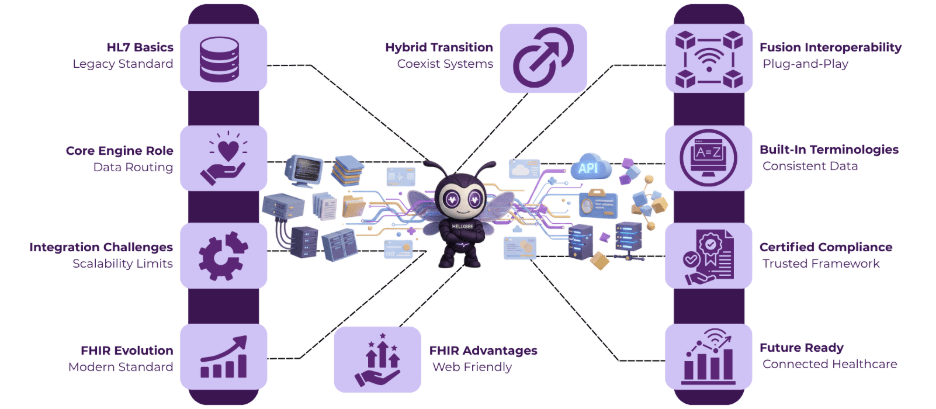
The Role of HL7 Integration Engine
An HL7 integration engine acts as middleware that connects various healthcare systems, such as EHRs, picture archiving and communication systems (PACS), and radiology information systems (RIS). It receives messages from one application, processes them, and routes them to the appropriate destination. This engine handles tasks like data mapping, where fields from one system’s format align with another’s, preventing errors in transmission.
In practice, the HL7 integration engine serves as a central hub, consolidating connections that would otherwise require point-to-point interfaces. This reduces maintenance costs and improves system reliability, as updates to one system do not disrupt others.
Common Challenges in HL7 Integration
Despite its strengths, HL7 integration presents hurdles. Version incompatibilities between systems—such as v2.x variations—can complicate mappings. Custom extensions in messages add complexity, requiring tailored configurations.
In addition, scalability issues emerge in high-traffic settings, where engines must process thousands of messages per minute without latency. As a result, data quality problems, like incomplete fields, lead to rejections or inaccuracies downstream.
Vendor lock-in poses another risk, as proprietary engines may limit flexibility. Open-source alternatives mitigate this, but demand in-house expertise for maintenance. Also, testing integrations thoroughly remains important to avoid disruptions in live environments.
Evolving Standards: Transitioning from HL7 to FHIR
As healthcare technology advances, the limitations of traditional HL7 v2—such as its rigid structure and lack of web-friendly features—have prompted a shift toward more modern standards. This evolution addresses the need for real-time, accessible data exchange in an era of mobile apps and cloud computing. Therefore, organizations increasingly migrate from HL7 v2 to FHIR, leveraging tools that bridge old and new formats for smoother transitions.
This migration often involves hybrid approaches, where existing HL7 systems coexist with emerging ones.
Integrating HL7 and FHIR: The Future of Healthcare Data Exchange
Many organizations use transformation services to convert HL7 messages into FHIR resources, enabling legacy systems to interoperate with new ones. This hybrid model supports gradual upgrades, where HL7 integration engines evolve to include FHIR capabilities.
Unlock Seamless Healthcare Interoperability with FUSION
Imagine a platform that not only meets modern healthcare standards like FHIR but actually pushes your operations forward. That’s FUSION: the FHIR server designed to make interoperability effortless and impactful. Whether you’re a hospital administrator streamlining workflows or a payer optimizing reimbursements, FUSION bridges the gap.
Built on FHIR, it leverages RESTful APIs for plug-and-play integration, enabling seamless connectivity with legacy systems, modern EHRs, and emerging tools like wearable devices and telehealth platforms. This isn’t just compliance, it’s acceleration.
FUSION goes deeper by embedding critical medical coding systems like SNOMED CT, LOINC, and ICD-10 directly into its architecture. This built-in intelligence maintains data consistency and accuracy, transforming raw information into actionable insights ready for clinical decisions, regulatory reporting, and advanced analytics. No more wrestling with mismatched formats or manual mappings: FUSION handles the heavy lifting!
Organizations using FUSION report up to 70% faster data sharing, slashing referral delays by 60% and reducing redundant tests by 25%. That’s not hype; it’s a measurable impact, with providers saving $1,000–$2,000 per patient annually through streamlined claims and operations.
How FUSION Ignites Data-Driven Innovation
The true magic of healthcare FHIR lies in its potential to fuel innovation, and FUSION amplifies this like no other. As a reliable engine for standardized data flows, it powers downstream applications that were once out of reach.
Take chronic disease management, for example. By integrating real-time data from wearables and EHRs, FUSION enables continuous monitoring and proactive interventions, potentially cutting hospital readmissions and optimizing therapies. Or, imagine a telehealth consultation that’s instantly better because the doctor has the patient’s full history right there. FUSION makes that happen, giving virtual care a huge boost in quality and making patients much happier.
Certified Excellence
FUSION is officially certified by the Drummond Group for FHIR-based interoperability, validating its conformance with healthcare data exchange standards HL7, FHIR, and SMART on FHIR. This certification demonstrates that FUSION meets industry-recognized benchmarks for secure, standardized data exchange — giving you the confidence to integrate seamlessly across systems.
What This Means for You
In a complex healthcare ecosystem, FUSION simplifies connectivity and safeguards data integrity. With enterprise-grade uptime (99.99%) and secure authentication powered by OAuth2 and encrypted endpoints, it supports trusted, real-time collaboration between hospitals, labs, and payers.
Whether you’re mapping USCDI elements for regulatory reporting or automating data flows for public-health initiatives, FUSION keeps you compliant with current interoperability frameworks and ready for future mandates.
What Users Say About AERIS
Dr. Sarah L.
Hospital Administrator
John T.
Telemedicine Provider
Emily P.
Healthcare Executive
FAQs
1.What challenges exist in HL7 integration?
Common challenges include version incompatibilities, custom message extensions, scalability issues in high-traffic environments, and the risk of vendor lock-in with proprietary engines.
2.How is HL7 different from FHIR?
HL7 v2 focuses on event-triggered exchanges using a rigid structure, while FHIR is web-friendly, supports real-time data access, and is designed for mobile and cloud-based healthcare applications.
3.Can HL7 and FHIR work together?
Yes, many organizations use transformation services to convert HL7 messages into FHIR resources. Hybrid approaches allow legacy HL7 systems to coexist with modern FHIR-based solutions.
4. Is FUSION certified for healthcare standards?
Yes, FUSION is certified by the Drummond Group for HL7, FHIR, and SMART on FHIR, validating its compliance with industry-recognized benchmarks for secure and standardized healthcare data exchange.
Final Thoughts
The HL7 integration engine remains vital for current healthcare operations, while the shift to FHIR and dedicated servers signals a more dynamic future. By embracing technologies like FUSION, providers can achieve greater efficiency and better patient outcomes.
So why settle for fragmented data when you can command a connected future? Contact Helixbeat today to schedule a demo to learn more about FUSION!