


Unlock the Power of Data — Discover Virtual Data Warehousing with Helixbeat
Welcome to the future of enterprise-scale analytics. If you’re looking to transform scattered, siloed data across CRM systems, ERP platforms, SaaS tools, and IoT feeds into a unified source of truth — you’ve found the right partner. With Helixbeat’s virtual data warehousing solution, you don’t need to invest in costly hardware or struggle with complex on-premises infrastructure.
What sets Helixbeat apart for US organizations is its trusted certifications and compliance standards, including SOC 2 Type 2, HIPAA, ISO 27001:2022, ISO 9001:2015, and registration in the US System for Award Management (SAM). These certifications guarantee your data is managed securely, compliantly, and to the highest industry standards — making Helixbeat the preferred choice for enterprises across healthcare, finance, retail, and government sectors.
schedule a free demo and see how virtual data warehousing can revolutionize your business.
What Is Virtual Data Warehousing?
Virtual data warehousing refers to a cloud-based, fully managed solution that consolidates data from diverse sources into a centralized repository, without the need for on-premises servers or manual data consolidation efforts. Instead of building and maintaining a physical data warehouse, organizations leverage elastic cloud infrastructure, automated data pipelines, and managed services to ingest, transform, store, and analyze data — all on demand.
Virtual data warehousing lets businesses handle growing data effortlessly. It works with all types of data — structured, semi-structured, and unstructured — and provides real-time updates, strong security, and organized data management. Setup is fast, often in hours or days, so decision-makers can access accurate insights quickly.
At its core, virtual data warehousing enables companies to treat data as a strategic asset. Whether you’re an e‑commerce retailer wanting to analyze customer behavior across web, mobile, and in‑store — or a healthcare provider needing HIPAA-compliant analytics on patient visits, claims, and outcomes — virtual data warehousing provides the backbone for scalable, reliable, data-driven decision making.
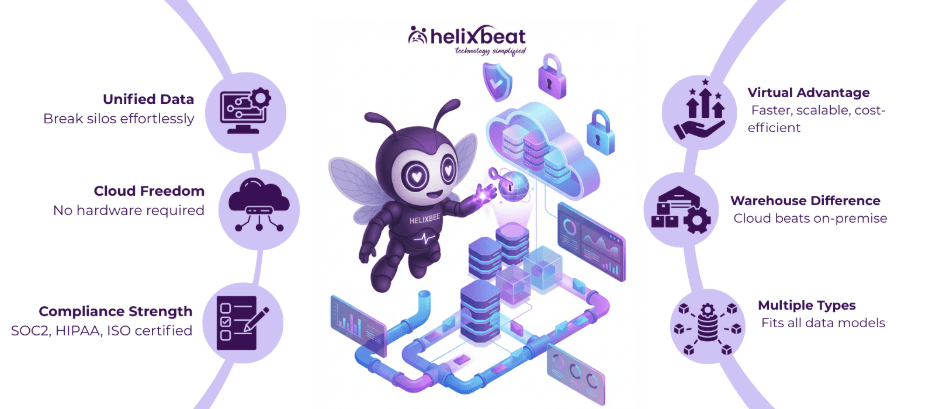
Virtual Data Warehousing vs Data Warehouse: What’s the Difference?
When comparing virtual data warehousing vs data warehouse, there are some key distinctions that often make the virtual model more attractive — especially for modern, fast-growing organizations:
- Infrastructure Ownership: Traditional data warehouse often implies on-premises hardware, storage, and compute resources under your ownership or lease. Virtual data warehousing shifts all of that to the cloud — no upfront CAPEX, no physical maintenance. This cloud-first model makes virtual data warehousing more agile and cost-effective.
- Scalability & Elasticity: A traditional data warehouse requires capacity planning and provisioning ahead of time. Virtual data warehousing scales up or down dynamically based on usage, enabling you to pay only for what you use — ideal for seasonal businesses or unpredictable workloads.
- Speed of Deployment: Setting up a conventional data warehouse can take months of hardware procurement, configuration, and data migration. Virtual data warehousing, by contrast, can often be operational in days or even hours.
- Maintenance Overhead: With a traditional data warehouse, your IT team bears responsibility for maintenance, performance tuning, backups, upgrades, and disaster recovery. Virtual data warehousing offloads all that — the vendor handles the backend, letting your team focus on data insights and business value.
- Data Integration & Diversity: Modern enterprises often deal with data from APIs, SaaS tools, IoT sensors, streaming platforms, relational databases, and more. Virtual data warehousing is built to ingest and integrate heterogeneous data sources seamlessly. Traditional data warehouses often struggle with this diversity.
- Cost Structure: Virtual data warehousing typically uses a pay‑as‑you-go or subscription pricing model. In contrast, traditional data warehouse involves capital expenditure and long-term maintenance costs.
In short, when evaluating virtual data warehousing vs data warehouse, the former often offers greater agility, lower cost, faster time-to-value, and less operational overhead — making it a better fit for businesses that need to move fast and scale efficiently.
Types of Virtual Data Warehousings
In the world of cloud-based data management, there isn’t a one-size-fits-all. Organizations choose different architectures and models depending on their needs. Here we discuss some common types of virtual data warehousings:
- Cloud-Native Data Warehouse (Fully Managed DWaaS): These are fully managed services offered by vendors — the infrastructure, storage, compute, maintenance, backups, and updates are all handled externally. Helixbeat’s offering falls in this category.
- Hybrid Virtual Warehouse (On-Prem + Cloud Hybrid): For organizations not ready to abandon their on-prem data stores, this model connects on-prem databases with cloud-based warehousing. Data is periodically synced or streamed.
- Real-Time / Streaming Virtual Warehouse: For businesses needing live data — e.g., e-commerce tracking, real-time analytics, IoT sensor data — this type of virtual data warehousing supports streaming ingestion, low-latency updates, and near-real-time querying.
- Data Lake + Virtual Warehouse Hybrid: Some organizations store raw/unstructured data in a data lake, while structured or transformed data resides in a virtual warehouse — offering flexibility, especially for data science and machine learning use cases.
- Multi-tenant Virtual Warehouse Platform: Ideal for SaaS providers or agencies — this provides isolated data environments per customer/client, managed centrally, with secure partitioning and compliance.
- Geographically Distributed Virtual Warehousing: For multinational companies needing data replication across regions — enabling compliance, local data residency, and low-latency access — this type uses cloud infrastructure across multiple regions.
- Compliance-Focused Virtual Warehouse: For regulated industries like healthcare or finance — with built-in compliance (HIPAA, SOC 2, ISO, etc.), encryption, auditing, access control — aligning with regulatory and security requirements.
No matter which of these types of virtual data warehousings your business needs — from small startups to large enterprises — cloud-based warehousing offers flexibility and scalability that traditional setups cannot match.
How Helixbeat Helps with Virtual Data Warehousing
Here’s how Helixbeat steps in to deliver a turnkey virtual data warehousing solution — empowering your business with modern data infrastructure and analytics readiness.
Unified, End-to-End Data Integration
Helixbeat connects to virtually any data source — relational databases, NoSQL stores, SaaS applications, CRM, ERP, streaming data platforms, APIs, and IoT feeds. Through managed ETL/ELT pipelines, data is automatically ingested, transformed, and loaded into the cloud warehouse. No more manual exports or error-prone scripts.
Cloud-Native, Fully Managed Warehouse
Helixbeat provides a fully managed cloud DWaaS — you don’t need to provision servers or worry about storage limits. The infrastructure scales automatically to meet demand, ensuring performance even as data volume grows.
Flexible Architecture — Fit for Any Business Model
Whether you’re a fast-growing startup requiring agility, an e-commerce business handling seasonal peaks, or an enterprise needing compliance-grade security — Helixbeat’s virtual data warehousing adapts. Their platform covers hybrid models, real-time streaming, multi-tenant setups, and compliance-oriented warehouses.
Compliance, Security & Governance Built In
Helixbeat ensures enterprise-grade security, encryption at rest and in transit, role-based access control, auditing, backups, and compliance with industry standards. For clients handling regulated data (e.g. healthcare, finance), this reduces risk and ensures audit readiness.
Rapid Deployment & Time-to-Value
With Helixbeat, your virtual data warehousing environment can go live within days or even hours. That means faster access to unified, analytics-ready data — accelerating decision-making and insight generation.
Cost-Efficiency & Operational Simplicity
Gone are the days of over-provisioning hardware or paying for idle servers. Helixbeat’s pay-as-you-go pricing and managed service model drastically reduce upfront costs and ongoing maintenance, enabling you to focus your internal resources on deriving business value instead of admin overhead.
Ready for Analytics, Reporting & Machine Learning
Once data is centralized and modeled, Helixbeat’s warehouse becomes the foundation for BI dashboards, reporting, data science, and even AI/ML workflows — enabling deeper insights, predictive analytics, and data-driven strategies.
With Helixbeat’s virtual data warehousing, you get a robust, scalable, secure, and future-proof data backbone — without the complexity and cost of traditional infrastructure.
See how Helixbeat’s cloud-based data warehousing solution fits your business needs and budget.
Virtual Data Warehousing vs Data Warehouse — Why Helixbeat Chooses the Virtual Path
In an era where data volumes grow exponentially and business requirements shift rapidly, traditional data warehouses often become bottlenecks. Helixbeat embraces virtual data warehousing vs data warehouse because: it enables scalability, agility, and lower cost; it reduces maintenance burden; it supports heterogeneous data sources; and it meets compliance standards — all essential for modern US enterprises operating in dynamic markets.
Whether you run a mid‑sized e‑commerce firm in San Francisco or a healthcare analytics startup in New York, virtual data warehousing empowers you to stay agile, scalable, and data-driven.
Testimonials
“We migrated from a patchwork of spreadsheets, databases, and flat files to Helixbeat’s virtual data warehousing — and suddenly our sales, marketing, and support teams saw the same unified data in real time. It was a game-changer.”
— Sarah L., VP Sales, e‑Commerce Retailer, Austin TX
“With Helixbeat we went live in under 48 hours. The virtual data warehousing setup was smooth, and we didn’t need to hire a dedicated DevOps team.”
— Michael P., CTO, FinTech Startup, New York City
“As a healthcare provider, compliance was non-negotiable. Helixbeat’s HIPAA-compliant virtual data warehousing gave us peace of mind and powerful analytics without sacrificing security.”
— Dr. Aisha M., Director of Analytics, HealthCare Network, Chicago IL
“Our data used to be scattered. Now, thanks to virtual data warehousing from Helixbeat, we have a single source of truth. Forecasting revenue is now accurate and simple.”
— Carlos R., CEO, Subscription SaaS Company, San Diego CA
“We needed real-time insights — and Helixbeat delivered. The streaming data integration into their cloud warehouse powers our live dashboards without latency.”
— Zoe K., Head of Operations, Logistics Firm, Atlanta GA
“The cost savings were immediate. We didn’t need to lease servers or hire admins. Their pay-as-you-go virtual data warehousing model fits perfectly for our growth trajectory.”
— John D., COO, Mid-sized Manufacturing Company, Ohio
“From day one, the Helixbeat team was responsive, professional, and transparent. Their setup of virtual data warehousing felt like plugging in a new CRM — but for our entire data architecture.”
— Linda S., Head of BI, Retail Chain, Seattle WA
Why Choose Helixbeat for Your Virtual Data Warehousing
- Speed & Agility: Get your data warehouse up and running in days. No hardware, no delays.
- Scalability & Flexibility: Whether you’re a startup or enterprise — scale storage and compute as needed.
- Unified Data from Any Source: CRM, ERP, IoT, SaaS, streaming — all integrated and ready for analytics.
- Compliance & Security: Built-in encryption, governance, and compliance support — ideal for regulated industries.
- Lower Total Cost: Pay-as-you-go model eliminates upfront investments and maintenance overhead.
- Expert Managed Services: Helixbeat’s team handles infrastructure, pipelines, maintenance — you focus on insights.
- Ready for Analytics, Reporting & AI/ML: Use your data warehouse as the foundation for dashboards, BI tools, predictive analytics, and machine learning.
Speak with a Data Expert
Learn how virtual data warehousing can boost your business decisions.
What Users Say About AERIS
Dr. Sarah L.
Hospital Administrator
John T.
Telemedicine Provider
Emily P.
Healthcare Executive
Frequently Asked Questions
- What is the difference between virtual data warehousing and a traditional data warehouse?
Virtual data warehousing leverages cloud infrastructure and is fully managed, offering scalability, flexibility, and lower upfront cost. A traditional data warehouse typically resides on-premises or on dedicated servers, requiring hardware investment, maintenance, and manual scaling. - Can virtual data warehousing handle real-time data ingestion?
Yes. Many virtual data warehousing setups — including those by Helixbeat — support real-time or near-real-time data ingestion and streaming, enabling live analytics, dashboards, and decision-making. - Is virtual data warehousing secure enough for regulated industries?
Absolutely. With robust encryption, access control, audit logs, and compliance-ready architecture, virtual data warehousing from Helixbeat meets standards required by healthcare, finance, and other regulated sectors. - How quickly can we deploy a virtual data warehouse with Helixbeat?
Deployment can be completed within days — often a matter of hours — depending on data volume and sources. Helixbeat handles all setup, integration, and migration, so you get up and running quickly. - Does virtual data warehousing reduce costs compared to running our own warehouse?
Yes. Since you eliminate hardware purchase, maintenance, over-provisioning, and administrative overhead, virtual data warehousing typically results in significantly lower total cost of ownership. - Can we integrate data from multiple platforms (ERP, CRM, SaaS, API, IoT) into one warehouse?
Definitely. Virtual data warehousing excels in integrating heterogeneous data sources — structured or unstructured, batch or streaming — into a unified, analytics-ready repository.