


FHIR Healthcare
Get Started with a Free Demo
New Lead: FUSION
FUSION Landing Page Form, connected with the Mailchimp.
"*" indicates required fields
In modern healthcare, FHIR (Fast Healthcare Interoperability Resources) is key to better efficiency and connectivity. Developed by HL7 International, FHIR gives us a framework for exchanging electronic health information seamlessly across different systems.
Today, the adoption of FHIR healthcare has accelerated due to regulatory mandates and technological advancements. Governments and organizations worldwide recognize its potential to create a more connected ecosystem, where patient data flows securely and efficiently.
Here, we’ll talk about the core of FHIR healthcare: its mechanisms, the benefits it offers, and its practical applications, along with the tools that boost its impact.
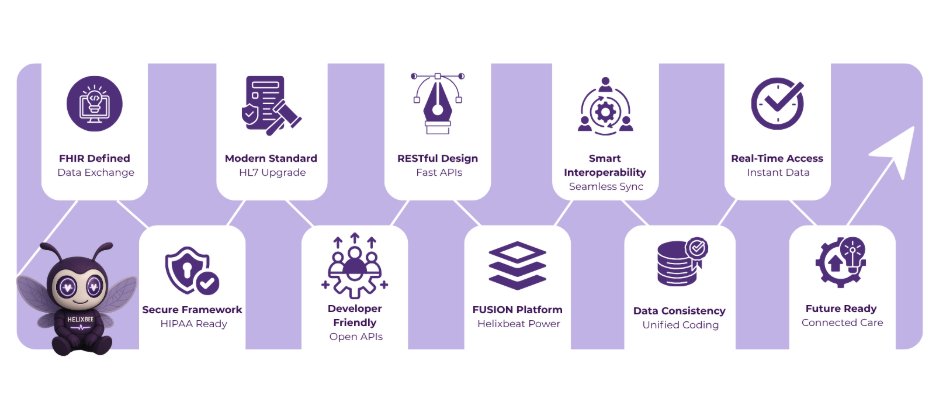
What is FHIR Healthcare
FHIR healthcare refers to the use of the FHIR standard to structure and exchange health data. Pronounced “fire,” FHIR builds on previous HL7 standards like HL7 v2 and CDA but introduces a more flexible, resource-based approach. Resources in FHIR represent discrete units of healthcare information, such as Patient, Observation, or MedicationRequest, each defined with precise data elements. This modular design enables granular data handling, making it easier to query and update specific information without overhauling entire systems.
FHIR healthcare operates on RESTful principles, utilizing HTTP methods like GET, POST, PUT, and DELETE to interact with resources via APIs. This web-friendly architecture is much easier for developers to use. It reduces the learning curve compared to older standards that relied on complex, difficult-to-learn messaging protocols. For example, a doctor can quickly pull up a patient’s allergy history from a remote system with just a simple API call, making fast assessments possible during emergencies.
One key strength of FHIR healthcare lies in its support for both human-readable and machine-interpretable formats. Resources can be exchanged in JSON or XML, with built-in validation to maintain data integrity. This versatility extends to mobile health apps, wearables, and telehealth platforms, where FHIR healthcare powers real-time synchronization. As healthcare continues to go digital, FHIR will become a foundational element for integrated care. Because it focuses on semantic interoperability, the data will be interpreted and understood consistently across every system.
The Benefits of Implementing FHIR Healthcare
Adopting FHIR in healthcare brings several advantages. First and foremost, it enhances interoperability, enabling EHRs, labs, pharmacies, and insurers to exchange data seamlessly with one another. This cuts down on duplicated efforts, like filling out the same patient forms over and over, and reduces errors that come from typing data by hand. Ultimately, providers get a complete view of a patient’s history, which leads to better diagnoses and more personalized treatments.
FHIR healthcare also accelerates access to quality data in real-time, which is critical for time-sensitive scenarios. Traditional systems often experience delays because they process data in batches; however, FHIR eliminates this issue. Its API-driven model enables systems to query and share information instantly. This empowers apps to pull vital signs from IoT devices or update records during virtual consultations.
Besides, security is still the most important part of any FHIR healthcare system. The standard incorporates OAuth 2.0 for authentication and SMART on FHIR for app authorization, safeguarding sensitive information during transit and storage. Compliance with regulations like HIPAA becomes more straightforward, as FHIR resources include metadata for audit trails and consent management. Moreover, its flexibility accommodates unstructured data, such as clinical notes or images, broadening its applicability beyond structured records.
Looking at the bigger picture, FHIR really opens the door to innovation by making it easier for third-party developers to jump in. Its open APIs encourage the creation of specialized tools, whether that’s a new analytics dashboard or a better patient portal, which adds value to the entire healthcare system.
Exploring FHIR Healthcare Integration Platforms and Tools
FHIR healthcare integration platforms and tools play a key role in operationalizing the standard across diverse environments. These platforms provide the infrastructure to map legacy data to FHIR resources, handle transformations, and manage API traffic. They often include validators, simulators, and deployment templates to accelerate development and testing.
FUSION by Helixbeat stands as a robust FHIR server designed for seamless integration. Built with RESTful APIs, FUSION facilitates easier, faster, and more accurate data exchange by storing patient data in FHIR format. This enables apps, hospitals, and systems to communicate and share critical health details in real-time. What distinguishes FUSION is its inclusion of medical coding systems like SNOMED CT, LOINC, and ICD, maintaining data consistency for clinical use, reporting, and analytics.
Key features of FUSION include:
- Key features of FUSION include
- FHIR-native architecture
- Plug-and-play
- APIs for rapid deployment
- Real-time data sharing across multiple endpoints
- Strong security controls that meet compliance standards
- Support for both structured and unstructured data
As a smart bridge, FUSION integrates with your existing systems; you don’t have to replace anything. This makes it perfect for organizations moving toward modern FHIR integration platforms. As a result, hospitals can quickly and easily exchange records with external labs or enable new app-based clinical tools, making overall interoperability effortless.
FHIR Healthcare Solutions for Hospitals and Clinics
FHIR healthcare solutions for hospitals and clinics optimize resource utilization through integrated platforms. FUSION exemplifies this by acting as a central hub for FHIR-compliant data management. Besides, FUSION is a huge help to multidisciplinary teams because it supports real-time sharing, meaning clinicians always have the most up-to-date patient information.
Overall, FUSION helps create a connected environment where data drives better decisions and outcomes.
Why AERIS is Your Key to Healthcare Innovation
At Helixbeat, we know your challenges: fragmented systems, delayed data, and rising costs. AERIS is here to change that, offering a personalized, scalable, and secure platform that fits your unique needs. Whether you’re a small clinic or a sprawling hospital network, AERIS delivers measurable results that elevate patient outcomes and boost your bottom line.
1. 20+ Years of Expertise
2. 50+ IT Professionals
A dedicated crew powers AERIS, delivering unmatched support and innovation.
3. 1,000+ Customers
Join a thriving community of healthcare leaders already transforming with AERIS.
4. 10,000+ Projects Completed
Proven success across countless integrations and workflows.
5. 95% Returning Customers
Our clients trust AERIS to deliver, time and time again.
Providers adopting AERIS report faster diagnoses, lower costs, and improved outcomes, positioning it as the go-to tool for future-proof HIE.
The AERIS Advantage: Numbers That Speak for Themselves
| Metric | Without AERIS | With AERIS | Your Benefit |
| Data Exchange Delays | Frequent bottlenecks | Reduced by 50% | Faster care in emergencies |
| Return on Investment | Slow, costly overhauls | 100% faster ROI | Grow without breaking the bank |
| Operational Costs | High redundancies | Cut by 30% | Save thousands annually |
| Error Rates | Up to 20% manual errors | Slashed by 90% | Precision for better patient outcomes |
Your Benefits, Amplified
1. 50% Fewer Delays
2. 100% Faster ROI
3. 30% Cost Savings, 90% Fewer Errors
How AERIS Works: Your 3-Step Path to Success
Final Thoughts
The trajectory of FHIR healthcare points toward widespread dominance in digital health ecosystems. By leveraging FUSION, organizations can harness its full potential for interoperability and innovation. In the future, embracing FHIR-based healthcare will become necessary for staying competitive and delivering patient-centric care. Contact Helixbeat today to learn how FUSION can transform your healthcare operations!
Frequently Ask Questions
1. How does FHIR improve interoperability in healthcare?
FHIR enables EHRs, labs, pharmacies, and insurers to exchange data efficiently, reducing duplication and errors while providing a complete view of patient history.
2. How does FHIR handle data formats?
FHIR supports both human-readable and machine-interpretable formats, including JSON and XML, and accommodates structured and unstructured data like clinical notes or images.
3. What security measures does FHIR implement?
FHIR incorporates OAuth 2.0 for authentication, SMART on FHIR for app authorization, and includes metadata for audit trails and consent management.
4. What is FUSION, and how does it work?
FUSION is a FHIR server that stores patient data in FHIR format, enabling real-time data sharing across apps, hospitals, and systems while supporting medical coding standards.
5. Can FHIR support mobile apps and telehealth platforms?
Yes, FHIR powers real-time synchronization for mobile apps, wearables, and telehealth platforms, allowing clinicians to access and update patient data instantly.